

The biggest battery doesn’t automatically make the better Alberta winter commuter. This Specialized Turbo Vado vs Trek Allant for Alberta winters comparison comes down to how each exact model and trim suits your route, cold-weather routine, and need for traction and control.
Cold can affect battery use, while snow and ice make tire choice and braking just as relevant as motor and battery specifications. Model year matters too: a 2026 Specialized Turbo Vado 4.0, for example, has a 710Wh battery, while the Trek Allant+ 7 Gen 2 is listed with a 500Wh battery. Those figures describe specific configurations, not every bike in either family, and they don’t tell the whole winter story.
This guide compares details that matter for commuting around Sherwood Park, Edmonton, and nearby communities. We’ll look at battery planning, tires, braking, equipment, and model-year differences, then help you build a shortlist around your own rides. You’ll also know what to assess in person, including fit and winter-readiness priorities.
Key Takeaways
- Compare the exact model year and trim, since Turbo Vado and Allant are model families with varying configurations.
- Use your commute’s surfaces and conditions to assess tire needs, braking priorities, and riding approach.
- For the Specialized Turbo Vado vs Trek Allant for Alberta winters, weigh the bike’s specifications alongside your cold-weather battery and storage routine.
- Define your route, check the configuration, and assess fit before narrowing your shortlist.
- In-person guidance in Sherwood Park can help you consider winter-use priorities, fit, and maintenance needs.
What Alberta winter riders should compare in the Specialized Turbo Vado vs Trek Allant
Cold starts, changing surfaces, and route conditions can shape an e-bike choice as much as the ride feel on a clear day. For the Specialized Turbo Vado vs Trek Allant for Alberta winters, start with the specific bike you’re considering and the commute it needs to handle. Turbo Vado and Allant are model families, not single builds with one fixed set of parts.
A useful comparison names the model year, trim, frame style, and market configuration. Those details help distinguish a step-through frame from a step-over, or one equipment package from another. General impressions of either brand can guide your shortlist, but they can’t replace specifications for the exact configuration. For background on how motors, batteries, and other components vary across electric bicycle technology, see this general overview.
The best winter fit depends on configuration and riding routine, not badge alone.
Which Alberta winter conditions matter most?
Map the whole commute, not just its easiest stretch. A maintained road or cleared shared path presents different demands from a snow-packed shortcut, a slushy intersection, or an icy section near your destination. If your route shifts between these surfaces, traction and predictable control deserve close attention.
Consider the practical details of your ride:
- Distance and cold starts: Note your round-trip distance and whether the bike begins each ride in a cold garage or outdoors. Your storage routine affects how you plan for battery use.
- Hills and traffic exposure: Record steep sections, busy crossings, and stretches where you need to slow or stop often. These conditions shape the control and ride-planning features you’ll value.
- Surface changes: Identify where pavement gives way to packed snow, slush, or ice. A route with frequent transitions calls for more attention to tire choice and riding technique than a consistently maintained route.
Conditions can vary from one commute to the next. Include likely detours and less-maintained segments in your assessment, rather than choosing around an ideal-weather route.
Why model year and trim change the comparison
A family name can cover different motors, batteries, components, frame options, and included equipment across years and trims. Even two bikes with the same family name may differ in ways that affect your priorities. Use the manufacturer’s specifications for the exact model code and year; don’t carry a component detail forward from an older review or assume it applies across the lineup.
Keep verified facts separate from general impressions. A published specification for one trim describes that configuration, not every Turbo Vado or Allant. For each candidate, record its motor system, battery, frame style, tires, brakes, and included commuter equipment, then compare like with like. If a detail varies by market or build, treat it as specific to that configuration instead of applying it across the family.
Specialized Turbo Vado vs Trek Allant: compare the specifications that affect winter riding
Compare matching configurations, not brand names. The table focuses on the 2026 Specialized Turbo Vado 4.0 Step-Over and the Trek Allant+ 7 Gen 2. It uses specifications for these exact versions. For details that depend on the build, compare the product specifications for the specific bike you’re considering.
| Specification | Specialized Turbo Vado 4.0 Step-Over, 2026 | Trek Allant+ 7 Gen 2 |
|---|---|---|
| Motor system | Specialized 2.0, 250W nominal, 70Nm torque | Bosch Performance Line CX, 250W, 75Nm torque, non-speed-pedelec version |
| Battery | Specialized U2-710, 710Wh, fully integrated | Bosch PowerTube, 500Wh |
| Frame options | Step-Over version compared; check the exact build | Check the exact build |
| Weight | Check the exact model specification | Check the exact model specification |
| Tires | Pathfinder Sport Reflect, 650b x 2.3 in. | Check the exact build |
For these two versions, the verified differences include the listed motor systems and battery capacities: 710Wh for the Vado 4.0 and 500Wh for the Allant+ 7 Gen 2. That comparison doesn’t establish winter range or handling. Cold temperatures and route conditions affect battery planning, so don’t treat a manufacturer’s stated range as a cold-weather guarantee. Follow each brand’s current battery-care instructions for storage, charging, and use in low temperatures.
Motor, battery, and winter ride planning
Motor torque is one specification to note, but it doesn’t tell you how either bike will feel on your commute by itself. Assist settings, gearing, cadence, and how smoothly you apply power all shape your experience, especially when starting or slowing on a slippery surface. Compare those factors on the exact build, and plan your battery use around your route, temperature, and access to indoor storage. For local winter riding ideas, consult Edmonton winter cycling resources.
Fit, handling, and contact points
Compare the manufacturer’s current geometry chart for the exact size and trim. Then assess reach to the handlebar, seated posture, and access to the controls while wearing your winter gloves and usual layers. A fitting conversation at the Sherwood E-Bikes showroom can help connect those checks to your commute, while e-bike maintenance support can factor into winter ownership planning.
Treat tire details with the same care. The Vado’s listed tire size and model identify its standard setup, but they don’t establish how it will perform on ice. Compare the Allant’s tire specification for the exact bike before drawing conclusions. Check tire clearance and suitable winter options against the bike’s specifications.
Which e-bike handles Alberta winter routes better? Assess tires, surfaces, and cold-weather routines
Neither model family earns a winter advantage by name alone. For the Specialized Turbo Vado vs Trek Allant for Alberta winters, look at the exact tires fitted, the surfaces you ride, and how you prepare for cold starts. A commuter travelling mostly on cleared pavement has different needs from one crossing packed snow or recurring icy sections. No tire or e-bike can guarantee safe handling on ice, so adjust your route and riding to the conditions.
Tire choice and changing Alberta surfaces
Start with the manufacturer’s tire specification for the precise year and trim. The previously compared 2026 Turbo Vado 4.0 Step-Over is listed with Pathfinder Sport Reflect tires in 650b x 2.3 inches. That specification identifies the stock tire, but doesn’t establish its performance on snow or ice. Tire options can vary across trims and model years, so don’t assume another Vado or an Allant has the same setup.
Match your expectations to the surface. Cleared pavement favours predictable rolling and control; slush can shift under the tire, while packed snow and ice call for greater caution and traction-focused choices. A tire suited to regular paved commuting may not be the best choice for a route with frequent snow-covered stretches. Studded tires are one option riders consider for icy conditions, but compatibility depends on the wheel, frame clearance, and exact bike configuration. Follow the manufacturer’s guidance before changing tires.
Pressure also affects how a tire meets the ground. Don’t make a large adjustment based on a general winter tip. Stay within the tire maker’s stated pressure range and consider the bike, rider load, and surface. Practise smooth starts, gradual braking, and controlled turns in a place where you can ride at low speed. If conditions exceed your comfort or control, choose another route or another way to travel.
Cold-weather battery care and ride preparation
Cold temperatures can affect lithium-ion battery efficiency, so plan around your actual commute rather than assuming a mild-weather range will carry over. Store the battery indoors at room temperature where the manufacturer permits, and attach it shortly before riding if that matches its instructions. Follow the specific Specialized or Trek battery-care guidance for charging and operating temperatures, storage, and any advice about covers. Avoid exposing the battery to conditions outside the manufacturer’s limits.
Keep a simple ride log: note the temperature, route, assist use, and remaining charge after familiar trips. These observations can help you build a personal cold-weather plan without relying on a fixed winter range estimate. Leave room for route changes and avoid planning a ride that depends on reaching the last available charge.
Winter care includes more than battery habits. Slush and road residue make regular checks of tires, brakes, and moving parts useful. A scheduled inspection can help identify wear or adjustment needs; include e-bike maintenance in your seasonal routine.
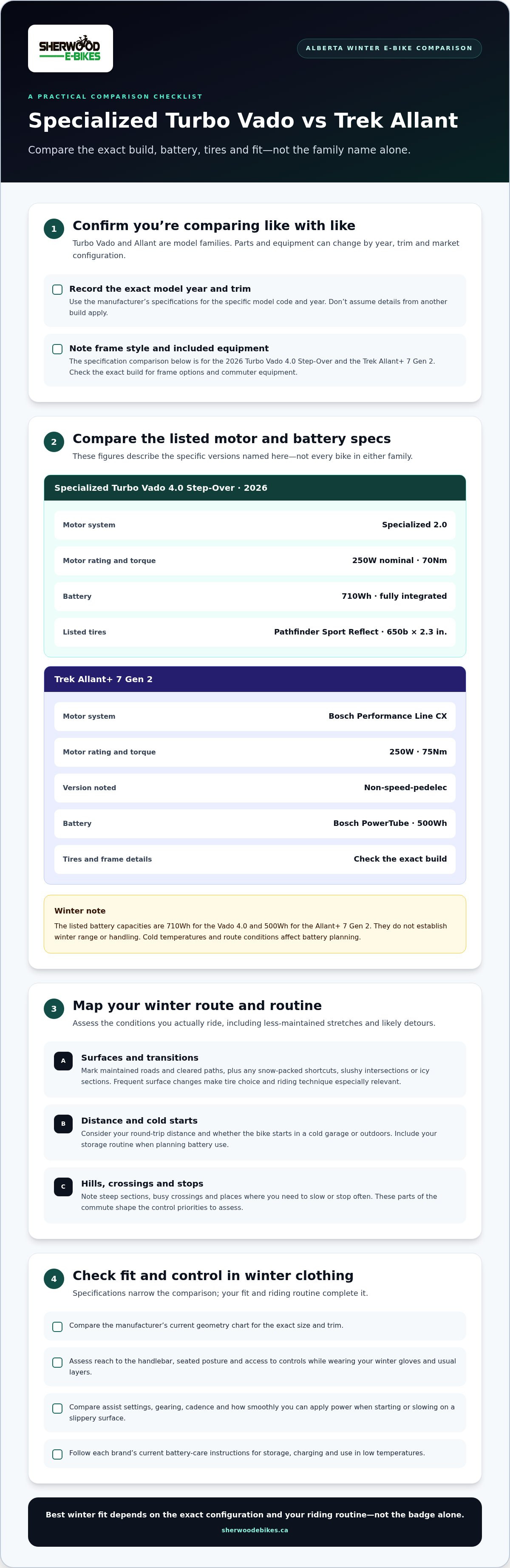
Use this Alberta winter checklist to choose between the Turbo Vado and Allant
Use your own commute as the test. For the Specialized Turbo Vado vs Trek Allant for Alberta winters, a larger battery or higher torque figure matters only if it suits your route, storage, and day-to-day riding. Work through these steps, then compare the configurations that meet your needs. There’s no universal winner.
- Define your route. Map the full trip, including distance, hills, traffic, cleared roads, and stretches that may be rough, snowy, or slushy. Regularly cleared pavement and variable surfaces can call for different tire and control priorities.
- Verify the exact trim. Write down the model year, trim, frame style, and market configuration. Check current manufacturer specifications for the motor, battery, tires, brakes, and included equipment. Don’t assume an older review describes the bike you’re considering.
- Compare fit. Consider frame access, riding posture, reach to the controls, and how the bike feels with your usual winter layers and gloves. On a test ride, assess starts, turns, and braking on a suitable surface.
- Review your winter routine. Think about where the bike and battery will be stored, where you can charge, and whether your commute leaves time for a backup plan when conditions or observed battery use change.
- Assess ongoing support. Include routine maintenance and suitable cold-weather accessories in your ownership plan. Check that any tire or accessory change is compatible with the exact bike.
Match the bike to your route and routine
A rider with a short commute on cleared roads and indoor storage may prioritize a comfortable fit and practical commuter equipment. A longer route with hills, changing surfaces, or limited charging access may put more weight on battery planning, tire options, and the daily effort of bringing the battery indoors. Clothing matters too: winter gloves can change how easily you reach controls, while extra layers may affect your riding position. These differences can lead two riders to prefer different configurations, even if they start with the same model family.
| Your priority | What to compare |
|---|---|
| Mostly cleared pavement | Fit, commuter equipment, stock tire, and route comfort |
| Variable or rough surfaces | Exact tire specification, compatible options, control, and cautious riding technique |
| Longer rides or hills | Battery capacity, motor system, assist use, and your charging routine |
| Outdoor or cold storage | Manufacturer battery-care guidance and practical indoor storage access |
Test fit and verify the details before deciding
Bring your route notes and compare the manufacturer’s current specifications for the exact Vado and Allant versions on your shortlist. A showroom discussion and test ride at Sherwood E-Bikes can help you assess fit and riding priorities without relying on a model-family reputation. For local, personalized e-bike advice in Sherwood Park, book a comparison discussion.
Get local help comparing winter-ready e-bikes in Sherwood Park and Edmonton
A local conversation can turn a specification list into a useful decision. Bring the exact Specialized Turbo Vado and Trek Allant versions you’re considering, and discuss how their fit, equipment, and service needs line up with your commute. Sherwood E-Bikes offers in-person advice and a showroom where you can explore e-bike options and take test rides. The goal is not to name a universal winner, but to clarify what matters for your riding routine.
What to bring to a local comparison
Come prepared with the details that shape your decision. Specific notes help keep the discussion focused on your winter use rather than broad impressions of either model family.
- Exact configurations: Note the model year, trim, frame style, and market version for each bike. Bring manufacturer specification sheets or links so the details can be reviewed side by side.
- Your intended route: Describe the usual distance, hills, traffic, and surfaces, including sections that may be less maintained or change during the ride.
- Your storage and charging setup: Explain where the bike and battery will be kept, and where you can charge between commutes.
- Your riding routine: Include how often you expect to ride in winter, what clothing and gloves you wear, and what you do when conditions change.
Use the same questions for both e-bike families: Does the frame suit your fit and winter layers? Do the listed tires and components match your route? Does the battery routine work with your storage and charging access? Keeping the comparison consistent makes it easier to separate confirmed specifications from assumptions. It also helps identify which points need a hands-on assessment, such as reach to the controls or ease of mounting and dismounting in bulky clothing.
Plan ongoing support for winter riding
Winter commuting adds regular checks to ownership. A maintenance discussion can help you understand what to monitor on your e-bike as it sees wet, cold, or gritty conditions, and which questions relate to its particular components. Sherwood E-Bikes provides e-bike maintenance and repair, connecting routine care to the bike you ride.
Sherwood E-Bikes serves riders in Sherwood Park, Edmonton, Leduc, Camrose, Fort Saskatchewan, Ardrossan, St Albert, Vegriville, Morinville, Wetaskiwin, and Spruce Grove. An in-person comparison can cover fit, route priorities, winter habits, and ongoing care in one practical discussion. It can also help you explore commuter e-bike options that suit your needs, without relying on an unsupported verdict between the Turbo Vado and Allant.
Ready to talk through your winter commute? Book a local e-bike consultation and bring your route notes and exact model details.
Turn your winter commute into a confident e-bike choice
Your shortlist doesn’t need a winner on paper. Treat the Specialized Turbo Vado vs Trek Allant for Alberta winters decision as a fit between a specific bike and the way you travel. Start with the features your commute depends on, then separate those essentials from preferences you can adapt, such as display layout or accessory setup. That distinction can keep a compelling headline specification from outweighing a detail that matters every day.
Keep your notes as your riding plans evolve. A change in work schedule, storage arrangements, or regular route may shift which configuration makes sense. Revisit your priorities with the exact model-year details in hand, and leave room to adjust your winter routine as you learn what works for you. The right choice is one you can assess clearly, maintain thoughtfully, and feel prepared to ride in the conditions you encounter.
Ready to take the next step? Plan your local e-bike consultation and turn your winter commute priorities into a practical shortlist. Your next ride can begin with a clear plan and advice shaped around your needs.
Frequently Asked Questions
Is the Specialized Turbo Vado or Trek Allant better for Alberta winters?
There’s no single winner for every Alberta commute. A configuration suited to a short trip on consistently cleared streets may not be the best match for a rider carrying a daily load or navigating frequent stop-start traffic. Compare each candidate against your own priorities, then keep only versions whose documented features and fit you can verify. That makes your shortlist useful for your riding, not just a brand preference.
Can you ride a Specialized Turbo Vado or Trek Allant in snow?
Possibly, if the conditions, bike setup, and your experience suit the ride. Snow can conceal ruts, debris, or uneven pavement, so visibility and a clear view of the route matter alongside traction. Before setting out, consider whether you can safely pause, turn back, or walk the bike if the surface changes unexpectedly. Neither model name guarantees suitable snow performance; use your judgement and avoid conditions beyond your control.
Does cold weather reduce e-bike battery range?
Cold can affect battery performance and the distance you can practically ride, but the effect varies rather than following a fixed winter figure. After a cold trip, check the manufacturer’s instructions before charging a battery that has been exposed to low temperatures. Charging limits and recommendations can differ by battery system. Give yourself a practical margin for the return trip, especially if your plans depend on charging at a particular destination.
What should I compare between a Turbo Vado and an Allant for winter commuting?
Compare more than the headline motor or battery figure. Check how easily you can reach the brake levers and controls with winter gloves, whether the display is readable in your usual light conditions, and whether the bike’s standard equipment suits your commute. Also consider any bags or load you expect to carry. Use the same checks on both bikes, and tie model-specific details to current manufacturer information.
Are the Specialized Turbo Vado and Trek Allant specifications the same across every model year?
No. A familiar family name doesn’t identify every component or equipment package. Before comparing figures, note the complete model designation shown on the bike’s documentation or product materials, including year and trim. If you’re comparing a used bike with a current listing, match the specifications to that particular version rather than relying on the family name alone. This helps prevent a detail from one build being mistaken for another.
Where can I get help comparing e-bikes for winter riding near Sherwood Park?
Sherwood E-Bikes in Sherwood Park offers local guidance for riders comparing e-bikes for winter use. Bring your commute notes and the product information for the Turbo Vado and Allant versions you’re considering. You can discuss how your typical trip, riding position, and winter clothing affect your priorities, then leave with clearer points to assess. Riders from Edmonton and nearby communities can use the same preparation.


