

The higher torque figure doesn’t automatically make one bike the better choice for your daily route. In the Aventon Level.2 vs Surface 604 Colt for Edmonton commuting comparison, both models are listed with a 500W motor, 750W peak output, a torque sensor and a standard 672Wh battery. The Aventon lists 60 Nm of torque, compared with 45 Nm for the Colt, but those figures alone can’t tell you how either bike will feel on your usual ride.
Your commute matters. Starts at busy intersections, longer distances, changing road conditions and the position that feels comfortable over time can all shape the better fit. We’ll compare the listed specifications and practical features, then put them in context for Edmonton-area riding. Treat advertised range and peak power as reference points, not guarantees of everyday performance.
Sherwood E-Bikes Ltd. offers local e-bike guidance, maintenance and showroom test rides. An in-person ride can help you assess handling, reach and comfort for yourself. Read on to see which model’s listed features may suit your route and preferences, and what to consider before making your choice.
Key Takeaways
- Start with your route, comfort and carrying needs, then compare the listed features against your priorities.
- The Aventon Level.2 vs Surface 604 Colt for Edmonton commuting comparison is about practical differences, not headline figures alone.
- Check the exact model year before relying on specifications or included equipment, since configurations can vary.
- Plan around your commute’s distance, stops, road surfaces and seasonal conditions rather than treating advertised range as a guarantee.
- A local test ride can help you assess fit and handling before you decide.
Aventon Level.2 vs Surface 604 Colt: What Edmonton Commuters Should Compare First
The right choice depends on your daily ride, not on which model has the more impressive-looking figure. A short trip through central Edmonton, a longer ride from Sherwood Park or a route that mixes paved streets with uneven sections can place different demands on comfort, carrying capacity and battery planning. Start with the journey you actually ride, then compare the Aventon Level.2 and Surface 604 Colt against those needs.
Map your route in practical terms. Note the distance each way, how often you stop, where you can park securely and whether you can charge at your destination. List what you carry, such as a work bag or groceries, and consider how you’ll secure it. Seasonal changes in daylight, weather and road conditions may also affect when and where you ride. Plan for your own routine instead of assuming either bike suits every condition.
Start with the commute, not the spec sheet
For short urban trips, easy handling in stop-and-go traffic may matter more than maximum advertised range. Longer daily rides put more emphasis on battery planning and a comfortable riding position. Mixed-surface commutes call for a close look at the route’s pavement and rougher sections. Think about whether you prefer a more upright or forward-leaning position, and assess how each bike feels when turning, slowing and starting again.
- Trip length: Record your usual round-trip distance and any regular detours.
- Parking and charging: Decide where the bike will be stored and whether charging is practical at home or work.
- Carrying needs: List what you take with you and how you want it secured.
These details give the comparison a useful frame. General background on e-bike designs and characteristics is available in Understanding Electric Bicycles, but a general overview can’t replace checking the equipment on the specific model year you’re considering.
Confirm the model year before comparing
Record the model year shown in the manufacturer documentation for both bikes. The model names alone don’t identify which year’s configuration you’re assessing. Match each specification to documentation for that year. If a figure is not clearly tied to the model year, leave it out rather than treating it as universal.
Model year matters because specifications and included equipment can vary. Compare documentation for the exact year of each bike rather than relying on the model name alone.
Advertised range and performance figures also describe defined conditions, not a guaranteed result for every rider. Route length, stops, surface changes, carried load and riding habits can affect your experience. Treat those figures as reference points, then compare the listed specifications with the needs you’ve identified.
Aventon Level.2 vs Surface 604 Colt: Compare Verified Specifications Side by Side
The figures below provide a starting point for comparing the Aventon Level.2 and Surface 604 Colt. Check the manufacturer documentation for the exact model year and battery configuration you’re considering before using a specification to make your decision.
Motor and torque
Aventon Level.2: 500W sustained, 750W peak, 60 Nm. Surface 604 Colt: 500W Bafang geared hub, 750W peak, 45 Nm.
Battery
Aventon Level.2: 672Wh, 48V, 14Ah. Surface 604 Colt: 672Wh, 14Ah standard, with an optional 960Wh, 20Ah battery reported.
Assist and stated range
Both are listed with a torque sensor and 32 km/h top speed. Aventon range is listed as up to 96 km; Colt is listed at up to 80 km with the standard battery and up to 129 km with the larger option.
Weight and certification
Aventon Level.2: 24.5 kg and UL 2849 certified. Surface 604 Colt: approximately 26.5 kg and UL 2849 certified.
Drivetrain, brakes and included equipment
Compare the specific component details and included-equipment lists for the model years you’re considering. Check whether items such as lights, racks and fenders are included or need to be added separately.
Both bikes are listed with a 500W motor, 750W peak output, torque sensor, 672Wh standard battery and 32 km/h top speed. The Level.2 has the higher stated torque, while the Colt has a reported larger-battery option.
Which specifications matter most for an Edmonton commute?
Motor and torque ratings describe listed output, not how a bike will feel in every situation. If your route has frequent stops, assess how assist responds as you start and pedal. Battery capacity and stated range can help you plan a trip, but measure them against your round-trip distance and charging routine. Check the model-year documentation for applicable Canadian safety information and equipment.
Separate listed features from real-world performance
“Up to” range is a listed maximum, not a guaranteed commute distance. Rider, terrain, assist setting, carried load and riding conditions can affect energy use. Don’t infer braking quality, comfort or component durability from motor or battery numbers. Compare documented brakes, gearing, lights, racks and fenders only when the information identifies them for the exact model year.
For hands-on help assessing fit and handling, explore local e-bike test ride options.
Which E-Bike Suits Edmonton Riding Conditions and Your Daily Route?
Use your route to interpret the specification comparison, not as proof that either model will perform a certain way on every Edmonton ride. The listed figures can help you identify what to test: how much range buffer you want, whether a reported battery option suits your charging routine, and how the bike feels through repeated stops. Match model-specific details to the documentation for the year and configuration you’re considering.
Match each model to a commute scenario
For a shorter urban commute, compare fit, handling and how naturally you can start and stop in traffic. On a longer daily trip, assess the listed range against your round-trip distance and charging access, leaving room for conditions that may increase battery use. If your commute includes changing surfaces, check the actual tyres and equipment listed for the specific model year. Motor, battery and weight figures don’t establish how either bike will handle those surfaces.
- Shorter urban ride: Prioritize manoeuvrability, a comfortable riding position and convenient secure parking. A headline range figure may be less useful than fit and ease of handling.
- Longer daily trip: Compare your distance with the listed range, then plan charging and a practical reserve. The Colt’s reported optional larger battery may be relevant if it is part of the model year and configuration you’re assessing.
- Mixed-surface riding: Check the manufacturer’s tyre and equipment specifications for the version you’re considering. Don’t infer traction or comfort from motor, battery or weight figures.
Balanced model comparison
Aventon Level.2
Listed advantage: The comparison lists up to 96 km of range and a lower weight than the Colt.
Consider: Range isn’t a guaranteed commute distance. Confirm the model year and configuration, and assess comfort and handling on a ride.
Surface 604 Colt
Listed advantage: The comparison reports an optional larger-capacity battery and up to 129 km of range with that option.
Consider: Confirm the battery configuration for the model year you’re considering. The advertised maximum doesn’t predict your everyday distance between charges.
Plan for seasonal riding and everyday ownership
Seasonal weather and changing road conditions can affect when you ride, what you carry and how you store the bike. Store the battery and bike appropriately, follow the manufacturer’s charging guidance, and check tyres, brakes, lights and fasteners as part of routine upkeep. Before carrying work items or groceries, confirm the bike’s equipment and plan how you’ll secure your load.
Sherwood E-Bikes Ltd. provides e-bike maintenance support for riders in Sherwood Park, Edmonton, Leduc, Camrose, Fort Saskatchewan, Ardrossan, St Albert, Vegriville, Morinville, Wetaskiwin and Spruce Grove. A test ride can also help you assess fit and handling directly, details a specification table can’t establish.
For Aventon Level.2 vs Surface 604 Colt for Edmonton commuting, choose the model whose listed configuration fits your route, storage, charging and carrying needs, not the one with a range figure you may never use.
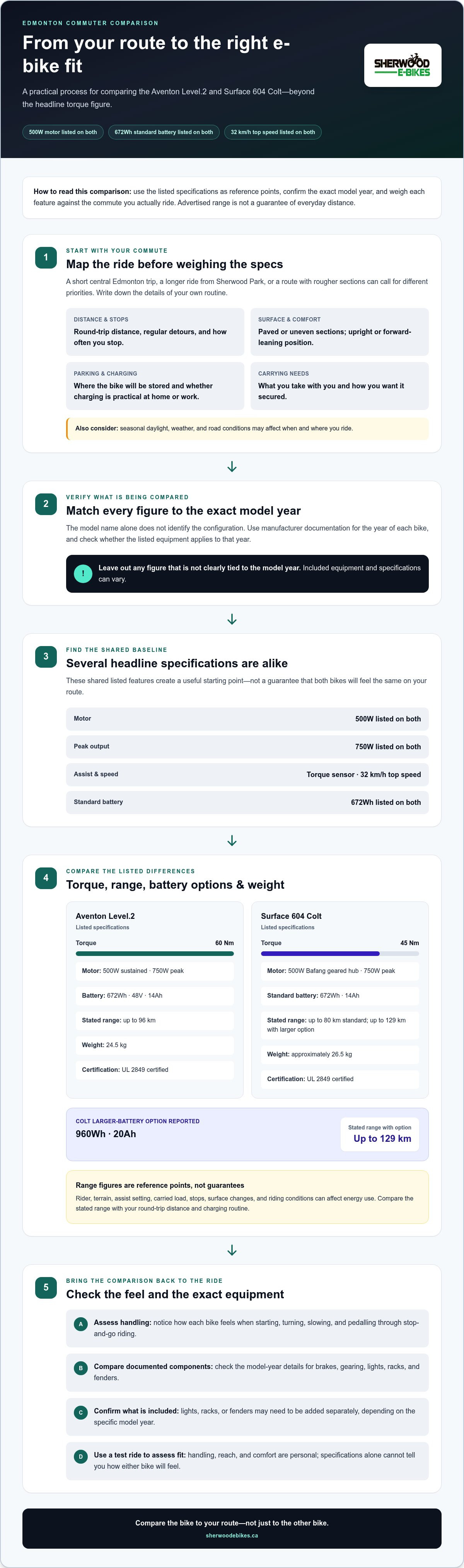
Use This Edmonton Commuter Checklist to Choose Between the Two Models
Make the decision in order. First describe the ride you need the bike to handle, then rank the features that matter most. Only after that should you compare the Aventon Level.2 and Surface 604 Colt specifications. This keeps a single headline number from outweighing fit, charging access or the practical details of your commute.
Rank your must-haves before choosing
Put your top priorities in order. Comfort and handling may come before maximum range for one rider; another may need a larger battery option for a longer routine. Include your budget, but compare current seller details separately from technical specifications. The listed information does not point to one model as the right choice for every commuter.
- Map your route. Write down your round-trip distance, stop-and-start sections, surface changes and regular detours. Note whether your commute varies by season.
- Assess fit and comfort. Decide what riding position feels natural and consider reach to the handlebar, control access and how the bike feels at low speed. A specification table can’t settle fit.
- Plan charging and storage. Identify where you’ll park the bike and whether you can charge it where it’s stored or at your destination. Compare a battery configuration only when it’s documented for the model year you’re considering.
- List what you carry. Note your usual bag, work items or groceries. Check confirmed equipment and carrying options for each exact model instead of assuming racks or accessories are included.
- Rank your priorities. Order comfort, range needs, handling, equipment and budget from most to least important. Mark any feature without model-year documentation as unconfirmed, not as an advantage for either bike.
Check fit and handling in person
A test ride can help you assess details a spec sheet can’t settle: whether the reach feels comfortable, whether controls fall naturally to hand, and how the bike responds as you start, turn and slow at low speed. Sherwood E-Bikes Ltd.’s showroom offers personalized advice and e-bike test rides.
For a useful comparison, ride with your normal footwear and, where practical, carry the kind of bag you expect to take on your commute. Pay attention to how easy it feels to mount, stop and manoeuvre. Record your impressions right after each ride so the details stay clear.
Keep a simple decision record: your route needs, ranked priorities, confirmed model-year features and test-ride impressions. If a specification is missing or conflicts across sources, don’t score it as a win for either bike. That’s a more reliable basis for the Aventon Level.2 vs Surface 604 Colt for Edmonton commuting decision than choosing by one number alone.
For personal guidance and a hands-on e-bike test ride, book a showroom visit.
Make Your Final Aventon Level.2 vs Surface 604 Colt Decision Locally
There isn’t a universal winner for every Edmonton commuter. The better choice is the bike whose configuration fits your route, riding position, storage and charging routine. The specifications offer useful distinctions, but confirm model-specific details against documentation for the year and configuration you’re considering.
Choose the bike that fits your verified needs
If the higher torque figure is confirmed for the exact Aventon Level.2 model year, it may matter to a rider who prioritizes that specification. If the Surface 604 Colt’s larger-battery option and associated range claim are listed for the version you’re considering, those details may interest someone whose commute makes battery capacity a key factor. Neither point alone decides which bike is the better fit.
Use this tie-breaker: choose the model that meets your essential route and ownership needs, then let fit and handling guide the decision if both meet them. Before purchasing, compare the exact model year, battery configuration, included equipment and current seller details. Don’t treat an advertised maximum range as a promise of everyday distance, or infer ride comfort from component figures.
- Prioritize route fit if your commute has specific distance, stop-and-start or surface requirements.
- Prioritize ownership practicality if secure storage, charging access or carrying items will shape your daily routine.
- Prioritize the ride feel if the specifications don’t reveal a meaningful difference for your needs, but one bike feels more natural to handle.
Get local guidance before committing
Specifications can narrow the choice, but they can’t tell you whether a bike’s reach, riding position or controls feel right. A test ride lets you check those details directly. Try starting, turning and slowing at a comfortable pace, and notice whether the handling suits the type of riding you plan to do. Bring your route priorities and questions so the ride helps you evaluate what matters most.
Sherwood E-Bikes Ltd.’s showroom offers personalized e-bike advice and test rides for riders in Edmonton and nearby communities. The team can help you translate general specifications into practical questions about fit, handling and commuter needs.
For your final Aventon Level.2 vs Surface 604 Colt for Edmonton commuting decision, pair model-year documentation with your own priorities and a real assessment of fit. Review current seller details before you commit, especially if the bike’s configuration or included equipment affects your choice.
Ready to discuss your commute and assess e-bike fit in person? Book a showroom visit.
Make Your Next Commute a Confident Choice
The right e-bike decision is one you can explain in terms of your daily needs, not just a spec sheet. As you move from comparing the Aventon Level.2 vs Surface 604 Colt for Edmonton commuting to making a choice, focus on what you need to learn: which details apply to the exact bike, which trade-offs matter to you, and what feels right when you ride.
Give yourself time to make that assessment. A few clear notes about your priorities can turn a close comparison into a more confident decision, especially when the listed specifications don’t settle the question on their own. The aim isn’t to find a universal winner. It’s to choose an e-bike that makes sense for the trips you plan to take and the way you want to ride.
For a practical next step, explore local e-bike advice and plan your visit. Sherwood E-Bikes Ltd. can help you assess your commuting priorities in person.
Frequently Asked Questions
Which is better for Edmonton commuting, the Aventon Level.2 or Surface 604 Colt?
Neither is the best choice for every Edmonton commuter; it depends on your route and priorities. The listed specifications may make the Colt’s optional larger battery worth considering, while the Level.2 has a higher stated torque figure. Those distinctions don’t prove how either bike will feel on your commute. Compare the exact model-year documentation, then weigh your ride impressions, storage setup and daily carrying needs.
What are the main specification differences between the Aventon Level.2 and Surface 604 Colt?
Both are listed with a 500W motor, 750W peak output, torque sensor and 672Wh standard battery. The Aventon Level.2 is listed at 60 Nm of torque and the Surface 604 Colt at 45 Nm. The Colt is also reported with an optional 960Wh battery. Match these figures to the model years you’re comparing before treating them as current specifications.
How far can the Aventon Level.2 and Surface 604 Colt travel on one charge?
The Aventon Level.2 is listed at up to 96 km. The Surface 604 Colt is listed at up to 80 km with its standard battery and up to 129 km with the optional larger battery. These are stated maximums, not assured commute distances. Account for your riding pattern and leave a practical reserve instead of relying on the highest advertised figure.
Which e-bike is better for hills on an Edmonton commute?
The listed torque figures favour the Aventon Level.2 on paper, at 60 Nm versus 45 Nm for the Surface 604 Colt. That difference alone can’t establish which bike will climb better for you. A hill’s length, your chosen assist level, carried load and riding style all affect the experience. If hills are part of your regular commute, compare the model-year specifications and assess each bike’s response during a suitable test ride.
Can I use either the Aventon Level.2 or Surface 604 Colt for winter commuting?
The listed specifications don’t establish a winter-use advantage for either model. Winter riding depends on conditions, the bike’s equipment and how you maintain it. Follow manufacturer guidance for battery storage and operation, and consider whether the tyres and brakes suit your planned rides. Reassess your route and riding plans as seasonal conditions change.
What should I compare besides price when choosing between these commuter e-bikes?
Compare fit, riding position, handling, verified battery configuration, included equipment, charging arrangements and how you’ll carry everyday items. Check the exact model year, since model names alone don’t identify every specification. Also consider where you’ll keep the bike and whether you can secure it conveniently. A practical choice should match your actual commute and ownership routine, not just the feature that looks strongest in an advertisement.
Can I test ride an e-bike before deciding in the Edmonton area?
Yes. Sherwood E-Bikes offers e-bike test rides at its showroom, where you can assess fit, controls and handling in person. Riders from Edmonton and nearby communities can also get personalized advice to help compare their commuting priorities. Book a showroom visit to plan your test ride.


