

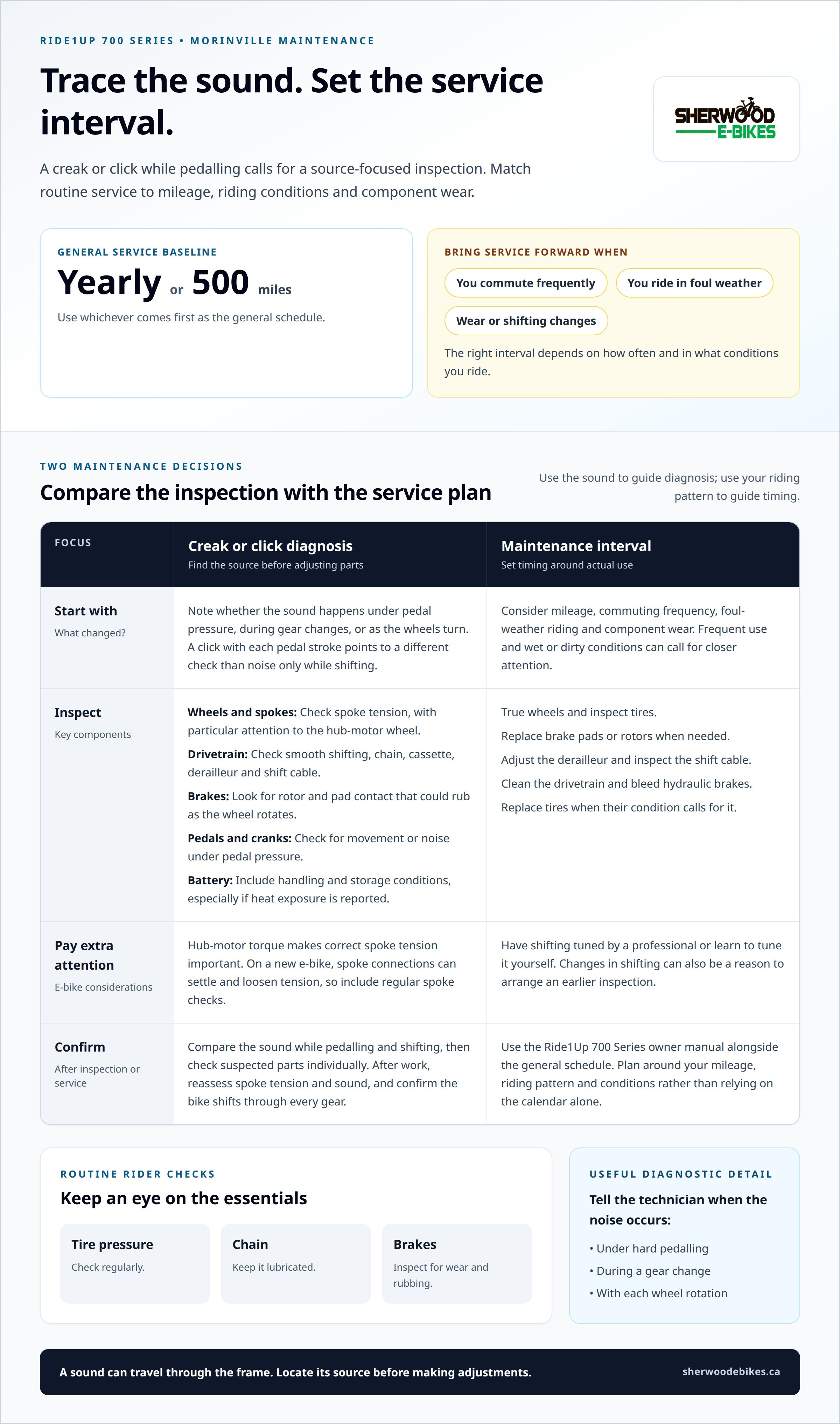
A creak or click while pedalling is a useful warning to investigate, not a sound to ignore. For Ride1Up 700 Series maintenance in Morinville, the key is to identify where the noise comes from and follow a service schedule suited to how often and in what conditions you ride. Ride1Up’s general schedule recommends servicing yearly or every 500 miles.
It’s understandable to want a clear answer when your familiar bike starts making unfamiliar sounds. A click can signal a component that needs inspection, while regular maintenance helps keep the moving parts working together as intended.
This guide explains what a professional can inspect when your Ride1Up 700 Series creaks or clicks under pedal pressure, and what affects the maintenance interval. You’ll also learn why frequent commuting and foul-weather riding call for closer attention, and which routine checks help keep the bike ready for Morinville rides.
Key Takeaways
- A creak or click while pedalling needs a focused inspection to trace its source, including the spokes, drivetrain and other moving parts.
- Use yearly servicing or every 500 miles as the general maintenance schedule, with more frequent attention for commuting and foul-weather riding.
- Regular tire-pressure checks, chain lubrication and brake inspections help catch wear and rubbing before they affect your ride.
- New e-bikes need regular spoke checks as the spoke connections settle, especially with the added torque of a hub motor.
- A professional assessment can help determine whether a local shop can handle the required work on your Ride1Up 700 Series hub motor.
How a professional diagnoses creaking or clicking while pedaling
A Ride1Up 700 Series noise needs a source-focused inspection. A professional first asks when the sound occurs: under pedal pressure, during gear changes, or as the wheels turn. That pattern helps narrow the check to the drivetrain, wheel, brakes, or another moving part. A click repeating with each pedal stroke, for example, calls for a different inspection than a sound heard only while shifting.
A technician assesses the bike under controlled conditions, listening as the cranks turn and noting whether the sound changes with pedalling effort or gear selection. They then inspect visible components for movement, wear, or contact. The goal is to trace the noise before adjusting anything. If the chain shifts roughly, for example, the cassette, chain, and derailleur are worth inspecting.
- Spokes: The technician checks spoke tension and listens for changes across the wheel. Any spoke adjustment should follow the correct spoke-adjustment procedure, then be checked again for sound.
- Hub-motor wheel: Spoke tension deserves particular attention on an e-bike. Hub-motor torque can contribute to broken spokes when tension is incorrect.
- Gears: The technician checks whether the bike shifts smoothly into every gear. Poor shifting can add wear to the cassette, chain, and derailleur.
- Brakes: The technician checks whether braking components rub. Contact between a rotor and pad can create noise as the wheel rotates.
- Pedals and cranks: These parts are inspected for movement or noise under pedal pressure, helping distinguish a pedal-stroke sound from wheel rotation.
- Battery: The technician checks battery handling and storage conditions as part of broader e-bike care, especially if heat exposure is reported.
These checks matter because sound can travel through the frame. A click near the pedals may seem to come from the crank, even when the wheel or drivetrain needs closer inspection. The technician compares the noise during pedalling and shifting, then checks suspected components individually. This step-by-step approach avoids treating every click as a loose pedal or every creak as a frame problem.
After locating the cause, the technician determines whether adjustment or further repair is needed. They also check that the Ride1Up shifts cleanly through every gear after drivetrain work. If a spoke was adjusted, they reassess its tension and sound. This final check helps confirm that the original noise has changed and that the related component operates as intended.
If you ride in Morinville, describe when the noise occurs and what changes it. A sound under hard pedalling, during a gear change, or with each wheel rotation gives the technician useful diagnostic context. If the work calls for tools or expertise beyond your own, professional service is the sensible next step.
How a professional sets maintenance intervals
Ride1Up’s general maintenance schedule calls for yearly service or service every 500 miles. For Ride1Up 700 Series maintenance in Morinville, a professional uses that schedule as a baseline. They then adjust timing to match your riding pattern. A regular commuter needs closer attention than an occasional vacation rider. Frequent foul-weather riding also calls for more frequent maintenance.
Compared with similar commuter e-bikes, the useful comparison is how often each bike is ridden and in what conditions. The Ride1Up 700 Series baseline is yearly or every 500 miles. Frequent commuting and foul-weather use can bring service forward. Another bike’s schedule shouldn’t replace model-specific guidance. A technician can use the same factors to shape a practical plan for local riding.
A technician can recommend service intervals based on mileage, riding conditions, and component wear. Regular commuting puts repeated use on the drivetrain, brakes, and wheels. Wet or dirty conditions can leave more contamination on moving parts, while occasional recreational riding creates different demands. A maintenance plan should reflect how you ride, not just the calendar.
Yearly service covers several systems that affect operation. Ride1Up’s annual maintenance list includes:
- Truing wheels and inspecting tires.
- Replacing brake pads or rotors when needed.
- Adjusting the derailleur and inspecting the shift cable.
- Cleaning the drivetrain and bleeding hydraulic brakes.
- Replacing tires when their condition calls for it.
Spokes deserve regular checks, particularly when the e-bike is new. Their connection points can settle and mate, which may loosen spoke tension. A professional can inspect the wheels during early service visits. Later maintenance can include further spoke checks. This matters on hub-motor e-bikes, where correct spoke tension is important.
Shifting also needs routine attention. Ride1Up recommends having the shifting mechanism tuned by a professional or learning to tune it yourself. During scheduled service, a technician can assess whether the derailleur or shift cable needs adjustment. Changes in shifting can also prompt an earlier inspection.
For model-specific maintenance instructions, use the Ride1Up 700 Series owner manual as a reference alongside the general service schedule. Apply its guidance with your mileage, commuting pattern, and foul-weather use in mind. This gives Morinville riders a practical basis for planning service. Ride1Up 700 Series maintenance in Morinville should reflect actual use, rather than treating one interval as right for every rider.
Ride1Up recommends more frequent electric bicycle maintenance for commuters and riders who frequently ride in foul weather than for occasional vacation riders. That difference gives a professional a practical way to tailor service timing: regular commuting or repeated foul-weather riding supports closer attention, while occasional vacation use points to a less frequent schedule. These patterns help determine when to bring the bike in, alongside the yearly maintenance plan.
Ride1Up's yearly maintenance list includes truing wheels, replacing brake pads or rotors, adjusting the derailleur, cleaning the drivetrain, bleeding hydraulic brakes, inspecting the shift cable, and replacing tires. A professional can use these listed tasks to organize yearly service, while considering whether the riding pattern calls for maintenance more often. This keeps the service plan connected to both the bike’s maintenance needs and how it is used.
How a professional checks Ride1Up 700 Series tire pressure, brake adjustment, and chain lubrication specifications
A technician checks tire pressure with a gauge, not by appearance alone. Ride1Up recommends checking e-bike tire pressure once or twice a week. Infrequent riders should have it checked before every ride. A maintenance inspection can compare the measured pressure with the tire’s specified range. The correct target depends on the tire, so a professional uses its markings and model guidance rather than guessing.
Tire pressure affects how the tire meets the road and responds under load. A technician can check both tires for visible damage, uneven wear, or slow leaks. If pressure keeps dropping, the tire and valve may need closer inspection. For Morinville commuters, regular checks help catch pressure loss and tire wear before they disrupt a ride.
Brake checks focus on clean, even operation. The technician inspects the pads and rotors, then spins each wheel to identify rubbing. Ride1Up recommends keeping braking components from rubbing, since contact can increase wear on both rotors and pads. If a rotor touches a pad during rotation, the technician identifies the cause before making an adjustment. A brake lever that feels different also helps direct the inspection.
- Tires: Measure pressure and compare it with the tire’s stated range.
- Brakes: Check pad and rotor condition, then listen and look for rubbing.
- Chain: Inspect its condition and lubrication before assessing drivetrain operation.
Chain lubrication helps reduce metal-on-metal contact and supports smoother pedalling and gear changes. A technician checks the chain for grime and signs of wear, cleans away contamination as needed, applies suitable lubricant, and removes the excess. Too little lubrication can leave the chain dry; too much can attract dirt. A final check confirms that it moves smoothly through the gears.
Bike systems interact. A dry chain can affect pedalling feel, while brake rub can sound like a drivetrain problem. After servicing, the technician tests wheel movement, brake clearance, and shifting. If the noise remains, they reassess its source rather than assuming lubrication or adjustment fixed it.
For this Ride1Up 700 Series, there is no tire-pressure figure in the maintenance details provided here. The technician should use the tire’s specified range, not apply a generic pressure to every tire. The same principle applies to brake adjustments: the component’s design and observed condition guide the work. Regular pressure checks, controlled brake clearance, and a clean, lubricated chain form a practical service routine for local riding.
E-bike repair shops in Morinville Alberta that service Ride1Up bikes
A Ride1Up 700 Series can need mechanical maintenance, electrical diagnosis, or both. A shop’s ability to service it depends on the repair required. Wheel truing, brake adjustment, chain care, and derailleur tuning involve bicycle components. A hub-motor or electrical fault calls for a different diagnostic scope. Treating these jobs as identical can leave the actual problem unresolved.
Start by identifying the main symptom and when it occurs. Clicking during pedalling calls for an inspection of the drivetrain or wheel. Brake rub points to the pads, rotor, and wheel alignment. A motor-assistance problem involves the electrical system as well as the bike’s mechanical condition. These details help define the work before a service visit.
For Ride1Up service in Morinville, distinguish routine bicycle work from hub-motor work. A technician can inspect the chain, cassette, derailleur, brakes, tires, and spokes as part of a mechanical assessment. If the problem involves motor assistance, wiring, or a hub-motor component, the repair requires relevant e-bike diagnostic capability. The fault should be identified before parts are replaced.
A useful service description makes the reported problem clear and helps identify what needs inspection. “Click under pedal pressure” is more helpful than “bike noise.” “Motor assistance cuts out” flags an electrical concern, while “rear brake rubs” points to a brake inspection. Clear descriptions help direct the bike to the appropriate repair process.
- Mechanical concern: Identify whether the issue involves shifting, braking, wheels, tires, or chain movement.
- Electrical concern: Describe changes in motor assistance, display behaviour, or power delivery.
- Combined concern: Note when the symptom appears, such as only while pedalling with assistance.
Ride1Up’s maintenance guidance also makes spoke tension relevant on hub-motor e-bikes. Incorrect tension can contribute to broken spokes, so wheel inspection is important alongside motor-related diagnosis. That does not mean every clicking sound comes from the hub motor. The technician should isolate the source through separate checks of the wheel, drivetrain, and electrical system.
Bring the Ride1Up model name, a clear description of the symptom, and any changes noticed during recent rides. For example, note whether the sound occurs in every gear or only under load. This information gives the technician a more precise starting point. In Morinville, choose service based on the repair system involved, rather than assuming every e-bike shop handles every Ride1Up mechanical and electrical issue.
Can local bike shops in Morinville service a Ride1Up 700 Series hub motor?
A Morinville bike shop can assess the Ride1Up 700 Series, but hub-motor work and ordinary bicycle repairs are different tasks. Wheel, brake, tyre, and drivetrain service concerns the bike’s mechanical components. Diagnosing a fault inside the motor system requires experience with e-bike electrical components. A shop’s ability to service the hub motor depends on the work required and its diagnostic capability.
Start with the symptom. A noise from the rear wheel, reduced assistance, or a problem that appears only when the motor is engaged calls for different checks. A technician can inspect the wheel and surrounding components first. If the concern appears electrical, the assessment needs to include the hub-motor system, not just a mechanical adjustment.
This distinction matters because a sound near the rear hub does not prove the motor itself is faulty. A wheel, brake, or drivetrain issue can produce symptoms in the same area. The technician should isolate the source before recommending a repair. For example, a rubbing brake needs a different response than a motor-assistance fault.
A useful service assessment separates the work into clear categories:
- Mechanical inspection: Check wheel condition, brake operation, tyre seating, and drivetrain function.
- Electrical assessment: Investigate changes in motor assistance or other electrical symptoms.
- Repair scope: Identify whether the issue involves a bicycle component, the motor system, or both.
For a Ride1Up 700 Series, share the model name and a precise description of the problem. Note whether assistance changes during a ride, whether the sound follows wheel rotation, or whether it happens only while pedalling. These details help the technician choose a relevant diagnostic path. Avoid describing every rear-wheel noise as a motor failure.
Ask for a clear explanation of what the inspection covers and which system needs attention. Mechanical maintenance and motor-specific electrical diagnosis are different kinds of work. The key is whether the required service matches the shop’s experience and equipment. Do not assume that every bicycle repair includes internal hub-motor service.
If your Ride1Up needs an inspection or routine mechanical work, book professional e-bike maintenance for a focused assessment. Describe the symptom and when it occurs. That gives the technician a practical starting point for separating wheel, brake, drivetrain, and hub-motor concerns, as well as electrical causes.
Ride1Up recommends checking electric-bike spokes regularly, particularly when the bike is new, because spokes can loosen as their connection points seat and mate. Ride1Up says correct spoke tension is especially important on electric bikes with hub motors because hub torque can contribute to broken spokes when tension is incorrect. Ride1Up recommends checking electric-bike tyre pressure once or twice a week, or before every ride for infrequent riders.
Ride1Up says an electric bike should shift smoothly into every gear to help protect its cassette, chain, and derailleur from premature wear. For battery care, Ride1Up recommends keeping an electric-bike battery at a 30 to 80 percent charge level as much as possible and storing it at temperatures between 0°C and 25°C.
Sherwood E-Bikes Ltd.: E-Bike Maintenance
If you own a Ride1Up 700 Series and need a professional inspection or routine care, contact Sherwood E-Bikes Ltd. to ask whether they can assess your bike. Describe the concern, such as clicking while pedalling, brake rubbing, or shifting trouble. That context helps focus the maintenance assessment on the relevant bike systems.
For related needs, E-Bike Parts and Cycling Accessories can support ongoing e-bike care. If your commuter needs an inspection, or you want help planning maintenance, contact Sherwood E-Bikes Ltd.
Plan Your Next Ride with Confidence
Ride1Up 700 Series maintenance in Morinville is easier to plan when you keep a short service record. Note each visit, the work completed, and any changes you notice afterward. This gives future service conversations a useful starting point, especially if a concern returns.
Before arranging service, decide whether you need routine care, E-Bike Parts, or support for your commuter. Sherwood E-Bikes Ltd. offers E-Bike Maintenance, E-Bike Parts, and Commuter E-Bikes. Describe your priority plainly, whether you’re planning ongoing upkeep, need replacement components, or are considering a commuter model.
A focused conversation helps identify a practical next step without assuming the same repair suits every Ride1Up 700 Series. Share the model and concern, then discuss which direction fits your riding plans. Connect with Sherwood E-Bikes Ltd. to discuss what comes next. Keep your e-bike ready for the routes ahead.


