

The right brake-pad compound matters as much as the fit. For a RadRover 6 Plus brake-pad replacement in Vegreville, choose between organic, semi-metallic and sintered pads based on your riding conditions, then confirm the pad shape matches the hydraulic caliper.
It’s easy to focus on material and overlook compatibility. The RadRover 6 Plus uses hydraulic disc brakes, and SRAM Level brake pads are listed as direct replacements for its hydraulic calipers. A matching shape and fit are essential; a compound that suits your rides won’t help if the pad doesn’t match the brake.
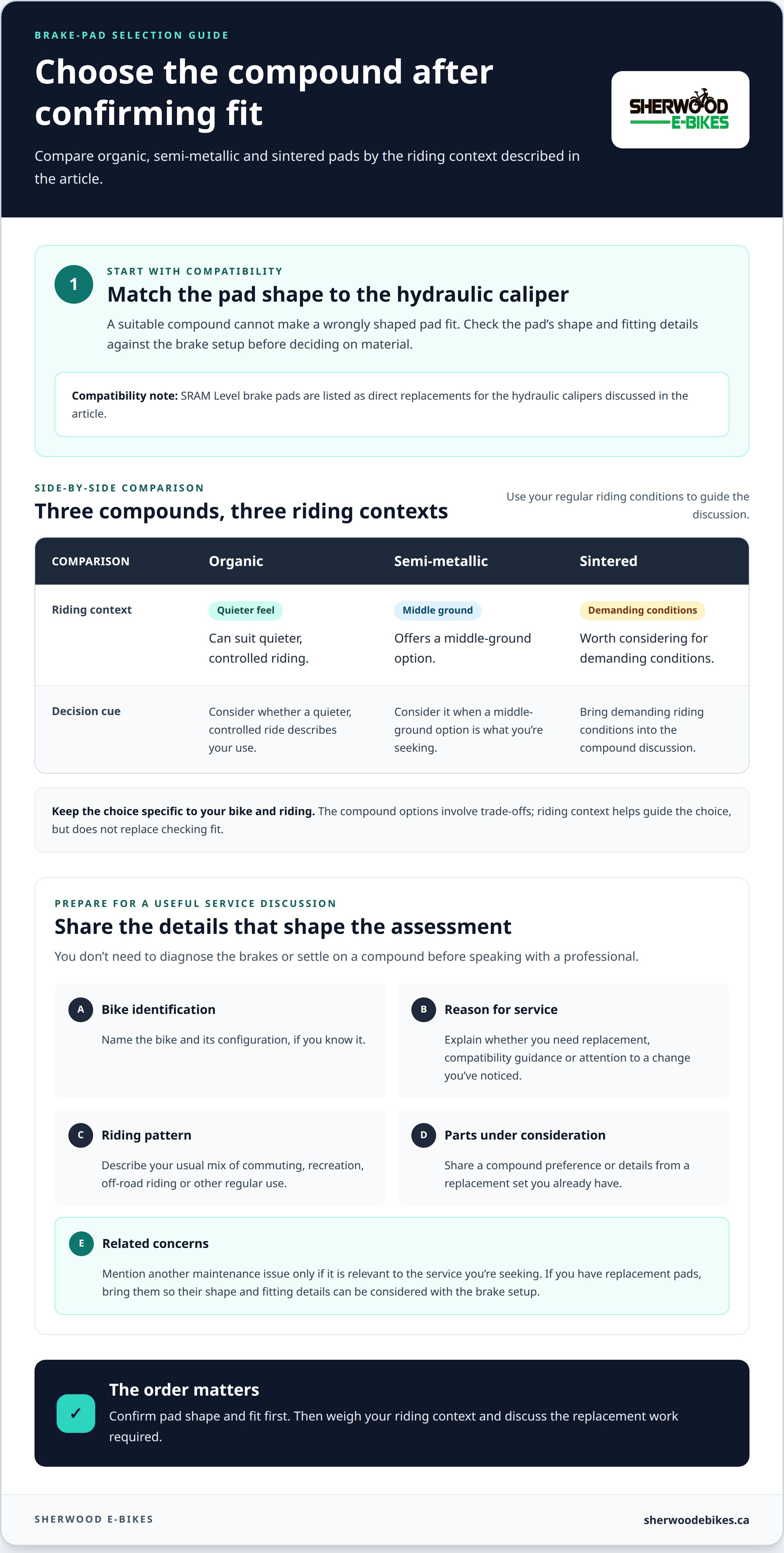
This guide explains how the three compounds differ, what to look for when checking hydraulic brake-pad compatibility, and what a professional considers during replacement. Organic pads can suit quieter, controlled riding; semi-metallic pads offer a middle-ground option; and sintered pads are worth considering for demanding conditions. Each choice involves trade-offs, so the best fit depends on how and where you ride. With the right match, you can make an informed decision before arranging service.
Key Takeaways
- Match the brake-pad shape to the hydraulic caliper before choosing a compound.
- SRAM Level brake pads are identified as direct replacements for the RadRover 6 Plus hydraulic calipers.
- Organic, semi-metallic and sintered compounds involve different trade-offs; your riding conditions help guide the choice.
- Replacing pads at both ends requires two sets, with each set serving either the front or rear brake.
- Sherwood E-Bikes offers e-bike maintenance and parts to support your brake-pad replacement needs.
Sherwood E-Bikes
Sherwood E-Bikes Ltd. offers E-Bike Maintenance for riders who want professional help with brake-pad selection and replacement for a RadRover 6 Plus. For someone in Vegriville, this can be a practical next step when pad compatibility is unclear, the brakes need attention, or maintenance is due. The useful starting point is the bike’s actual brake setup, followed by a parts choice that fits it and suits the way you ride. That keeps the service discussion centred on your bike, rather than a generic recommendation based only on material type or a product description.
Brake-pad replacement involves both choosing a suitable part and carrying out maintenance. The pad must fit the brake assembly, and its compound should suit how you ride. These decisions are related but not interchangeable: a preferred compound cannot make a wrongly shaped pad suitable. Sherwood E-Bikes Ltd. provides e-bike parts and maintenance, bringing compatibility and replacement service together for riders from Vegriville and the surrounding area.
Professional support can be useful even when you already have a likely answer. You may know which kind of compound you want, but still need help matching a pad to the caliper. Or you may have a compatible-looking part and want a professional to handle the replacement. In either case, explain what you’re trying to resolve. A clear request lets the discussion focus on the RadRover 6 Plus, the brake components and your riding needs without asking you to arrive with a technical diagnosis.
For a RadRover 6 Plus brake-pad replacement in Vegriville, bring the decision back to three practical considerations: fit, intended use and the maintenance work required. The right order matters. Compatibility establishes whether the part belongs in the brake; your riding context helps shape the compound discussion; and professional maintenance addresses the replacement itself. Treating each consideration on its own helps prevent a product label or a broad material description from being mistaken for a complete recommendation.
Fit should lead the conversation because brake pads are made to suit particular caliper designs. A description that says a pad is for disc brakes does not, by itself, establish that it fits the bike’s caliper. The shape and fitting details still matter. If a pad is being considered for the RadRover 6 Plus, a professional assessment can focus on those details rather than relying on a general category. This is especially helpful if you’re comparing options that look similar or use different terms to describe their intended fit.
Once fit is considered, describe how you ride. A bike used mainly for commuting has a different routine from one ridden off-road. Some riders do both, or use an e-bike for errands and recreation. These habits help clarify what you want from the braking experience. They do not determine a compound by themselves, but they give the maintenance discussion useful context. The goal is to choose a compatible part with your real riding in mind, rather than assuming every rider needs the same material.
Be specific about what brought you in. You might be planning routine replacement, notice a change in braking, or be unsure whether pads you already have will fit. Describe what you have observed in everyday terms; you do not need to identify the cause. That gives the professional a starting point, while the bike’s components guide the compatibility assessment and the work required.
If you have a compound in mind, explain why. You might prioritize a quieter feel, want a balanced option, or be considering pads for demanding riding. That preference is useful context, but it does not replace a fit check. It also helps the professional discuss whether the option suits the bike and how you use it. The aim is a reasoned decision, not a choice based on a product name or another rider’s different setup.
The service conversation can also clarify what you need. You may want replacement, help understanding compatibility before choosing parts, or advice about a broader maintenance concern alongside the brake issue. State your main need first, then mention any related concern that affects how you use the bike. This keeps the discussion focused on the work requested instead of assuming every visit needs the same tasks.
For a useful discussion about replacement, share a few basic details in advance or when arranging service:
- Bike identification: Name the RadRover 6 Plus and its configuration if you know it.
- Reason for service: Explain whether you’re seeking replacement, compatibility guidance or attention to a change you’ve noticed.
- Riding pattern: Describe your usual mix of commuting, recreation, off-road riding or other regular use.
- Parts you’re considering: Share a compound preference or the details on a replacement set you already have.
- Related concerns: Mention another maintenance issue only if it’s relevant to the service you’re seeking.
This is not a checklist for diagnosing brakes yourself. It is a simple way to explain your needs and give the maintenance discussion useful context. You do not need to remove components, identify a failure or choose a compound before speaking with a professional. If you already have replacement pads, bring them for assessment so their shape and fitting details can be considered alongside the bike’s brake setup.
Parts and service play different roles. E-bike parts need to match the caliper; e-bike maintenance covers the work on the bike. Sherwood E-Bikes Ltd. offers both, so you can discuss the replacement part and its installation together. The shop also carries cycling accessories, though they are separate from brake-pad compatibility unless an accessory is relevant to your needs.
A model name helps make the discussion specific, but it does not answer every component question. Product descriptions may use different labels, and pads with similar outlines can have different fitting details. Consider the part in relation to the actual brake assembly. If you are comparing a replacement product, share its identifying information rather than relying only on a photo or a general listing.
For riders who use the bike in varied conditions, give a balanced account rather than describing only one type of ride. A RadRover 6 Plus used for everyday transportation and occasional trail riding has a different pattern of use from one used almost exclusively for recreational riding. Mentioning both helps the professional understand the demands you have in mind. It doesn’t require a prediction about how a particular pad will perform; it makes the discussion more relevant to the way you actually use the bike.
This context helps distinguish a preference from a requirement. You may prefer a particular braking feel, but the first requirement is a pad that matches the caliper. Once compatibility is established, you can discuss material in light of your priorities. Keeping these steps separate prevents a common misunderstanding: comparing compounds does not prove that a particular pad fits your bike.
When you’re arranging maintenance from Vegriville, keep the request direct. Say that you have a RadRover 6 Plus and need help with brake-pad replacement or compatibility. If the bike has a particular configuration, mention it. Add a short description of your riding and the concern that prompted the request. That gives the service discussion a clear focus without requiring you to make a technical judgement about the brake system before bringing it forward.
The same approach helps when comparing new pads with the originals. Product names and material descriptions can narrow the options, but the shape and fitting points still need to match the caliper. A professional can consider that physical fit alongside your preference for organic, semi-metallic or sintered pads. The part must suit the bike before its material can be assessed for your riding.
If you simply want the work handled, say so. You do not need to choose a compound or bring a preferred brand to make the service discussion useful. If you have a preference, share it as a starting point. A professional can consider the maintenance and relevant parts together while keeping your priorities in view. This makes the decision practical without turning a straightforward service request into a product comparison.
Riders who take an active role in maintenance can still benefit from professional support with brake-specific decisions. Bring questions about fit, describe how you expect to use the bike and discuss the part you are considering. This keeps the technical assessment and replacement focused on the brake assembly while giving you a clear role in communicating your priorities. It is a practical middle ground between guessing and stepping away from the decision.
After service, keep any information provided about the parts used and the maintenance completed. A note can make future discussions clearer if you need another replacement or want to revisit your compound preference. It also gives you a straightforward record of what has been fitted, without relying on memory. If you notice a concern after the bike returns to use, describe what you experience and when it occurs. That information is more useful than trying to diagnose the reason on your own.
The central benefit of a professional approach is a connected decision: the replacement must correspond to the brake, the compound discussion should reflect your riding, and the service should address the work you’re seeking. Sherwood E-Bikes Ltd. can support the parts and maintenance aspects of that process. If you’re in Vegriville and need help with a RadRover 6 Plus brake-pad replacement, describe the bike and your needs so the conversation can begin with the right context.
For a professional discussion about your brake-pad needs, contact Sherwood E-Bikes Ltd.
Frequently Asked Questions
Does the RadRover 6 Plus use the same brake pads on the front and rear?
A replacement set contains two pads for either the front or rear brake. Replacing pads at both ends requires two sets.
What are the risks of replacing RadRover 6 Plus brake pads incorrectly?
A pad that has the wrong shape or fit is unsuitable for the caliper, even if its compound suits your riding. Check compatibility against the brake assembly.
What is the cost of replacement brake pads for a RadRover 6 Plus in Canada?
What tools and supplies are needed to replace RadRover 6 Plus brake pads?
You need a compatible replacement pad set and the spring from the original pad, retained for installation in the new pad. Each set contains two pads for either the front or rear brake.


