

An expired warranty doesn’t automatically mean an e-bike is beyond repair. Out-of-warranty e-bike service in Alberta may involve diagnosing the fault, identifying parts compatible with your model and discussing a practical repair plan.
It’s understandable to want clear answers before bringing in a bike, especially when warranty coverage and model compatibility affect the next steps. This guide explains how to review your coverage, what information helps identify compatible parts and what to prepare before a service appointment.
You’ll also learn what independent repair can involve and how maintenance support can help when an e-bike needs attention beyond its warranty period. The goal is to help you understand the process and make an informed decision about your bike.
Key Takeaways
- Review your warranty documents and note any coverage that may still apply before planning a repair.
- Have your bike’s model details and the problem description ready to help assess repair needs and compatible parts.
- Independent e-bike service can be a path to repair when manufacturer coverage has ended.
- Plan your drop-off by gathering relevant bike details and describing any symptoms clearly.
- Sherwood E-Bikes Ltd. offers e-bike maintenance, parts, commuter e-bikes and cycling accessories for local riders.
Sherwood E-Bikes Ltd.
Sherwood E-Bikes Ltd. is a practical next step for e-bike maintenance and parts in Sherwood Park and Edmonton, as well as Leduc, Camrose, Fort Saskatchewan, Ardrossan, St Albert, Vegriville, Morinville, Wetaskiwin and Spruce Grove. Its E-Bike Maintenance and E-Bike Parts support repair needs, while Commuter E-Bikes and Cycling Accessories may suit a changed riding routine. The right starting point depends on the symptom, the bike’s model and configuration, and what you need from the repair.
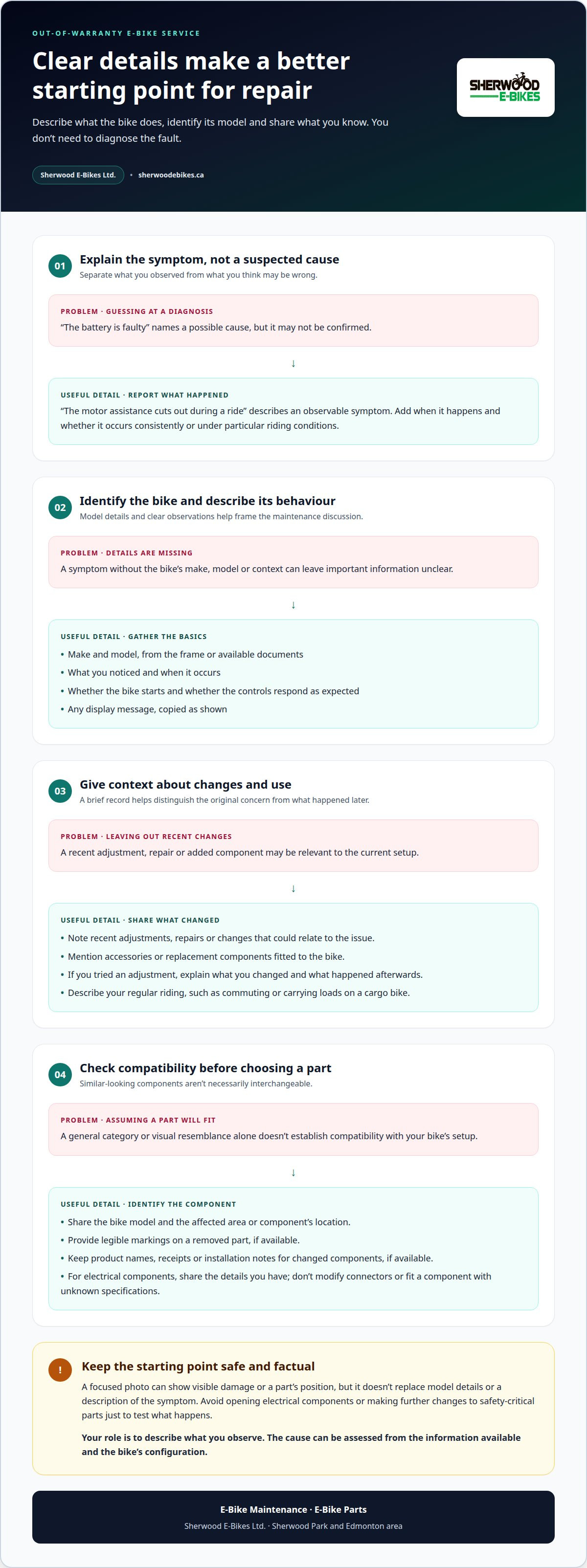
Separate the symptom from your suspected cause. “The motor assistance cuts out during a ride” describes what you’ve observed. “The battery is faulty” is a diagnosis. Starting with the symptom keeps the maintenance discussion focused on the bike’s behaviour and the information available, rather than an unverified explanation.
Gather the make and model details, then describe when the concern occurs. Note whether it happens consistently, only under particular riding conditions or after a recent change to the bike. If the display shows a message, record its wording. These details provide useful context without requiring you to diagnose the problem or take the bike apart.
Start with the maintenance need
E-Bike Maintenance is relevant when your main concern is how the bike operates or what attention it needs. Explain what changed, when you first noticed it and whether it happens every time. You don’t need to identify the failed component. A clear account of the symptom helps distinguish an operating concern from a routine adjustment or a part that appears worn.
Describe what you can observe. Does the bike start? Does the assistance behave differently? Do the controls respond as expected? Is there a new sound, and when does it occur? These details are more useful than a list of possible causes, especially when a symptom could involve different mechanical or electrical components.
Your regular use also provides context. A commuter may rely on the bike for routine trips, while a cargo-bike rider may use it for errands or carrying loads. Explain the kind of riding you do and how the symptom affects it. This clarifies what you need from maintenance without turning your description into a diagnosis.
For local riders, Sherwood E-Bikes Ltd. provides e-bike service in Sherwood Park. Keep the maintenance question specific: what is happening, under what conditions, and which part of the ride is affected? Clear details make it easier to discuss the concern in practical terms and understand what information is relevant to the next step.
Share useful details without guessing
Before arranging service or bringing in the bike, gather details that identify it and explain the concern. Use the model name shown on the frame or in the bike’s documents. Describe the symptom in plain language and note when it occurs. If the display shows a message, copy its wording rather than trying to interpret it.
- Identify the bike’s make and model from its markings or available documents.
- Describe what you noticed and when it happens.
- Note recent adjustments, repairs or changes that could relate to the issue.
- Mention accessories or replacement components fitted to the bike.
An e-bike combines mechanical and electrical components, so similar symptoms can have different causes. A new sound may come from a moving part, while inconsistent assistance may involve a control or another system component. Your role is to report what you’ve observed, not to test every possibility or name a failed part.
A focused photo can show a visible issue, such as damage or the position of a part. Include enough of the bike to make the location clear. A photo supports your written description, but it doesn’t replace the model information or an explanation of when the problem occurs.
If you’ve already tried an adjustment, describe what you changed and what happened afterward. This distinguishes an earlier attempt from the original symptom. Avoid opening electrical components or making further changes to safety-critical parts just to see whether the behaviour changes. A factual starting point is more useful than a long list of guesses.
It can also help to separate what you know from what you’re unsure about. For example, you may know that assistance stopped during a ride but not whether the cause was a control, connection or another part. That’s a useful description as it stands. You don’t need to make the problem sound more technical to explain it clearly.
Think about parts compatibility
E-Bike Parts are relevant when a concern involves a component that needs attention or replacement. Parts that look similar aren’t necessarily interchangeable. Compatibility can depend on the bike model, the component’s position and how it connects with other parts. Identifying the bike and affected area keeps a parts discussion specific to its setup.
The symptom alone doesn’t always establish whether a component needs adjustment, repair or replacement. If you have a removed part, keep it with the bike and share any legible markings. If it’s still installed, describe its location and function. Don’t remove a component to identify it if you’re not comfortable doing so.
Records of previously changed components can help explain the current setup. Keep the product name, receipt or installation note if available, particularly when a part differs from the original configuration. If you don’t have records, a clear photo and description can still provide context. Don’t assume a replacement will fit based only on its general category.
Electrical components need particular care because parts may be designed to work together as a system. Don’t modify connectors or install a component with unknown specifications. Instead, explain the issue and share the bike and component details you have. This keeps the discussion focused on the part’s role and compatibility.
Identify why you’re asking about a part. You may have noticed visible damage, wear, a change in how the bike feels or a component that no longer works as expected. These details can distinguish a parts question from a broader maintenance concern. If you’re unsure which applies, describe the symptom and the part involved instead of choosing a diagnosis in advance.
Parts choices can affect how the bike functions as a whole. A component may need to fit its mounting point and work with related parts, rather than simply match a name or appearance. Available records can clarify the existing setup. If you don’t have records, the model information and a description of the component still help establish what you’re discussing.
Consider accessories in context
Cycling Accessories can support how you use and carry your e-bike, but an accessory won’t address every maintenance concern. If the bike has a mechanical or electrical symptom, keep that as the focus. If you want to make regular trips more practical, describe what you carry, how you ride and what function you want an accessory to serve.
A commuter may want to carry everyday items, while a family rider may need a setup suited to regular errands. The right accessory depends on the bike’s design and intended use. Consider where it attaches and whether it could interfere with controls or moving parts. These details are particularly useful when the bike already has added components or a changed configuration.
Keep a repair need separate from an accessory choice. First describe the bike’s operating concern. Then consider accessories suited to comfort, carrying needs or your riding routine. This helps avoid treating a convenience upgrade as a repair requirement or expecting an accessory to resolve a mechanical problem.
If an accessory is already fitted, mention it when discussing a related maintenance concern. It may provide useful context if it affects access to a component or changes the bike’s setup. Explain when it was added and what changed afterward, if anything. Don’t identify it as the cause unless you’ve directly observed that.
When choosing an accessory for everyday use, consider how it fits into your ride rather than selecting it in isolation. A carrying accessory should suit the items you plan to bring and how you expect to use the bike. Other accessories may support comfort or convenience. Describe your intended use to keep the discussion connected to the bike and your routine.
When a different bike may suit your needs
A maintenance question can prompt a separate decision about how you want to ride. If your current bike no longer suits your routine, a Commuter E-Bike may be worth considering as another mobility option. Think about your regular routes, the surfaces you travel on, what you carry and where you store the bike. These practical needs help define what you want from a commuter setup.
A repair doesn’t automatically mean you need another bike. If your current one still suits your needs, addressing its maintenance concern may be the right path. If your routine has changed, assess a potential replacement against those new requirements rather than treating an out-of-warranty repair as the reason on its own.
When considering a commuter option, think about your full routine rather than one feature. How often do you ride? What do you carry? Which routes do you take, and what riding position do you prefer? Clear answers make it easier to explain what you need and which compromises you want to avoid.
Consider storage and day-to-day handling too. A bike that suits your route should also fit where you keep it and how you manage it before and after a ride. If you regularly carry items, note what needs to come with you. These practical details frame a commuter-bike discussion around your actual routine, not just a broad label.
Maintenance remains part of e-bike ownership, whether you keep your current bike or choose a different one. Knowing the model and configuration makes maintenance discussions more focused. Sherwood E-Bikes Ltd. offers E-Bike Maintenance, E-Bike Parts, Commuter E-Bikes and Cycling Accessories for different needs, from addressing a repair concern to planning a setup for daily riding.
Make the drop-off more straightforward
If you plan to bring the bike in, prepare a short handover covering the model, symptom and conditions in which it occurs. Mention recent work or changes, along with any accessory or replacement part that may be relevant. Bring notes or documents that explain the bike’s setup. A concise, factual summary is more useful than a list of suspected causes.
Stick to what you’ve observed. “The assistance changes during a ride” is more precise than declaring an electrical part has failed when that hasn’t been established. If the issue happened once, describe it as a single event; if it repeats, explain the pattern. This keeps the handover accurate.
Identify any modifications and, if possible, the component involved. Changes to the bike’s setup can matter when discussing parts or maintenance. If you don’t know the component’s name, describe where it is or show a photo. You don’t need to disassemble the bike to explain its configuration.
If a concern affects how safely or reliably the bike operates, don’t ride it until you have a clear basis for doing so. Keep any loose components with the bike. Handle electrical parts carefully and avoid opening or modifying them. These preparations help keep attention on the maintenance concern and the bike’s current condition.
Before bringing in the bike, make sure your handover clearly explains the reported issue. If the concern involves a sound or behaviour that occurs only in a particular situation, describe that rather than trying to recreate it. If a display message appeared, include its exact wording. The goal is to share a clear account, not conduct a test or prove a suspected cause.
The maintenance discussion can then focus on details that shape the next step: the bike’s model, its current setup, the component involved and the symptom you described. These details help clarify whether the concern relates to E-Bike Maintenance, E-Bike Parts or another practical need. The aim is to move from uncertainty about the bike’s behaviour toward a clearer understanding of what needs attention.
Bring the information you have, even if you can’t identify the cause. The model name, a clear symptom description and relevant details about the bike’s configuration provide a useful starting point. Sherwood E-Bikes Ltd. offers E-Bike Maintenance, E-Bike Parts, Commuter E-Bikes and Cycling Accessories. Contact Sherwood E-Bikes Ltd. to discuss your e-bike and the support you’re looking for.
Choose a practical next step
A repair decision can also be a chance to consider what you need from your e-bike going forward. If your current bike still suits your routine, focus on the maintenance issue and any relevant parts. If your daily trips or carrying needs have changed, consider whether a Commuter E-Bike better fits how you ride now.
Sherwood E-Bikes Ltd. offers E-Bike Maintenance and E-Bike Parts for riders addressing service needs, as well as Commuter E-Bikes for those considering a different setup. Bring your model details and a clear description of the concern to start a focused conversation about the next step for your bike.
Contact Sherwood E-Bikes Ltd. about service to discuss your needs. A clear plan can help you move forward with confidence and get back to the rides that matter to you.
Frequently Asked Questions
Which independent bike shops in Sherwood Park service this e-bike?
This article doesn’t identify an independent bike shop for the repair. Sherwood E-Bikes Ltd. serves riders in its local target communities, including Sherwood Park and Edmonton. The type of repair matters too: mechanical work and electrical-system concerns involve different components. Share the bike’s model and the problem you’re experiencing when discussing service options in your area.
Which independent bike shops in Edmonton service this e-bike?
Sherwood E-Bikes Ltd. offers E-Bike Maintenance and E-Bike Parts for Edmonton-area riders. The repair depends on the bike and the component involved. For example, a concern with braking or the drivetrain differs from an issue involving electrical assistance. When describing the problem, explain how it affects the ride and whether it occurs under particular conditions. This gives the maintenance discussion a practical starting point.
Which Alberta bike shops service this e-bike in other cities?
Sherwood E-Bikes Ltd. serves riders in Sherwood Park, Edmonton, Leduc, Camrose, Fort Saskatchewan, Ardrossan, St Albert, Vegreville, Morinville, Wetaskiwin and Spruce Grove with E-Bike Maintenance and E-Bike Parts. The work depends on the bike’s setup and the concern involved. A mechanical adjustment differs from an electrical-system issue, so describe the symptom and identify the bike model when discussing maintenance.
What safety or warranty issues should I consider when using a third-party repair shop?
Review your warranty documents for any coverage that may still apply. Warranty coverage can depend on the warranty terms and the bike’s ownership history. Avoid opening electrical components or modifying connectors, and check whether the bike is subject to a recall. A recall may require you to stop using the bike until a remedy is available.
What repairs can a local bike shop perform on an e-bike?
Independent e-bike repair shops may service e-bikes and source compatible drivetrain components and parts. Compatibility depends on the bike’s model and configuration, so share those details and describe the symptoms when discussing service with Sherwood E-Bikes Ltd.
How do I prepare an e-bike for service and find its model and serial number?
Before service, gather the bike’s make and model from markings on the frame or its documents. Describe the symptoms and when they occur, and note any recent repairs, adjustments, accessories or replacement parts.


