

The best puncture-protection choice isn’t automatically the fastest-rolling tyre. In the BKT vs Schwalbe Marathon E-Plus puncture resistance comparison, the Schwalbe’s SmartGuard construction includes a 5 mm protective layer and two layers of RaceGuard fabric, and its puncture protection is rated 7. The right choice still depends on the exact BKT tyre model and how you balance flat protection with rolling resistance.
It makes sense to look beyond puncture ratings: added protection can affect rolling resistance, while an e-bike’s load and riding conditions also shape the choice. This comparison explains the Marathon E-Plus protection layers, how its rolling-resistance results vary with pressure, and how it differs from Marathon Plus options.
Use these details to weigh protection against efficiency for your commute, cargo setup, or everyday e-bike use. The goal is to choose based on tyre construction and riding needs, not the model name alone.
Key Takeaways
- Compare rolling-resistance results at the same tyre pressure and load to understand how protection affects ride efficiency.
- Separate Marathon E-Plus from Marathon Plus: their intended e-bike use and specific tyre designs affect which comparison matters.
- Match the tyre to your e-bike’s load, speed, riding surface, and wheel requirements, not just its puncture rating.
- Identify the exact BKT model before drawing a direct comparison, since the model name determines which specifications are relevant.
- Use the decision guide to weigh flat protection against rolling feel for your commute, cargo setup, or everyday rides.
Marathon E-Plus puncture protection and SmartGuard construction
The Marathon E-Plus combines layered puncture protection with a tyre design intended for e-bikes. Its rating and construction help explain its protection, but cannot provide a direct BKT comparison without the exact BKT model.
Marathon E-Plus construction
The Marathon E-Plus uses SmartGuard with two layers of RaceGuard fabric beneath it. SmartGuard is described as a 5 mm layer, while Smart DualGuard combines 4 mm of special rubber with those two fabric layers. The layered design places protective material under the tread, where sharp objects can penetrate. Its puncture protection rating is 7.
These details describe Schwalbe’s protection system, but don’t establish how a BKT tyre performs. BKT makes different tyre models, and without a specific model and construction details, there’s no like-for-like comparison with the Marathon E-Plus. Start with the exact model name, then compare its protective layers and test results with Schwalbe’s.
Independent tests and Canadian ratings
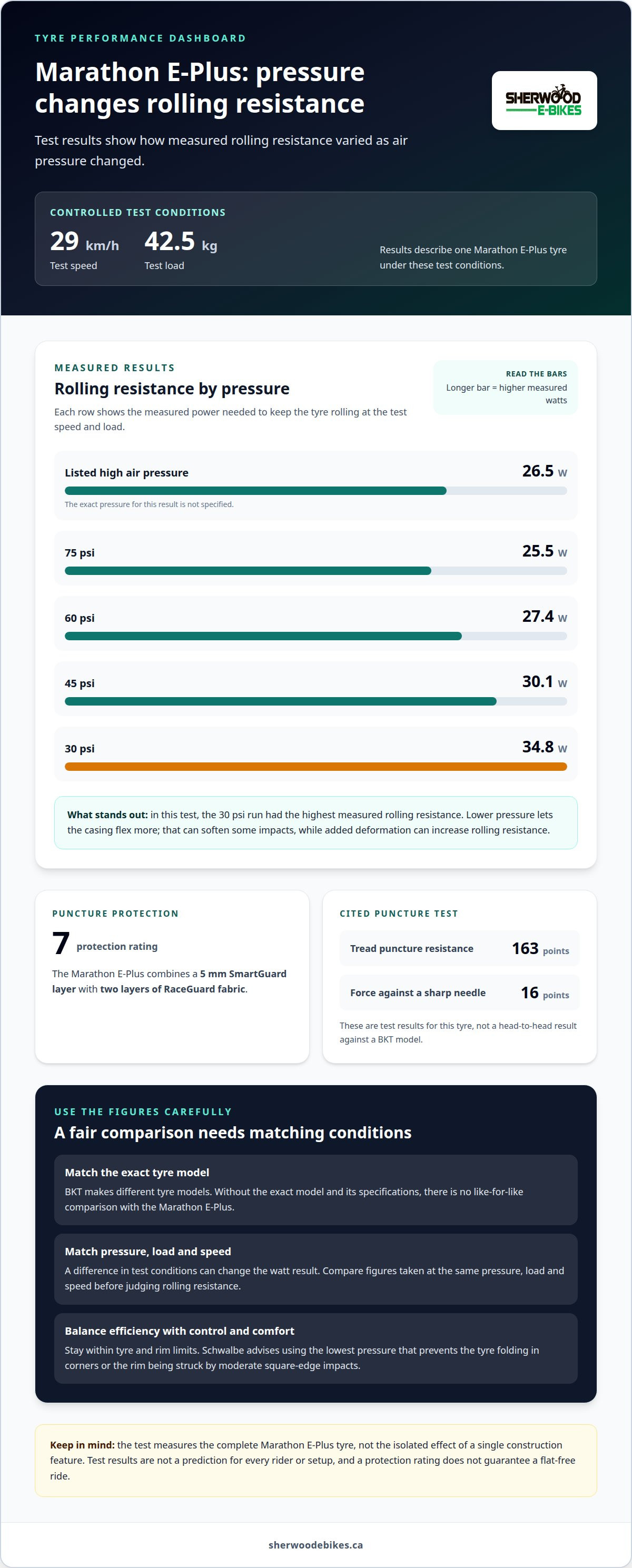
In the cited test, the Marathon E-Plus scored 163 points for tread puncture resistance and 16 points for force against a sharp needle. It also received the page’s protection rating of 7. These figures describe that tyre under test conditions; they aren’t a head-to-head result against a BKT model.
These test scores don’t represent Canadian cyclist or retailer ratings. A rider’s experience can vary with road conditions, debris, pressure, load, and maintenance. One rider reported a staple puncture that sealant plugged after removal, illustrating that the outcome can depend on more than the casing alone.
BKT performance depends on the model. Without an independent result or Canadian rating for a specific BKT tyre, there’s no like-for-like score. The evidence describes the Marathon E-Plus’s measured protection, but doesn’t establish it as a test winner over BKT.
Schwalbe touring tyres can carry different constructions, so don’t treat one model’s rating as a rating for every touring tyre. The Marathon Plus family is rated 7 on Schwalbe’s puncture-protection scale, and the Marathon Plus also uses a 5 mm SmartGuard layer. Ratings indicate a protection category; puncture-test scores measure performance in a particular test. Neither guarantees a flat-free ride.
| Option | Protection information | Comparison limit |
|---|---|---|
| Schwalbe Marathon E-Plus | Rating 7; 5 mm SmartGuard; two RaceGuard layers | Test scores available for this tyre |
| BKT bicycle tyre | Exact model needed | No model-specific test result for a direct match |
| Schwalbe Marathon Plus | Rating 7; 5 mm SmartGuard | A separate model from Marathon E-Plus |
Tubeless tyres and sealant address punctures differently from protective tyre layers: sealant can plug some small holes, while larger damage may still cause air loss. The Marathon Plus requires an inner tube and isn’t tubeless compatible; don’t assume that specification applies to every tyre discussed here. This comparison makes no claim about Canadian prices or stock. Before choosing, match the exact BKT model and tyre format to your wheel and riding needs.
Rolling resistance and puncture resistance trade-offs
The Schwalbe Marathon E-Plus test results show how air pressure changes rolling resistance. The test measured one tyre at 29 km/h under a 42.5 kg load, so use its figures as controlled results, not a prediction for every rider or setup.
At the test’s listed high air pressure, the Marathon E-Plus produced 26.5 watts of rolling resistance. At 75 psi, the result was 25.5 watts. The measured value rose to 27.4 watts at 60 psi, 30.1 watts at 45 psi, and 34.8 watts at 30 psi. In this test, the lower-pressure runs required more power to keep the tyre rolling at the same speed and load.
Pressure also changes how a tyre responds to the road. Lower pressure lets the casing flex more over rough surfaces, which can soften some impacts. That added deformation can increase rolling resistance, as the 30 psi result illustrates. Higher pressure can reduce casing movement, but a firmer tyre may pass more bumps through to the rider. Comfort and efficiency depend on the tyre, wheel, load, and surface.
The test measures the complete Marathon E-Plus tyre rather than isolating the effect of one construction feature. To compare rolling resistance with BKT, you need the exact BKT model and the same test speed, load, and pressure. Otherwise, differences may reflect test conditions or model choice rather than a clear performance advantage.
For a practical pressure choice, stay within the tyre and rim limits, then account for the bike’s load and the surfaces you ride. Schwalbe advises using the lowest pressure that prevents the tyre from folding in corners or the rim from being struck by moderate square-edge impacts. This balances comfort and rolling resistance with control and impact protection. Cargo loads or rough pavement can change the pressure that suits a setup.
Compare test conditions before treating two watt figures as a winner. A pressure mismatch can make one tyre appear faster or slower when conditions differ. The 42.5 kg load and 29 km/h speed in the Marathon E-Plus test provide reference points, but they don’t represent every Canadian commute. For everyday use, weigh puncture protection, surface roughness, tyre pressure, and comfort together. Riders on debris-heavy routes may put more weight on puncture protection, while those prioritizing easier rolling may focus on pressure and casing behaviour. Neither goal should override safe handling or the tyre’s permitted operating range.
Comparison with Marathon Plus
Marathon Plus and Marathon E-Plus are related touring tyres, but their weights vary by model and size. The tested Marathon E-Plus weighed 911 g, while Schwalbe specifies 930 g. A listed 28c Marathon Plus weighs 750 g. These figures describe different tyre versions, so they don’t establish a same-size weight advantage.
The Marathon Plus range also includes versions aimed at different riding needs. The Marathon Plus Tour weighs around 960 g per tyre, while the Marathon Plus MTB weighs 1,275 g. Those weights show why the family name alone isn’t enough for choosing or comparing tyres. A mountain-bike version and a touring version have different formats and shouldn’t be treated as interchangeable.
Weight can affect how a tyre feels when accelerating and steering, but it doesn’t measure puncture protection or durability by itself. A heavier tyre may differ in size or construction, so compare the exact model and size before drawing conclusions. For commuters choosing between E-Plus and a standard Marathon Plus, the route and required tyre format matter as much as weight.
Tread and sidewall durability also require separate evidence. A tyre’s total weight doesn’t show how resistant either area is to penetration or wear. Compare equivalent tests under consistent conditions, and don’t assume a result for one Marathon Plus version applies to Marathon Plus Tour or Marathon Plus MTB.
Use this practical comparison when narrowing the options:
- Match the exact model and tyre size to your wheel and bike use.
- Compare listed or measured weights only when the versions are clearly identified.
- Look for separate tread and sidewall durability evidence.
- Consider how the tyre format suits your route and handling needs.
The Marathon E-Plus and Marathon Plus belong to the same product family, but choosing between them means comparing individual specifications rather than assuming they perform alike. Weight describes the tyre, but doesn’t replace model-specific evidence about punctures, wear, or rolling behaviour. Compare the precise version and size for your bike and riding conditions. This keeps a touring tyre comparison relevant to the job it needs to do.
Marathon E-Plus design for e-bikes
The Marathon E-Plus is designed around the heavier loads and higher average speeds associated with e-bikes. Its casing is specified at 67 TPI, and Schwalbe identifies it as E-50 for fast e-bikes reaching speeds up to 50 km/h.
That designation indicates speed suitability, not a promise of a smooth ride or immunity from punctures. Construction, pressure, wheel fit, and the bike’s load all affect performance. For example, on an urban commute with bags, the loaded rear tyre may respond differently from the front. Choose fit and inflation for the complete bike setup.
Speed ratings differ across the Schwalbe Marathon Plus family. Schwalbe describes E-25 versions for pedal-assist e-bikes up to 25 km/h, while the Marathon E-Plus carries the E-50 mark for speeds up to 50 km/h. The Marathon Plus family is listed in sizes from 35-349 to 47-622; that range should not be assumed to apply to every E-Plus version.
There isn’t one shared size or speed rating for every BKT bicycle tyre. These details depend on the exact BKT model, while the Schwalbe figures above apply to the named Marathon products. For a direct comparison, match the tyre size marked for your wheel and compare the model’s intended speed category with your e-bike’s use.
Pressure also affects the balance between rolling efficiency and impact protection. The Marathon E-Plus has a manufacturer-listed maximum of 85 psi, but that maximum isn’t a target pressure for every wheel and rider. Tyre width, rim limits, rider and cargo load, and surface conditions all matter. For example, a smooth paved commute and a rough path call for different considerations, even on the same e-bike.
Use this fit sequence to narrow the options:
- Match the tyre’s size marking to the wheel and available frame clearance.
- Compare the e-bike’s intended speed with the tyre’s E-25 or E-50 designation.
- Set pressure within applicable tyre and rim limits, accounting for load and surface.
- Compare BKT and Schwalbe only after identifying the exact models.
For a commuter e-bike, correct size and speed category come before seeking maximum puncture protection or a smoother ride. A tyre that fits the wheel and suits the bike’s use gives you a sound basis for comparing protection and rolling behaviour. The Marathon E-Plus and Marathon Plus share a family name, but their specifications aren’t interchangeable.
What BKT tire model is being compared with the Schwalbe Marathon E-Plus?
Because no specific BKT model is identified, this comparison can’t establish a direct model-to-model result. A BKT vs Schwalbe Marathon E-Plus puncture resistance comparison becomes useful when the BKT tyre’s full sidewall markings can be matched to comparable specifications.
Read the sidewall as a set of identifiers, not just a brand label. The model name identifies the tyre line, the size describes its fit, and any stated use or speed designation indicates its intended application. Consider these details together. A similar tread pattern alone doesn’t show that tyres were designed for the same conditions.
Next, compare the evidence available for each model. Construction descriptions explain how a tyre is built, puncture tests measure resistance under specific conditions, and rider reports describe individual use. These types of evidence answer different questions and aren’t interchangeable. A construction feature can explain the design, for instance, but it doesn’t provide a comparative test score.
A useful comparison record can separate those claims:
- Fit: Note the full size and confirm it suits the wheel and frame clearance.
- Intended use: Record the surface and riding category each model is designed for.
- Protection evidence: Separate stated construction from measured puncture results and rider reports.
- Test conditions: Record whether tests assess the tread, sidewall, or both, and note pressure and load.
These distinctions help avoid a common mistake: treating a rating, a penetration-force result, and a rider’s puncture history as directly comparable measures. A rating summarizes protection within a system. A test result applies to its stated method and sample. A rider report reflects a particular route, setup, and experience. Use the evidence that answers your question, and describe it accurately.
For Canadian commuters choosing tyres, the practical question is whether the documented model and intended use suit the bike’s actual route. A paved commute with debris calls for different priorities than rough paths or mixed surfaces. Compare equivalent models, then weigh protection against the ride characteristics that matter to you. Until the BKT model and matching test conditions are clear, you can describe the Schwalbe specifications, but can’t draw a definitive BKT performance ranking.
A direct independent-test comparison requires an identified BKT model and matching test conditions. Judge results using the same method, including whether the test covers the tread, sidewall, or both.
Without an identified BKT model, the comparison can’t be tied to a specific BKT tyre.
Sherwood E-Bikes
Sherwood E-Bikes Ltd. can help you connect tyre choice with your e-bike and riding routine. If you’re comparing puncture protection for a commuter setup, its E-Bike Maintenance and E-Bike Parts are relevant next steps. Cycling Accessories can support everyday riding, and Commuter E-Bikes are another option if you’re choosing a complete bike.
Bring the exact tyre model and size to your discussion. That keeps the focus on fit, intended use, and the trade-off between protection and rolling feel, rather than a brand-level comparison. For riders in Sherwood Park and nearby communities, it’s a practical way to move from research to a setup suited to daily travel.
Contact Sherwood E-Bikes Ltd. to discuss your e-bike and tyre needs.
Make your next tyre choice fit your ride
Consider the rides you want your e-bike to handle, not just the tyre name on a comparison chart. A BKT versus Schwalbe Marathon E-Plus puncture-resistance comparison is useful only when the BKT model, tyre size, and intended use are clear. This gives you a better starting point for deciding which trade-offs matter for your setup.
If you’re refining a commuter build, Sherwood E-Bikes Ltd. can help connect tyre decisions with your broader e-bike needs. Its E-Bike Parts, Commuter E-Bikes, and E-Bike Maintenance offerings support different stages of choosing and maintaining your setup. Focus on the fit and riding use you need, then take the next step with advice tailored to your choice.
Contact Sherwood E-Bikes Ltd. to discuss your e-bike setup and move ahead with confidence.
Frequently Asked Questions
Which tyre should you choose?
Choose a tyre whose exact model, size, and intended use suit your e-bike. For a daily commute, prioritize wheel fit, your usual road surfaces, and the protection details for that model. The Marathon E-Plus has published puncture-test information, but a fair BKT comparison requires identifying a specific BKT tyre. Don’t choose by brand name alone: compare equivalent specifications and intended uses.
What puncture protection technology does the Schwalbe Marathon E-Plus use?
The Marathon E-Plus uses Smart DualGuard, combining SmartGuard with two layers of RaceGuard fabric beneath it. The rubber layer helps resist penetration, while the fabric layers reinforce the area beneath the tread. For a replacement, match the tyre’s size and construction to your wheel and riding needs. A protective casing can reduce puncture risk, but can’t prevent every puncture from sharp debris.
What are the puncture test results or ratings for each tyre?
The Schwalbe Marathon E-Plus scored 163 points for tread puncture resistance and 16 points for force against a sharp needle; its protection rating is 7. Those results describe the E-Plus, not a direct comparison with every BKT tyre. BKT results depend on the model being assessed, so don’t treat a brand-wide rating as equivalent to a model-specific test score.
How do tyre weight, rolling resistance, and ride comfort compare between the two?
The tested Marathon E-Plus weighed 911 g, while Schwalbe specifies 930 g. Its rolling resistance measured 25.5 watts at 75 psi under the stated test conditions. These figures don’t establish a BKT advantage or disadvantage without a matching model, pressure, and load. For comfort, consider how tyre pressure and casing flex suit your bike, rider load, and usual surfaces.
How do BKT and Marathon E-Plus compare in sidewall and tread durability?
The Marathon E-Plus scored 163 points for tread puncture resistance and had the highest tested force-to-penetrate result among the compared tube tyres for both tread and sidewall. A direct comparison with BKT requires the exact BKT model and its matching durability results.


