

A trike can stay upright while stopped, but it isn’t automatically the safest choice in every situation. Alberta seniors comparing trikes, quads and two-wheel e-bikes should weigh stationary support against handling and storage needs. The right fit depends on how you mount, turn and ride on your usual routes.
When balance is a concern, it makes sense to put stability first. A trike offers support at a stop, while a two-wheel e-bike can be easier to manoeuvre through tight paths and storage spaces. Trikes also require slower, careful cornering to reduce the risk of tipping.
This comparison explains how the options differ at low speeds and on turns, and which features can make a ride easier to manage. You’ll also find practical safety habits to consider, from choosing a step-through frame to practising in an open, flat area before riding near traffic.
Key Takeaways
- Match the ride to your balance, usual routes and storage space; a trike’s support while stopped comes with different handling needs.
- Look for an easy-to-mount frame and a riding position that feels comfortable and controlled.
- Account for cornering on a trike: slow before turns and steer smoothly to help reduce tipping risk.
- Use a test ride to practise starting, stopping, mounting and turning before heading into traffic.
- Compare safety features and everyday fit across trikes, quads and two-wheel e-bikes before choosing.
What is the best type of ebike for an older rider?
The best fit depends on how you mount, balance, steer and store your ride. Compare a step-through e-bike with an eTrike on your usual routes, not just while standing still.
Step-through frames and mounting access
A step-through frame has a low or open section between the seat and handlebars. You can walk through the frame instead of lifting a leg over a high top tube. Low-step designs still have a raised section, so compare its height with your leg lift and balance ability. A lower opening can make mounting and dismounting more manageable, but you’ll still need to steady the bike.
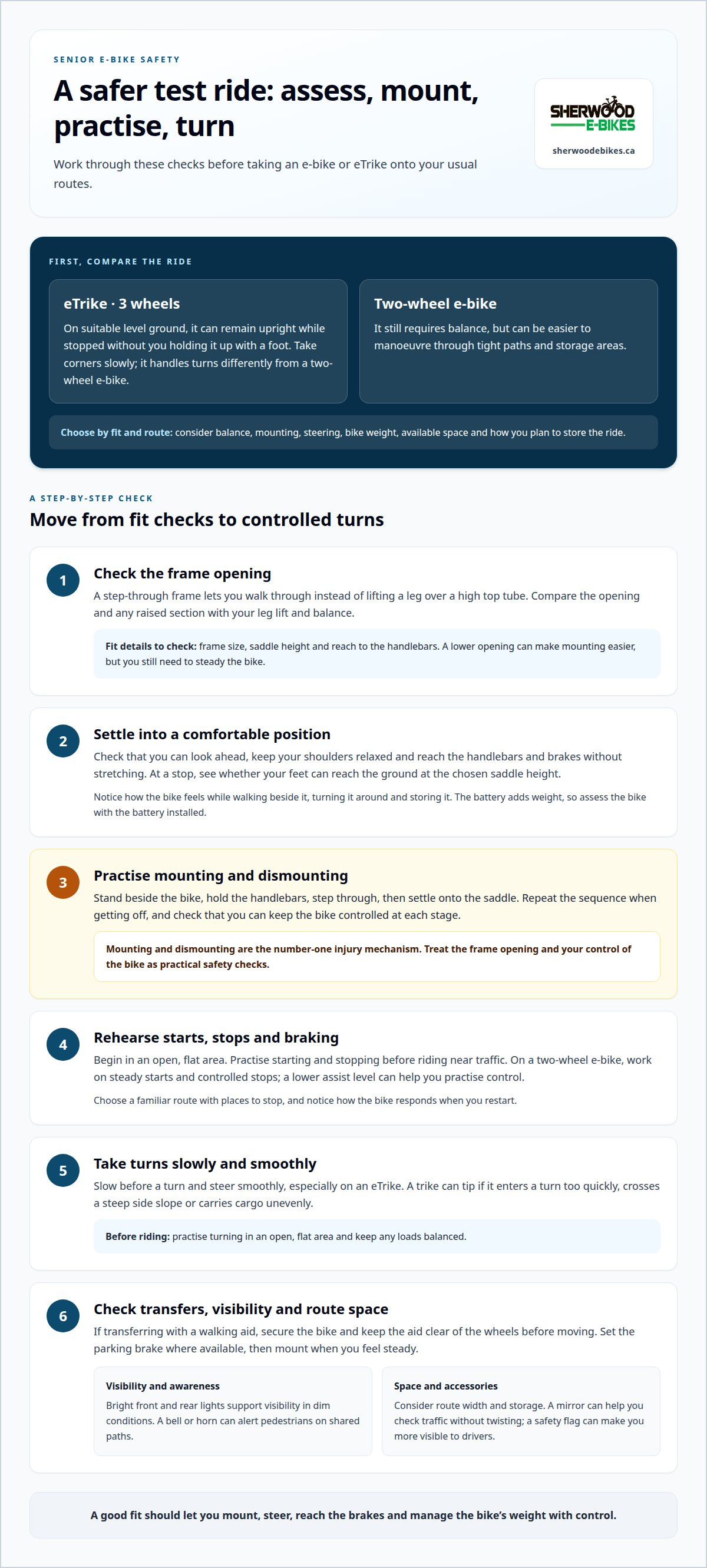
Practise the movement in stages: stand beside the bike, hold the handlebars, step through, then settle onto the saddle. Repeat the sequence when getting off. Falls while mounting or dismounting are the number-one injury mechanism, so a frame you can walk through is a practical feature to assess. Check whether you can keep the bike controlled at each step. Frame size, saddle height and reach to the handlebars all affect fit.
When comparing RadTrike alternatives for seniors with balance concerns in Alberta, assess the step-through opening alongside the saddle height. These measurements affect how easily you can mount and settle into position. A frame that looks low in a photograph may still require a leg lift that feels awkward in practice.
Upright riding positions
An upright position keeps your torso higher than a forward-leaning posture. It can make it easier to look ahead and reach the handlebars comfortably. During a test ride, check whether your shoulders stay relaxed and your hands reach the controls without stretching. Also check whether your feet can reach the ground while stopped, given the saddle height and your leg length.
Fit involves more than posture. The bike’s weight affects how easily you can guide it while walking beside it, turning it around or storing it. The battery adds weight, so notice how the bike feels with it installed. A comfortable upright setup should still let you steer smoothly and reach the brakes. If the handlebars feel too far away or the bike is difficult to steady while walking, reassess the fit.
Step-through bicycles versus eTrikes
A step-through e-bike has two wheels, while an eTrike has three. On suitable level ground, an electric trike can remain upright while stopped without you holding it up with a foot. That can help if balancing at a stop is difficult. A two-wheel bike still requires balance, but can be easier to manoeuvre through tight paths and storage areas.
When comparing RadTrike alternatives for seniors with balance concerns in Alberta, consider how each option handles the transition between stopping and moving. An eTrike may feel steady when parked, but it handles corners differently from a two-wheel e-bike. Take turns slowly to reduce the risk of tipping. On a two-wheel option, practise steady starts and controlled stops in an open, flat area. Choose based on your balance needs, route space and ability to manage the bike’s weight.
Riding considerations for seniors with balance issues
Choose a ride that suits your balance, route surfaces and usual distance. The right setup should make mounting, controlling speed and navigating everyday obstacles feel manageable.
Riding styles and safer riding features
On paved neighbourhood routes, consider how easily you can start, stop and steer from a comfortable position. Pedal assist can support smoother starts with less strain, while a lower assist level can help you practise control. On sandy or mixed routes, tire footprint and steering response matter. Match the bike to the surfaces you expect to ride.
Plan battery use around your intended distance, hills, cargo and assist level. A display can help you monitor the remaining charge during a ride. For a first outing, choose a familiar route with places to stop, and notice how the bike responds when you restart. A useful comparison of RadTrike alternatives for seniors with balance concerns in Alberta considers these everyday demands alongside the bike’s fit.
Stability and access adaptations
Choose adaptations for specific tasks. A lower seat keeps you closer to the ground, and a step-through frame reduces the leg lift needed for mounting. A parking brake can keep an eTrike stationary during a transfer. Bright front and rear lights support visibility in dim conditions; a bell or horn can alert pedestrians on shared paths.
Before riding, consider whether standing on one leg or turning quickly makes you feel unsteady. If you use a walking aid, secure the bike before transferring and keep the aid clear of the wheels before moving. Set the brake where available, then mount only when you feel steady. These steps address the transition, not the bike’s handling once underway.
When comparing RadTrike alternatives for seniors with balance concerns in Alberta, consider route width and storage as well as balance. Electric trikes are typically heavier than conventional bicycles, and two-wheel bikes are generally narrower. Folding designs may reduce storage demands, but consider how you’ll manage the folded bike. Choose accessories for a clear purpose: a mirror can help you check traffic without twisting, while a safety flag can make you more visible to drivers.
Cornering requires its own adjustment. Slow before a turn and steer smoothly, especially on an eTrike. A trike can tip if it enters a turn too quickly, crosses a steep side slope or carries cargo unevenly. Keep loads balanced and practise in an open, flat area before riding near traffic. These habits help you build control without adding unnecessary gear.
Test rides, safety habits and common buying mistakes
In Alberta, look for a bicycle retailer carrying adult electric trikes and arrange an in-person test ride. A short ride helps you assess mounting, starting, braking and turning before you choose.
Test rides and Alberta buying options
Use the test ride to compare how each bicycle responds to your movements. Practise getting on and off, starting from a stop, braking and making a broad turn. Try a step-through frame if lifting your leg over a high frame feels awkward. On an electric trike, notice how the rear wheels track through a turn and whether you can steer smoothly.
Begin in an open, flat area before riding near traffic. Start with a lower assist level, then practise stopping and restarting until the controls feel familiar. A test ride should include the movements you’ll use on ordinary routes, not just a straight stretch. Don’t choose based only on a stable parked position; turning and braking reveal different handling demands.
Comfort and safety features
Check that the saddle height lets you reach the controls comfortably and that the handlebars don’t make you stretch. A step-through frame can ease mounting and dismounting, while a parking brake helps keep an eTrike stationary during those transitions. Bright front and rear lights improve visibility in early morning and evening conditions.
On shared paths, a bell or horn can alert pedestrians; a tall safety flag can help drivers see an eTrike rider. A rear-view mirror lets you check traffic without twisting your body. These features support awareness, but don’t replace careful steering, braking or route choice.
Use this checklist before and after your first ride:
- Wear a helmet and make sure it sits securely before setting off.
- Set the parking brake before mounting or dismounting an eTrike.
- Practise on flat ground, then slow before turns and steer smoothly.
- Check the tires and brakes often, especially before a planned ride.
- Transfer carefully from a walking aid, keeping it clear of the wheels.
A common mistake is treating three wheels as protection against every fall. An electric trike can tip if it enters a turn too quickly, is steered abruptly, crosses a steep side slope or carries poorly distributed cargo. Keep loads balanced and avoid sharp turns at higher speeds. Another mistake is rushing the learning process; take time to understand the bicycle’s handling before adding traffic, hills or longer routes. A relaxed pace helps you notice how the brakes, assist and steering respond.
How trikes and quads can affect stability at low speeds
Three or four wheels change how a ride behaves at a stop, during a slow turn and in a tight space. Compare each layout by its actual handling, not wheel count alone.
On suitable level ground, an electric trike can remain upright while stopped without the rider holding it with a foot. That can make stopping feel different from stopping on a two-wheel electric bike, which must be balanced at rest. However, stability while stationary doesn’t guarantee the same stability through a corner. The rider still needs to manage speed, steering and the surface.
A quad has four wheels, but that alone doesn’t establish how it will handle. Its wheel placement, steering and turning behaviour affect its response at low speeds. A wider layout may also need more room to turn than a narrow two-wheel bike. Consider where you’ll ride and store it, including whether it can pass through a gate or fit in your garage.
On an electric trike, a rear differential lets the rear wheels rotate at different speeds while cornering. This accommodates the different paths taken by the inside and outside wheels through a turn. It doesn’t remove the need to corner carefully. Slow down before turning, then steer smoothly rather than changing direction abruptly.
Trike stability can change as a turn tightens or the ground slopes sideways. Entering a turn too quickly, steering abruptly or crossing a steep side slope can contribute to tipping. Cargo placement matters too. A heavy bag on one side can distribute weight unevenly, so secure loads low and centred where the design allows. Practise broad turns before attempting tighter ones.
At low speed, compare how each option behaves during a stop, start and turn. An eTrike can stay upright while stopped on suitable level ground, while a two-wheel bike requires balance. A quad’s four-wheel layout is distinct, but don’t assume it will feel easier in every setting. A step-through frame can help with mounting, but frame access and the space needed to turn are separate considerations.
Storage and route width also shape the practical choice. Two-wheel bikes are generally narrower and need less floor space than electric trikes. Many bicycles are easier to load onto traditional bike racks or into vehicles than electric trikes. Measure the route from the storage spot to the exit, including any narrow doorway or turn. A bike that fits the garage but cannot be moved smoothly through a gate may not suit daily use.
For a balanced comparison, assess stopping support, cornering response, turning room and cargo position separately. A trike offers an upright stop on level ground, but careful cornering remains essential. A quad’s four wheels don’t answer every handling question. Choose the layout that suits your actual routes, available storage and ability to steer through turns at a controlled pace. For readers also shopping for self-balancing technology and electric ride-on toys for grandchildren or kids, hoveroo.com.au provides a helpful reference for how low-speed balance features are applied in youth rideables.
What is the RadTrike and what features support riders with balance concerns?
The RadTrike is a three-wheel electric tricycle, so it differs from a two-wheel e-bike in how it stands still. On suitable level ground, an electric trike can remain upright without the rider balancing it with a foot. That may suit someone who feels unsteady at stops, but three wheels don’t prevent tipping during turns. Judge the ride by its handling in motion as well as its stability while parked.
For balance concerns, pay close attention to mounting and dismounting. Falls during these transitions are identified as the number-one injury mechanism in the guide. A step-through frame that you can walk through avoids lifting a leg over a high frame. On a trike, a parking brake can help keep it stationary during mounting or dismounting. These are useful design considerations, not proof that every model includes the same equipment.
A lower seat can keep you closer to the ground, while pedal assist can support smoother starts with less strain. Fat tires can provide a wider footprint, but they don’t remove the need to steer carefully. A rear-view mirror helps you check traffic without twisting your body. Bright lights, a tall safety flag and a bell or horn address visibility and awareness, not balance itself.
Cornering remains a key difference between a trike and a two-wheel e-bike. A rear differential lets an electric trike’s rear wheels rotate at different speeds through a corner. Even so, entering a turn too quickly, steering abruptly, crossing a steep side slope or carrying poorly distributed cargo can contribute to tipping. Slow before turns, steer smoothly and keep cargo balanced. Practise on an open, flat surface before riding near traffic.
Consider daily use before deciding whether this layout suits you. Think about whether you feel unsteady standing on one leg or turning quickly. Your usual routes also matter: paved, sandy, hilly or mixed terrain can affect what you need from a ride. Assess storage too, because electric trikes are typically heavier than conventional bicycles, while two-wheel bikes are generally narrower. Measure the storage space and the route through doorways or tight areas.
A practical comparison separates support while stopped from stability while moving. Ask yourself whether staying upright at a stop matters more than manoeuvring through narrow paths or storing a narrower bicycle. During a test ride, practise mounting, starting, braking and making slow turns. Choose a low assist level while learning, wear a helmet and check the tires and brakes often. These habits help you assess the RadTrike’s handling without treating its three-wheel design as a guarantee against falls.
Sherwood E-Bikes: E-Bike Parts
Sherwood E-Bikes Ltd. serves riders in Sherwood Park and Edmonton with E-Bike Parts and E-Bike Maintenance. If you are comparing options for stability, Commuter E-Bikes and Cycling Accessories are practical choices to consider for everyday riding.
Turn to these offerings when you need replacement parts, maintenance or accessories for an e-bike, or want to explore a commuter model. A suitable setup depends on your balance, routes, storage space and comfort handling the bike. Contact Sherwood E-Bikes Ltd. or visit sherwoodebikes.ca to discuss your e-bike needs.
Choose a ride that fits your next chapter
When comparing RadTrike alternatives for seniors with balance concerns in Alberta, make your next step specific: identify the ride you want to take and what would make it manageable. A short list of priorities can focus your decision, whether that means easier everyday travel, a particular type of bike or support keeping an e-bike maintained.
Sherwood E-Bikes can help you explore options suited to your riding needs. Bring your questions about e-bike parts, commuter models or maintenance, and use the discussion to clarify what matters most in your choice. The goal is a setup that feels practical for your routine, not one selected by wheel count alone.
Contact Sherwood E-Bikes for advice and take your next step toward a ride that suits you.
Frequently Asked Questions
Can electric trikes tip over?
Yes. An electric trike can tip during a fast turn, abrupt steering, a steep side slope or when cargo is poorly distributed. For example, a heavy bag hanging on one side can affect how the trike behaves through a corner. Keep loads balanced, reduce speed before turning and steer smoothly. Three wheels help a trike stay upright while stopped on suitable level ground, but don’t prevent tipping while riding.
Any trade-offs?
Yes. A trike can stay upright while stopped, but its extra width and weight affect everyday handling. A narrow doorway, crowded storage area or vehicle rack can make it more awkward to move than a two-wheel bike. Turning also feels different, so route width and the number of corners matter. Before choosing, picture a normal trip from storage to the street, including any tight passage, hill or sharp turn.
Can seniors with balance issues still ride an ebike?
Yes, seniors with balance concerns can ride an e-bike if they can manage its controls, mounting and stopping safely. Start by checking whether you can reach the brake levers, operate the assist controls and steady the bicycle while stationary. A step-through frame can reduce the leg lift needed to mount. Practise familiar movements in a quiet, open area, and choose a riding position that gives you a clear view ahead.
What Does “Safer” Actually Mean for an Older Rider?
“Safer” means a bike fits the rider’s abilities and intended routes, not that it removes every risk. Consider whether mounting, controlling speed, braking and turning feel manageable. For someone uneasy balancing at stops, a trike’s support while stationary may matter most. For someone navigating narrow paths or storage, a narrower two-wheel e-bike may be easier to handle. Judge each option against the specific task that causes concern.
What safety risks should seniors with balance concerns consider before riding an electric trike?
Consider risks during transfers, starts, turns and stops. Moving from a walking aid to a trike requires a secure position and careful handling. Sudden steering or a fast corner can unsettle the trike, while unevenly placed cargo can affect its balance. Choose a route suited to your experience, keep loads centred and allow time to learn the trike’s steering response before adding traffic or complex turns.
Which electric trikes have the lowest step-through height and most stable designs?
Look for an e-trike with a step-through frame you can walk through and a lower seat. On suitable level ground, an electric trike can remain upright while stationary, but it still needs careful, slow cornering.
How do RadTrike alternatives compare on price, range, weight, and payload in Canada?
Electric trikes are typically heavier than conventional bicycles; the material provides no comparison of range or payload.


