

What if the most reliable way to cross the North Saskatchewan River during rush hour didn't involve a steering wheel or a transit card? For many residents, e-bike commuting edmonton has transformed from a summer hobby into a year-round necessity as gas prices hover around 154.6 cents per litre. You likely already know that navigating the city's steep hills and unpredictable weather requires more than just a standard set of wheels.
It is frustrating to arrive at work exhausted from the River Valley climb or delayed by a late bus. We understand that local riders face unique challenges, from securing their investment in the city centre to maintaining battery range in the extreme cold. This guide provides a complete roadmap for mastering your daily transit. You will discover how to utilize the 33 kilometres of new bike routes being added this year, reduce your monthly transportation costs, and arrive at your destination feeling refreshed. We'll explore winter-ready gear, theft prevention strategies, and the specialized maintenance needed to keep your e-bike running smoothly through every season.
Key Takeaways
- Discover why e-bike commuting edmonton is now faster than the bus and more cost-effective than car ownership in 2026.
- Navigate the city's 33 kilometres of new bike lanes and the River Valley trails using strategic route planning.
- Compare the upfront investment of a high-quality e-bike against rising fuel costs and the $102 monthly ETS pass.
- Identify the essential gear needed to stay dry, safe, and sweat-free while conquering the climb out of the River Valley.
- Understand the importance of professional maintenance and rentals to ensure your transit remains reliable in all weather conditions.
Why E-Bike Commuting is Redefining Edmonton’s Urban Mobility in 2026
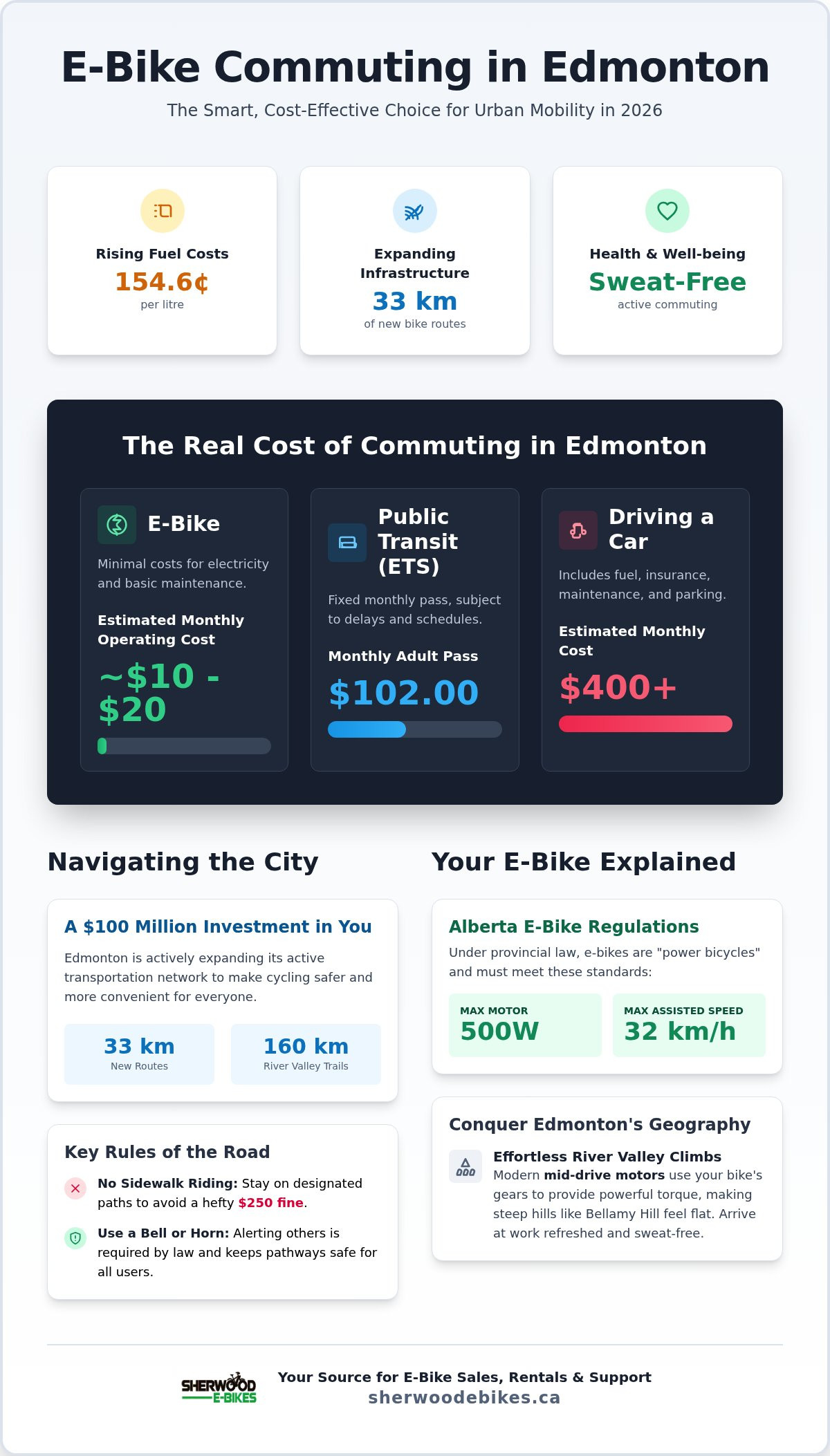
By 2026, the Capital Region has reached a significant tipping point. With gasoline prices reaching 154.6 cents per litre and the City of Edmonton investing $100 million into active transportation, e-bike commuting edmonton has shifted from a niche hobby to a primary transit strategy. The city is currently adding 33 kilometres of new routes, creating a connected network that makes two-wheeled travel safer and more efficient than ever before. For many, the choice is simple: avoid the $102 monthly cost of an ETS pass and the unpredictability of bus schedules in favour of a reliable, motorized ride.
Choosing the right equipment is the first step toward a successful commute. Modern e-bikes are generally classified as "power bicycles" under Alberta law, meaning they feature an electric motor limited to 500 watts and a top assisted speed of 32 km/h. When selecting a model, you'll choose between pedal-assist systems, which provide power based on your effort, and throttle-driven bikes that can move without pedalling. Understanding these electric bicycle laws ensures you stay compliant while enjoying the health benefits of an active lifestyle. Beyond the physical activity, e-bikes offer a massive reduction in your carbon footprint, helping the city meet its long-term environmental goals.
The 'Last Mile' Solution for Edmonton Suburbs
E-bikes effectively bridge the gap between suburban residential areas and major transit hubs. In communities like Sherwood Park, waiting for a feeder bus can add 20 to 30 minutes to a daily trip. An e-bike allows you to bypass these delays, travelling directly from your front door to an LRT station on your own schedule. This flexibility is a game changer for those who want to use public transit but find the initial leg of the journey too slow or unreliable. Most commuters find that an e-bike is significantly more predictable than relying on traditional bus routes during peak hours.
Overcoming the River Valley Obstacle
For decades, the steep climb out of the River Valley was the single biggest barrier to cycling in the city. Mid-drive motors have completely changed this dynamic. By leveraging the bike's internal gearing, these motors provide the torque necessary to make the ascent up Victoria Park Road or Bellamy Hill feel effortless. This technology ensures that "sweat-free" e-bike commuting edmonton is a reality for office workers. You can tackle the city's most challenging geography while wearing professional attire, arriving at your desk without needing a change of clothes or a shower. If you are curious about how this feels, you can book a rental to test the assistance levels on your own route before committing to a purchase.
Navigating Edmonton’s Expanding Bike Infrastructure and Routes
Edmonton's commitment to active transit has reached a new peak in 2026. The city's $100 million expansion program is currently adding 33 kilometres of new routes to the existing network. This investment makes e-bike commuting edmonton a viable reality for those who previously felt restricted by high-traffic corridors. The core of this system is the 160 kilometres of maintained multi-use trails in the River Valley, providing a scenic and efficient alternative to congested arterial roads. However, navigating these paths requires more than just a map; it requires an understanding of local bylaws. Remember that riding on the sidewalk is prohibited and carries a $250 fine. Staying on designated paths is the best way to ensure a smooth, legal journey.
Safety on shared-use pathways (SUPs) requires a mix of etiquette and awareness. You must use a working bell or horn, as required by Alberta law, and keep your speed under the 32 km/h limit. When you reach the city centre, security becomes the priority. Use high-quality U-locks and consider removing your battery if you are parking in high-traffic areas. While the infrastructure is improving, the cost of driving remains a major motivator for switching. You can use the AMA Driving Cost Calculator to see how much you could save by swapping your car for an e-bike. Many riders find that the savings on insurance and maintenance alone cover the cost of their e-bike within the first year.
Key Commuter Corridors in the Capital Region
The 102 Avenue protected bike lane serves as the spine of downtown transit. It offers a direct, separated path through the city's core, keeping you safely away from vehicle doors. For north-south travel, the Tawatina Bridge and High Level Bridge provide essential connections that avoid heavy vehicle traffic. Commuters coming from Sherwood Park face unique challenges on Wye Road or Baseline Road. However, the growing network of regional trails is beginning to close these gaps, making the transition between the suburbs and the city centre much more manageable.
Smart Route Planning Tools for YEG
Successful e-bike commuting edmonton depends on choosing the right path. There is a significant difference between "bike-friendly" streets, which may only have painted lines, and "bike-protected" corridors that use physical barriers. Use local digital maps to find the flattest routes that avoid unnecessary elevation changes. If you aren't ready to commit to a purchase, checking out the Best Bike Rentals in Sherwood Park & Edmonton (2026) is a great way to test specific routes on your daily commute. Before you head out, you can book a maintenance check to verify your brakes and tires are ready for the River Valley's demands.
The Real Cost of Commuting: E-Bikes vs. ETS and Driving in Alberta
Switching to e-bike commuting edmonton is often a financial decision as much as a lifestyle one. When you factor in the average annual car insurance premium in Edmonton of roughly $2,000 and the volatile cost of fuel, the math becomes clear. Gas prices at 154.6 cents per litre mean a standard vehicle commute can cost hundreds of dollars a month just in fuel. Add in city centre parking fees and the $500 to $1,500 typically spent on car maintenance, and an e-bike often pays for itself within the first 12 to 18 months of ownership.
The upfront investment for a quality commuter e-bike in 2026 generally ranges from $1,600 to over $6,000. While this is higher than a traditional bicycle, the ongoing costs are remarkably low. Charging a battery costs only a few cents, and regular maintenance for tires and brake pads is a fraction of automotive repair bills. By choosing a motorized ride, you eliminate the need for expensive registration and the high depreciation associated with new vehicles.
E-Bike vs. Edmonton Transit Service (ETS)
At $102 for an adult monthly pass, ETS is a steady expense that adds up to $1,224 per year. However, an e-bike offers a level of reliability and speed that public transit often struggles to match. On a typical 10km commute, an e-bike can save you 15 to 20 minutes each way by eliminating transfers and wait times at bus stops. You aren't just saving the monthly fee; you're gaining back hours of your personal time every month. Unlike a bus, your e-bike doesn't suffer from cancellations or route changes, making your morning schedule completely predictable.
Resale Value and Longevity
Alberta's climate can be tough on electronic components, but choosing a local shop for e-bike maintenance protects your investment. High-quality batteries and motors are designed to handle hundreds of charge cycles if properly cared for. When you maintain your bike with specialized diagnostics, the resale value remains high because buyers value a documented service history from a local specialist. You can find a deeper breakdown in our guide on Electric Bikes vs. Cars: The Cost Savings in Alberta. This proactive approach ensures your ride serves as a reliable transit solution for years to come.
Essential Gear for Year-Round Commuting in Edmonton’s Climate
To succeed with e-bike commuting edmonton, your equipment must match the city's environmental demands. Safety starts with the 'Big Three': high-visibility apparel, a certified helmet, and a powerful lighting system. Edmonton mornings are often dark, especially during the long shoulder seasons. A 500-lumen front light and a reactive rear light are essential for visibility in traffic. These tools ensure that drivers can see you long before you reach an intersection, which is critical for navigating the city's busy commuter corridors.
Carrying work essentials shouldn't compromise your comfort. While backpacks are common, panniers are the superior choice for office workers. They move the weight of your laptop and clothes to the bike frame, preventing the "sweaty back" syndrome often associated with traditional cycling. This is a key part of arriving at work ready for a professional environment. Additionally, don't overlook fenders and chain guards. Edmonton's spring and autumn are notoriously slushy. Full-coverage fenders prevent road spray from reaching your clothes, while a chain guard protects your drivetrain from the grit and moisture that can lead to premature wear.
Edmonton Winter Commuting Essentials
When temperatures drop to -20°C, your strategy must change. Studded tires are non-negotiable for navigating the ice ruts that often form on secondary streets. These tires provide the lateral grip needed to stay upright on frozen surfaces. For your hands and feet, bar mitts (pogies) and thermal-rated footwear are far more effective than standard winter gloves. Battery care is equally critical during an Alberta winter. Cold weather reduces lithium-ion efficiency significantly. Always store your battery indoors when the bike is parked for long periods to maintain its longevity. You can find more details on seasonal regulations and care in our Alberta E-Bike Winter Storage Guide.
Maintenance for Salt and Grit
Edmonton's road salt is incredibly corrosive. It can quickly degrade your chain, cassette, and frame if left unattended. We recommend a weekly cleaning routine using a damp cloth and bike-specific lubricant to prevent rust. If you notice a "crunchy" sound or decreased shifting performance, it's time for a deep clean. To keep your ride in peak condition, you should book a professional tune-up at Sherwood E-Bikes. Our technicians specialize in cleaning and protecting e-bike components from the unique damage caused by Alberta winters. You can also browse our selection of cycling accessories to find the best fenders and lights for your specific model.
Getting Started with Sherwood E-Bikes: Sales, Rentals, and Expert Support
Starting your journey with e-bike commuting edmonton is about more than just picking a model from a catalogue. It's about finding a vehicle that fits your body, your specific route, and your lifestyle. A test ride is the most critical part of this process. It allows you to feel how the motor responds to your input and how the frame handles local terrain before you make a decision. At our showroom, we curate a selection of Canadian-friendly brands like ENVO, RIZE, and Wolff. These manufacturers design bikes specifically to handle the temperature swings and diverse geography found in the Capital Region.
If you aren't ready to commit to a purchase, our "Try Before You Buy" rental program is the perfect solution. You can take a commuter model out for a few days to test your actual route. This gives you the chance to see how it handles the climb out of the River Valley or how easily it integrates with your daily schedule. Buying where you live matters because e-bikes require specialized maintenance and diagnostics. Having a local team that understands the specific wear and tear caused by Edmonton's roads ensures your transit stays reliable for years. We take pride in being a grounded, helpful neighbour for both enthusiasts and newcomers.
Choosing the Right Commuter Model
Frame geometry plays a major role in urban convenience. Step-through frames are increasingly popular for city riding because they make it easy to mount and dismount at traffic lights or while carrying a heavy load of groceries. Step-over frames often provide a more traditional feel and additional rigidity for those with longer commutes. You can learn more about these differences in our guide on Commuter vs. Trail E-Bike: Which is Right for Alberta Riders?. We also help you match motor torque to your specific path. If your commute includes the steep grades of Bellamy Hill, we'll recommend a high-torque system to keep your ride sweat-free.
Visit Our Sherwood Park Showroom
We provide personalized advice for new commuters from across the Greater Edmonton Area, including St. Albert and Leduc. Our goal is to help you transition to a more efficient way of moving through the world. We can customize your ride right in the shop, installing essential accessories like heavy-duty racks, full-coverage fenders, and integrated lighting systems. These additions transform a standard e-bike into a dedicated year-round transit machine. You can book your e-bike rental today to experience the benefits of electric mobility firsthand. Whether you're looking for a new way to beat the rush hour or simply want to lower your monthly costs, we're here to support your shift toward the future of e-bike commuting edmonton.
Take the Next Step Toward Your Modern Commute
Mastering e-bike commuting edmonton is an investment in your time, health, and financial freedom. By leveraging the city's 33 kilometres of new bike routes and the power of mid-drive motors, you'll bypass rush-hour congestion and the rising costs of fuel. You now have the tools to navigate the River Valley sweat-free and the knowledge to protect your battery through an Alberta winter. Whether you're looking to replace a second car or simply want a more reliable alternative to the bus, the technology is ready to support your lifestyle shift.
As a locally owned, community-focused specialist, we're here to ensure your transition is seamless. We're an authorized dealer for Canadian-friendly brands like ENVO, RIZE, and Wolff. Our full-service maintenance shop in Sherwood Park keeps your ride in peak condition. Book a Test Ride or Rental at Sherwood E-Bikes Today to experience the efficiency of electric transit firsthand. It's time to reclaim your morning and enjoy a better way of moving through the city.
Frequently Asked Questions
Do I need a special licence to ride an e-bike in Edmonton?
No licence, insurance, or registration is required to operate an e-bike in Alberta. As long as your ride meets the provincial definition of a power bicycle, which includes a 500-watt motor limit and a top assisted speed of 32 km/h, you can ride legally without a driver's licence. However, you must be at least 12 years old and wear a mandatory helmet at all times.
How do e-bike batteries perform in Edmonton's -30°C winter weather?
Lithium-ion batteries experience a temporary drop in efficiency when temperatures hit -30°C. You can expect your total range per charge to decrease by 30% to 50% during extreme cold snaps. To maximize your performance, always store and charge your battery indoors at room temperature, only attaching it to the bike frame immediately before you begin your trip.
Are e-bikes allowed on Edmonton's shared-use paths and the LRT?
E-bikes are permitted on all shared-use paths in the city but are strictly prohibited on sidewalks. Riding an e-bike on a sidewalk can result in a $250 fine. You can also bring your e-bike on the LRT during off-peak hours, provided you use the designated bike-friendly areas in the cars to ensure there is enough space for other passengers.
What is the best way to prevent e-bike theft in downtown Edmonton?
Using a high-quality U-lock combined with a secondary cable lock is the most effective way to secure your investment downtown. Since batteries are a high-value component, you should always remove yours and take it with you when parking in the city centre. Many riders also install hidden GPS trackers to help with recovery in the event of a theft.
How much does it cost to charge an e-bike battery in Alberta?
Charging an e-bike battery in Alberta is remarkably inexpensive, typically costing less than 15 cents per full charge based on current electricity rates. Even if you ride every single day, your monthly electricity cost for e-bike commuting edmonton will likely be under five dollars. This is a massive saving compared to the $102 cost of an adult monthly ETS pass.
Can an e-bike really handle the steep hills in the North Saskatchewan River Valley?
Modern e-bikes are specifically designed to conquer the steep climbs out of the River Valley without the rider breaking a sweat. Mid-drive motors are particularly effective for routes like Bellamy Hill or Victoria Park Road. These systems leverage the bike's internal gears to provide the necessary torque, allowing you to maintain a steady speed on inclines that would stop a traditional cyclist.
What happens if my e-bike breaks down during my commute?
Reliable e-bike commuting edmonton starts with preventative maintenance at a specialized local shop. If you experience a mechanical issue, having a relationship with a local specialist ensures you can access professional diagnostics and repair services quickly. While we don't offer roadside assistance, keeping your drivetrain clean and your tires inflated will prevent most common commuting delays.
Is it worth buying an e-bike if I only plan to commute in the summer?
Investing in an e-bike is definitely worth it even if you only ride from May to September. With gasoline prices at 154.6 cents per litre and high downtown parking rates, the savings over five months can significantly offset the purchase price. Many riders find the experience so positive that they eventually decide to extend their season into the autumn and winter months.


