
Imagine you're cruising down Jasper Avenue on a Monday morning, but by Saturday, you're tackling the loose gravel of the Edmonton river valley. Many riders worry that a bike built for the street will fail them on the trails, or that a rugged mountain bike will feel like overkill on a paved commute. Deciding between a commuter vs trail e-bike shouldn't feel like a gamble when you are looking for the perfect ride.
We at Sherwood E-Bikes Ltd. agree that choosing the right setup is difficult when your route includes both smooth asphalt and unpredictable dirt paths. You'll discover how to balance urban efficiency with trail-ready durability so you can find a comfortable ride that truly fits your 70/30 riding split. This guide breaks down suspension technology, local power regulations, and the specific features that make an e-bike Alberta-ready for the 2026 season. Whether you are navigating Alberta's evolving e-bike regulations or Edmonton's specific sidewalk rules, you will gain the clarity needed to choose a bike with confidence.
Key Takeaways
- Learn the design priorities that separate a commuter vs trail e-bike, focusing on urban efficiency versus rugged off-road performance.
- Understand how tire width and suspension systems impact your comfort on Edmonton's multi-use pathways and river valley trails.
- Discover how Alberta’s specific e-bike regulations and local terrain dictate the best motor and frame style for your daily needs.
- Identify your personal riding split to determine if you need a specialized utility machine or a nimble machine built for steep grades.
- Realize the value of a "try before you buy" approach using local rental fleets to ensure your investment handles Alberta’s unique geography.
Understanding the Core Differences: Commuter vs. Trail E-Bikes
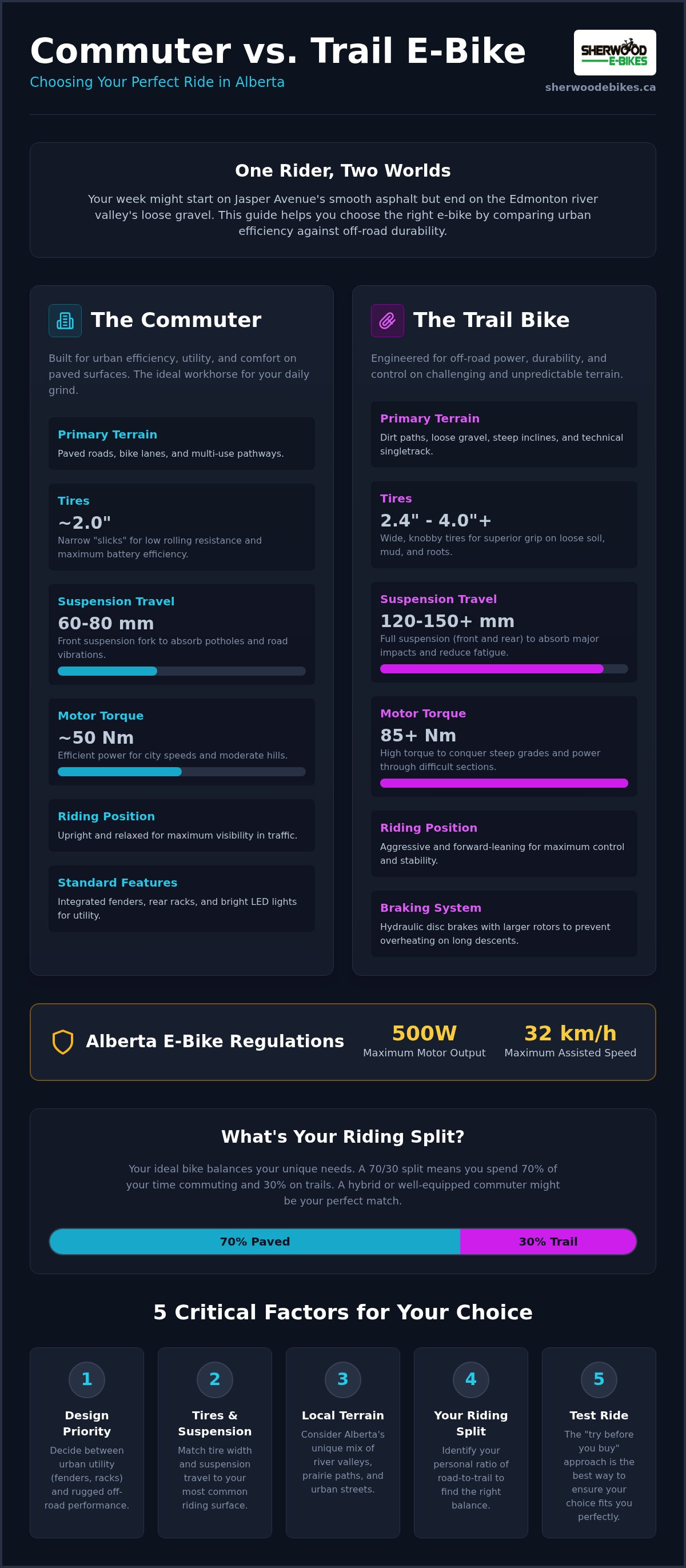
Choosing between a commuter vs trail e-bike depends on your primary environment. Alberta riders often face a mix of flat, windy suburban paths and technical, root-filled river valley sections. A commuter e-bike is built for efficiency on pavement. It prioritizes utility for the daily grind. Conversely, a trail e-bike is a high-performance machine featuring a reinforced frame and a torque-heavy motor designed to conquer steep inclines and absorb heavy impacts. By 2026, the lines between these categories have started to blur. Many modern designs now offer a hybrid experience, blending city speed with off-road ruggedness. Reviewing the history of electric bicycle technology shows how these specialized builds evolved to meet different needs.
The Commuter Profile: Efficiency and Utility
Commuter models serve as the workhorses of the urban environment. They prioritize visibility with an upright riding position. This setup allows you to monitor traffic and surroundings with ease. Most units include integrated accessories like fenders, rear racks, and bright LED lights. Efficiency remains the focus. Narrower tires reduce rolling resistance on asphalt, which helps you maintain speed while preserving battery life. Brands like Wolff and Aima excel in these streamlined designs for a smooth trip to the office.
The Trail Profile: Power and Durability
Trail e-bikes are engineered specifically for the dirt. The most significant difference is the suspension travel. This feature absorbs shocks from rocks and roots, significantly reducing rider fatigue during long sessions. These bikes utilize wider, knobby tires to provide essential grip on "mtb bike trails" where loose soil or mud would cause a street bike to slide. The frame geometry is more aggressive. It positions your weight for maximum control during steep descents. When you test ride a Rize or Envo trail model, you will notice the increased stability and responsive handling.
Performance Breakdown: Tires, Suspension, and Geometry
Understanding the technical specs of a commuter vs trail e-bike helps you avoid buying a machine that feels sluggish on the road or unstable on the dirt. Tires are the most visible difference. A commuter bike typically uses 2.0 inch city slicks. These tires minimize rolling resistance so you can maintain speed on paved paths with less battery drain. Trail bikes use 2.4 inch knobby tires or even 4.0 inch fat tires. These provide the necessary footprint to grip loose soil and gravel. When you're climbing a steep section of the Edmonton river valley, that extra traction is the difference between a smooth ascent and a frustrating spin-out.
Motor power also varies significantly between these styles. While most street models offer roughly 50Nm of torque, trail-focused units often push 85Nm or higher. This extra torque is vital for starting on steep grades or navigating through thick mud. However, all riders must stay within Alberta e-bike laws, which limit motor output to 500W and assisted speeds to 32 km/h. Handling is further influenced by battery placement. Mid-mounted batteries lower the centre of gravity. This makes the bike feel more balanced during tight turns. If you're unsure which setup feels right, visit our showroom to compare these specs in person.
Suspension: Comfort vs. Capability
Choosing the right suspension for a commuter vs trail e-bike depends on your most frequent route. Suspension "travel" refers to how much the fork or shock can compress, measured in millimetres. A commuter bike usually features 60mm to 80mm of front travel. This is plenty for Edmonton’s potholes and frost heaves. Trail bikes require 120mm to 150mm of travel, often with a full-suspension system to protect your back from hard impacts. Remember that more suspension adds weight. If you need to carry your bike up apartment stairs, a lighter front-suspension model might be the smarter choice. High-end air suspension also requires seasonal maintenance to stay plush.
Braking Systems: Stopping Power for Safety
Safety in Alberta’s unpredictable weather requires reliable brakes. Hydraulic disc brakes are superior to mechanical ones because they offer consistent stopping power in rain, snow, or mud. Trail bikes use larger rotors to dissipate the heat generated during long descents. This prevents "brake fade" when you need control the most. Keeping these systems crisp is essential for any rider. You can book professional e-bike maintenance to ensure your pads and rotors are ready for the season. A well-tuned brake system provides the confidence to explore new paths safely.
Navigating Alberta’s Terrain: River Valleys to Rural Roads
The Edmonton River Valley provides a unique challenge for those comparing a commuter vs trail e-bike. It is one of the largest urban park systems in North America, offering a mix of smooth asphalt and technical dirt paths. If your route stays on the paved multi-use trails, a commuter model is efficient and fast. However, Alberta’s geography often includes clay-heavy mud and loose gravel that can settle on even the most well-maintained paths. A trail-capable machine offers the stability needed to handle these shifting surfaces without losing traction.
Riding in Sherwood Park involves navigating wide multi-use pathways where wind resistance is a constant factor. A streamlined commuter bike helps you slice through the breeze, but the "Alberta Factor" means you must also prepare for sudden weather shifts. Before you head out, ensure you are familiar with the latest Alberta E-Bike Laws. Remember that Edmonton prohibits e-bikes on sidewalks, and violations can result in a $250 fine. Staying on designated paths is not just about etiquette; it is a legal requirement.
Edmonton’s MTB Bike Trails: What You Need
There is a massive difference between a flat paved path and "singletrack" dirt trails found in Terwillegar Park or Strathcona Science Park. Technical sections with exposed roots and steep grades require the reinforced frames and higher torque found in trail e-bikes. For riders who want a bike that handles the office commute during the week and technical trails on Saturday, we recommend versatile brands like Rize. These models provide the power needed for steep river valley climbs while remaining manageable on city streets.
The Winter Commute in Sherwood Park
Alberta winters demand specific hardware. Fat tire e-bikes currently account for 36% of Canadian listings because they excel in rutted snow and slush. Sub-zero temperatures can reduce battery range by 30% or more, so plan your distance accordingly. Use this checklist to winterize your ride:
- Store your battery indoors to maintain cell health and charging capacity.
- Clean salt and road grime daily to prevent corrosion on the drivetrain.
- Lower your tire pressure slightly to increase the contact patch on icy patches.
- Apply wet-weather lube to the chain to protect against moisture and road salt.
The Roundup: 5 Critical Factors for Choosing Your Match
Finalizing your decision on a commuter vs trail e-bike requires a realistic look at your lifestyle and future goals. You must be honest about where your tires will actually touch the ground. If your riding is 90% pavement, a commuter bike's efficiency will save you battery and effort during long trips. If you find yourself on dirt paths 50% of the time, the durability of a trail bike becomes a necessity rather than a luxury.
Comfort and agility represent a major trade-off in design. Commuter bikes often feel like a "couch on wheels" because they feature an upright geometry and plush saddles. This setup is perfect for long, steady rides on paved paths. Trail bikes are nimble machines. They require a more aggressive body position to help you navigate tight corners and technical obstacles. If you prioritize a relaxed posture, the commuter is your winner.
Cargo needs are frequently overlooked during the initial purchase. Commuter bikes usually include integrated racks and fenders from the factory. Many trail bikes are designed for pure performance and lack the mounting points for heavy panniers. If you plan to carry groceries or work gear, ensure your bike can handle the weight without compromising the suspension. Adding these accessories later can be difficult or impossible on certain frames.
Maintenance budgets also vary between these two categories. Trail bikes have more moving parts, such as complex suspension linkages and high-performance drivetrains, that require professional attention to prevent premature wear. Finally, think about future-proofing. Choose a bike that matches the skills you plan to develop over the next two seasons so you don't outgrow your investment too quickly. Balancing these five factors will lead you to the right choice between a commuter vs trail e-bike.
Factor 1: Your Daily Route
Climbing out of the river valley requires consistent power and high torque. If your commute involves steep grades, look for motors that can handle the incline without overheating. Integrated lighting is another essential for dark Alberta winters when the sun sets early. Brands like Envo offer urban reliability with features designed for these specific daily challenges.
Factor 2: Storage and Weight
Weight is a major hurdle for many riders. A full-sized trail e-bike can weigh up to 70lbs, making it difficult to lift onto a bus rack or into a truck bed without help. If you live in an apartment with limited space, consider folding commuter models that tuck away easily. Regardless of your choice, staying on top of professional e-bike maintenance ensures your investment stays reliable year-round. Book a rental today to see how different weights feel in your hands before you buy.
Test Riding Your Options at Sherwood E-Bikes Ltd.
While technical specs tell part of the story, the final decision on a commuter vs trail e-bike happens in the saddle. Sherwood E-Bikes Ltd. operates on a 'try before you buy' philosophy because comfort is subjective. You need to feel how the motor reacts when you start on a hill or how the frame geometry affects your visibility in traffic. Spend 15 minutes testing how the weight is distributed. A well-balanced bike makes a massive difference when you are weaving through urban obstacles or navigating a narrow path. Online shopping misses these nuances, which is why a physical test ride is the only way to ensure your investment fits your body and riding style.
The Rental-to-Owner Pathway
Renting is the most effective way to eliminate guesswork. Take a commuter model home for a weekend to test your actual driveway and storage space. The following week, take a trail model to see if you genuinely enjoy the extra capability on rougher ground. Sherwood E-Bikes Ltd. offers a diverse fleet for real-world testing. This process clarifies your needs far better than a quick spin in a parking lot when deciding on a commuter vs trail e-bike. Check our Best Bike Rentals guide to see which models are currently available for extended testing.
Expert Fitting and Customization
Proper fit prevents long-term strain on your wrists and back. The team at Sherwood E-Bikes Ltd. adjusts every touchpoint, from saddle height to handlebar reach, ensuring the bike matches your frame. If you want the ruggedness of a trail machine with the utility of a city bike, we can help you customize your ride. This 'SUV' approach allows you to add fenders and racks to a high-performance frame. You can book your consultation today to discuss these modifications. We focus on building a bike that handles the specific demands of your Alberta lifestyle while maintaining professional standards for every component we install.
Choose Your Path With Confidence
Deciding on a commuter vs trail e-bike comes down to where you want your journey to take you. You have seen how technical specs like suspension travel and motor torque dictate your comfort on Edmonton’s river valley paths or Sherwood Park’s paved pathways. By weighing your daily cargo needs against your desire for off-road agility, you can select a ride that handles our unique Alberta climate year-round. The right choice will not just get you to work; it will change how you experience the outdoors.
Sherwood E-Bikes Ltd. is proud to be a locally owned and operated specialist. As an authorized dealer for Rize, Envo, and Wolff, we offer a curated selection of machines built for our geography. Our full-service maintenance centre is on-site to keep your investment in peak condition regardless of the season. Book a test ride or rental in Sherwood Park today to see which model feels right for your next adventure. We look forward to helping you join the e-bike movement with a ride you truly love.
Frequently Asked Questions
Can I use a commuter e-bike on gravel "mtb bike trails" in Edmonton?
You can use a commuter e-bike on flat, well-maintained gravel paths like those found in the upper sections of the Edmonton river valley. However, these bikes aren't designed for technical "mtb bike trails" that feature large roots, loose rocks, or steep drops. Using a street-focused model on rugged terrain increases the risk of tire punctures and puts unnecessary stress on the frame and fork.
Are trail e-bikes much heavier than commuter models?
Trail models are generally heavier because they require reinforced frames and complex suspension systems to handle off-road impacts. While a streamlined commuter might weigh between 50 and 60 lbs, a rugged trail unit can often exceed 70 lbs. This extra weight provides essential stability during high-speed descents but makes it harder to lift the bike onto a vehicle rack or carry it up stairs.
Do I need a special licence to ride a trail e-bike in Alberta?
You don't need a licence, registration, or insurance to operate any e-bike in Alberta. Provincial law classifies them as "power bicycles" provided the motor is 500W or less and the power assistance cuts off at 32 km/h. All riders must be at least 12 years old and wear an approved bicycle helmet regardless of whether they are on a city street or a mountain trail.
Which e-bike motor is better for steep river valley hills?
A mid-drive motor is typically the best choice for steep river valley hills because it leverages the bike's existing gears for better climbing efficiency. When you compare a commuter vs trail e-bike, look for torque ratings. A motor with 80Nm of torque or higher will help you conquer the steepest inclines out of the valley without breaking a sweat or overheating the system.
Can I add a cargo rack to a full-suspension trail e-bike?
Adding a standard cargo rack to a full-suspension bike is difficult because the rear triangle moves as the shock compresses. You'll usually need a specialized rack that mounts directly to the seat post or a frame-specific accessory designed by the manufacturer. If your daily routine requires carrying heavy panniers, a hardtail trail bike or a dedicated commuter model is much more practical.
How often does a trail e-bike require professional maintenance compared to a commuter?
Trail bikes require more frequent professional maintenance because they're constantly exposed to dust, mud, and high-impact vibrations. You should have the suspension seals and pivot bearings inspected at least once per season to prevent premature wear. Commuter bikes are generally lower maintenance, but both styles need regular brake adjustments and drivetrain cleaning to stay reliable in Alberta's climate.
What is the best e-bike brand for a mix of city and trail riding in Canada?
Brands like Rize and Envo are top choices for Canadians who need a versatile machine for both city streets and weekend trails. These manufacturers build rugged frames that handle our diverse geography and shifting weather conditions. Choosing a brand with local parts availability ensures that your commuter vs trail e-bike stays on the road instead of waiting weeks for international shipping.
Is it worth renting an e-bike before I decide which style to buy?
Renting is highly recommended because it allows you to test a bike on your actual daily route or favourite local trail. A short ride around a parking lot won't reveal how a bike handles a 10 km commute or a steep river valley climb. We provide a rental fleet specifically so you can experience the motor engagement and geometry of different styles before committing to a purchase.


