

What if the biggest obstacle to your morning commute isn't the Groat Road hill or a January cold snap, but a handful of outdated myths? You've likely heard that electric batteries can't handle -30°C or that maintenance costs will drain your savings faster than a gas guzzler. It's natural to feel hesitant when you're looking for a reliable way to navigate the city's expanding 160 kilometre trail system. We're here to clear the air and help you move forward with confidence.
In this guide, we dismantle the five most common misconceptions about riding an edmonton ebike to help you realize the true value of electric mobility in Alberta. You'll learn how modern tech thrives in our climate, where you can legally ride under current 2026 regulations, and how to find local specialist support. We're previewing a future where your transit is affordable, efficient, and perfectly suited for our unique northern landscape.
Key Takeaways
- Learn how modern battery technology allows your edmonton ebike to perform reliably even in sub-zero Alberta temperatures.
- Discover why pedal-assist technology often leads to more frequent exercise and better fitness than traditional cycling.
- Explore how the city's 2026 infrastructure expansion creates safer, seamless connections for your daily commute.
- Compare maintenance schedules to see why modern electric motors are built for long-term reliability and easy servicing.
- Realize significant financial savings by comparing the total cost of ownership between an e-bike and a second family vehicle.
Myth 1: An Edmonton E-Bike is Only for the Summer Months
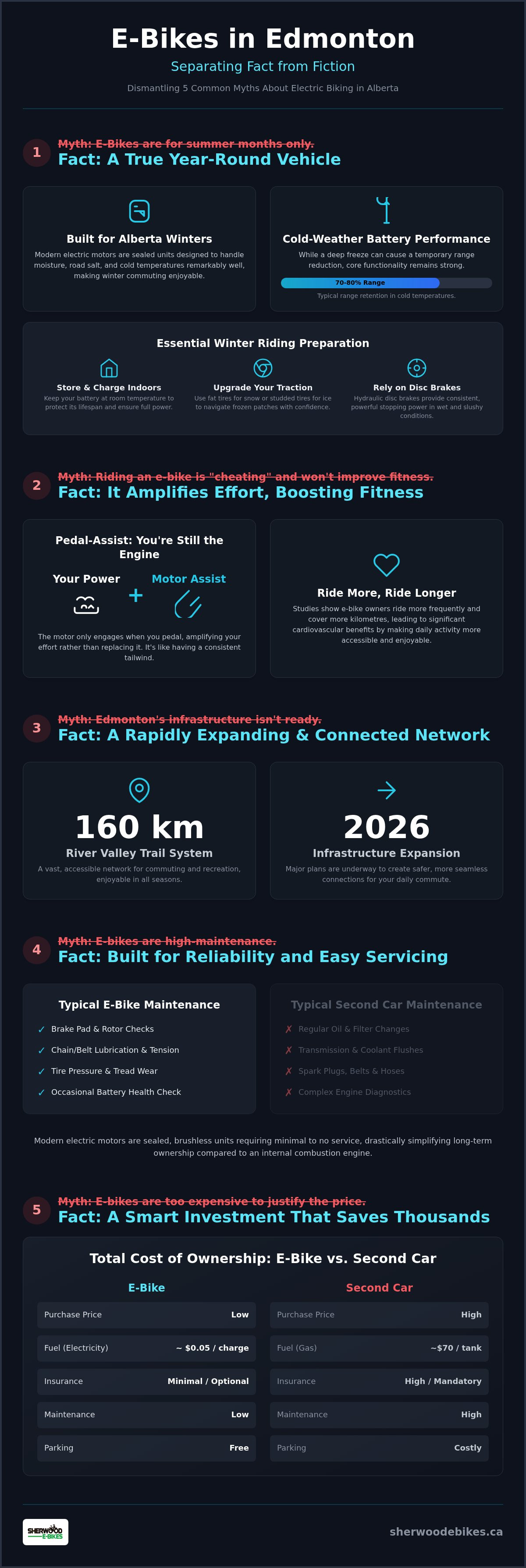
Many locals assume that once the first frost hits, their edmonton ebike belongs in the garage until April. This couldn't be further from the truth. Modern electric motors are sealed units designed to handle moisture, road salt, and cold temperatures remarkably well. In fact, many riders find winter commuting more enjoyable with electric assist. It allows you to maintain a steady pace through heavy snow without over-exerting yourself and sweating through your winter layers.
The electric bicycle has evolved into a legitimate year-round vehicle. While you might see a 20% to 30% reduction in battery range during a deep freeze, the core functionality remains intact. The key is understanding how to manage your hardware when the mercury drops below zero. With the right preparation, the city's 160 kilometre River Valley trail system becomes an accessible winter playground rather than a no-go zone.
Cold-Weather Battery Care in Alberta
Lithium-ion batteries are sensitive to temperature, but they aren't fragile. The golden rule for Alberta winters is simple: always store and charge your battery indoors. Cold cells don't accept a charge efficiently and can even suffer permanent damage if plugged in while frozen. If you're commuting to work, bring your battery inside your office. For more technical tips on preserving your cell's lifespan, check out our Alberta E-Bike Winter Storage Guide. Keeping your battery at a room-temperature baseline ensures you have full power when you head back out into the snow.
Traction and Safety on Edmonton Trails
Safe winter riding is all about the contact patch. Fat-tire models are popular in the Edmonton area because they float over packed snow and provide stability on uneven ruts. For those riding on cleared paths or icy side streets, studded tires are a game-changer. They provide the necessary grip to navigate frozen patches with confidence. We also recommend hydraulic disc brakes for consistent stopping power in slushy conditions. If you're planning a seasonal swap, look into e-bike tire replacement in Sherwood Park to ensure your treads are ready for the ice. A well-prepared bike makes the winter commute feel like a highlight of the day rather than a chore.
By winterizing your ride and protecting your electrical connections with specialized lubricants, you'll realize that the "off-season" is just another opportunity to ride. Don't let the snow stop your momentum.
Myth 2: Riding an E-Bike is "Cheating" and Won’t Improve Fitness
The idea that riding an edmonton ebike is "cheating" is a persistent but outdated myth. To understand why, you first need to distinguish between a throttle-based scooter and a pedal-assist bicycle. In a pedal-assist system, the motor only engages when you are actively turning the pedals. You remain the primary power source; the technology simply acts as a consistent tailwind that follows you everywhere. It amplifies your effort rather than replacing it entirely.
For many local professionals, the biggest barrier to cycling is the physical toll of the daily commute. Arriving at a downtown office covered in sweat isn't a viable option for most. An e-bike solves this by allowing you to manage your exertion levels with precision. You can stay in a low-intensity zone while climbing out of the River Valley, then switch to a lower assist level on the flats to get your heart rate up. It turns cycling from a grueling physical challenge into a practical, daily transit solution.
Scientific research supports this shift toward electric mobility. A study from the University of Colorado Boulder found that e-bike use provides meaningful exercise and cardiovascular benefits for riders. Because the perceived effort is lower, e-bike owners tend to ride more kilometres per week and more frequently than those on traditional bikes. You aren't doing less work; you're simply doing it over longer distances and more often.
Customizing Your Workout with Power Modes
Modern bikes from brands like Envo feature sophisticated controllers with multiple power modes. These settings allow you to treat your ride as an active recovery session or a high-intensity interval workout. You aren't stuck with one level of difficulty. On days when you feel energetic, you can turn the assist off. When you're facing a stiff headwind on the High Level Bridge, you can bump the power up to stay on schedule without overexertion.
Inclusivity in the Edmonton Cycling Community
Electric bikes act as the ultimate equalizer for local families. They allow riders of different ages and fitness levels to stay together on the trails. This is especially impactful for seniors in Sherwood Park who want to remain active without risking joint strain. The technology ensures that age or physical limitations don't end your cycling career. If you want to see how these bikes change your activity data, consider trying our e-bike rentals for a few days. You'll quickly see that the only thing you're "cheating" is the sedentary lifestyle of a car commute.
You can explore our latest commuter models to find a balance of power and performance that fits your specific fitness goals.
Myth 3: Edmonton’s Infrastructure Isn’t Ready for E-Bikes
It is a common misconception that our city streets are designed only for cars. In reality, the City of Edmonton is in the middle of a massive transformation. Between 2023 and 2026, the city committed $100 million to expanding the active transportation network. By the end of 2026, an additional 33 kilometres of new, protected bike lanes and connections will be operational. This investment makes owning an edmonton ebike more practical than ever before. You aren't just riding on the shoulder of a busy road; you're utilizing a dedicated, growing network designed for safety and speed.
The true strength of electric mobility lies in solving the "last mile" problem. Even with our expanding LRT lines, many commuters still face a long walk from the station to their final destination. An e-bike bridges this gap effortlessly. You can cover those final few kilometres in minutes, regardless of the terrain. Safety has also improved with the technology. Modern e-bikes come equipped with integrated LED lighting and electronic horns that are far more visible and audible than traditional acoustic bike accessories. When you arrive downtown, you'll find an increasing number of secure bike lockers and monitored parking areas, allowing you to realize better security for your investment.
Navigating the River Valley and Commuter Routes
Commuting from Sherwood Park to the downtown core is now a seamless experience. Dedicated pathways allow you to bypass heavy traffic on the 101 Avenue or Wye Road corridors. While the steep grades of the High Level Bridge or the Victoria Park hill might intimidate a traditional cyclist, the motor on your e-bike flattens these obstacles. Legally, e-bikes are classified as "power bicycles" in Alberta. This means you can enjoy the 160 kilometres of linked pathways in the River Valley as long as your motor is 500W or less and your assisted speed tops out at 32 km/h. Just remember that riding on sidewalks is prohibited in Edmonton and can result in a $250 fine.
The Utility of Cargo E-Bikes in Urban Centres
For residents in neighbourhoods like Strathcona or Oliver, e-bikes are replacing the need for a second car. High-capacity Rize e-bikes are specifically designed to handle heavy loads, making them perfect for grocery runs or hauling gear for a weekend at the park. You can cruise past gridlocked traffic during peak hours, saving time and avoiding the frustration of searching for parking. The agility of these modern machines ensures you remain a part of the city's flow without the high costs and environmental impact of a traditional vehicle.
Myth 4: E-Bikes are High-Maintenance and Hard to Repair
Many potential riders hesitate because they fear that an edmonton ebike is a fragile piece of technology. They worry that a single electrical glitch will turn their investment into an expensive paperweight. This myth persists because people confuse complexity with fragility. In reality, the maintenance schedule for an electric bike is nearly identical to that of a traditional acoustic bicycle. You still need to keep your tires inflated, your chain lubricated, and your brakes adjusted. The electrical components are largely "set and forget" systems designed to last for years without intervention.
By 2026, the reliability of mid-drive and hub motors has reached an industry peak. These units are sealed against the elements, protecting them from the dust of the River Valley and the salt of winter roads. Unlike a car, there are no oil changes or spark plugs to worry about. Most electrical issues are solved through simple firmware updates or sensor adjustments. This is where the advantage of local support becomes clear. While direct-to-consumer or "big box" bikes might save you money upfront, they often lack a local service path when you need a specialized fix.
Modern shops now use proprietary diagnostic software to communicate directly with your bike's controller. This allows technicians to realize quick fixes for electrical issues by identifying the exact sensor or connection that needs attention. Instead of guessing, we use data to get you back on the road faster. This specialized approach ensures your motor and battery perform at peak efficiency throughout their lifespan.
Professional Service vs. DIY Maintenance
You can handle most basic upkeep at home with a few simple tools. Keeping your chain clean and checking your tire pressure weekly will prevent the majority of common mechanical problems. However, the electrical system requires a different approach. When your motor needs a health check or a software update, it's time to visit our service centre. We have access to the specialized tools and genuine e-bike parts required to maintain your warranty and ensure long-term performance. Using generic components on a high-torque system can lead to premature wear or safety risks.
The Longevity of Modern E-Bike Components
A high-quality lithium-ion battery is built to last between 500 and 1,000 full charge cycles. For the average Edmonton commuter, this translates to five or more years of daily use before you notice any significant capacity drop. Brands like Wolff prioritize durability by using reinforced frames and premium bearings that stand up to heavy daily use. To keep your ride in peak condition, follow our commuter e-bike maintenance guide for a seasonal checklist that covers everything from battery storage to brake pad thickness.
Ready to ensure your ride stays reliable? Book a professional tune-up at our specialized service department today.
Myth 5: E-Bikes are Too Expensive to Justify the Price
At first glance, the price tag of a premium edmonton ebike can cause a bit of sticker shock. However, viewing this strictly as a "bicycle" price rather than a "vehicle" price is where the logic fails. When you compare the total cost of ownership to a second car or even a daily commute on public transit, the value becomes clear. In a city where parking and fuel costs continue to rise, electric mobility offers a practical way to reclaim your monthly budget. You aren't just buying a toy; you're investing in a high-efficiency transit solution.
Consider the hidden expenses of car ownership in Alberta. Between registration, insurance, and the ever-fluctuating price at the pump, a second vehicle can cost thousands of dollars annually just to keep on the driveway. An e-bike eliminates these hurdles. Charging a battery costs pennies, and you can bypass the high daily parking fees found in the downtown core. For many local families, replacing one vehicle with an e-bike provides the same mobility at a fraction of the long-term cost.
Resale value is another factor to consider. Unlike budget bikes from big-box retailers, premium brands maintain a strong value on the secondary market in Alberta. If you decide to upgrade your model in a few years, you'll find a robust community of buyers looking for well-maintained, name-brand electric bikes. Financing options also make the transition easier, allowing you to realize the benefits of a new ride for a monthly cost that often rivals a standard transit pass.
The Real ROI of an Edmonton E-Bike
The return on investment extends beyond your bank account. While annual maintenance for a vehicle often runs into the thousands, a comprehensive e-bike service is much more manageable. Active commuting also contributes to long-term health, which can reduce medical expenses and improve daily productivity. For those looking to enter the market without a massive upfront commitment, brands like Aima or Letrigo offer reliable, budget-friendly entry points. These models provide the same core benefits of electric assist while keeping your initial investment accessible.
Try Before You Buy: The Rental Advantage
We realize that committing to a new mode of transportation is a big decision. That's why we encourage a "test-drive" period. Renting an e-bike for a weekend allows you to test your actual commute from Sherwood Park or south Edmonton without any long-term pressure. You can see exactly how much time you save and how the bike handles your specific route. Many of our customers discover that the bike pays for itself in gas savings alone within the first year. Even better, you can often apply your rental fees toward the final purchase of a new model. Book your test ride or rental through our online portal to see the value for yourself.
Take the Next Step Toward Modern Mobility
Moving through the city shouldn't be a source of stress or high monthly expenses. By dismantling these common myths, it's clear that an edmonton ebike is a high-performance utility vehicle perfectly suited for Alberta's unique climate and topography. Whether you're navigating the 160 kilometres of River Valley trails or commuting through the newly expanded bike lanes of 2026, electric mobility offers a reliable, year-round solution.
At Sherwood E-Bikes, we combine local expertise with specialized support to ensure your transition is seamless. As an authorized dealer for premium brands like Envo, Rize, and Wolff, we offer more than just a showroom. Our full-service maintenance and parts department is here to keep your ride in peak condition for years to come. We are proud to serve the Edmonton and Sherwood Park communities with professional advice and curated selections.
Stop letting outdated misconceptions hold you back from a better way of moving. It's time to experience the efficiency and progress of electric transit firsthand. Book a test ride or service appointment today and discover why electric is the smartest way to move.
Frequently Asked Questions
Are e-bikes legal on Edmonton bike paths?
Yes, e-bikes are legal on multi-use pathways and bike lanes across the city. To qualify as a power bicycle in Alberta, your ride must have a motor of 500W or less and a top assisted speed of 32 km/h. Remember that riding on sidewalks is prohibited in Edmonton. Violating this bylaw can result in a $250 fine, so stick to the 160 kilometres of linked trails in the River Valley.
How long does an e-bike battery last in an Alberta winter?
You should expect a 20% to 30% reduction in range during the coldest months. Cold temperatures slow down the chemical reactions inside lithium-ion cells, but they don't stop the bike from functioning. Always store and charge your battery indoors at room temperature to maintain its health. This practice ensures your edmonton ebike remains a reliable transit tool even when the mercury drops below -20°C.
Do I need a special license to ride an e-bike in Edmonton?
You do not need a driver's license, insurance, or vehicle registration to operate a legal e-bike in Alberta. The province classifies these as power bicycles rather than motor vehicles. However, riders must be at least 12 years old to operate one. It is also mandatory for all riders to wear a helmet regardless of their age or the specific path they are using.
Can I ride my e-bike in the rain or snow?
Yes, you can ride in wet or snowy conditions without damaging the electrical system. Manufacturers design motors and battery casings to be water-resistant. We recommend installing full-coverage fenders to keep slush away from the electronics. Regular maintenance is also important during winter. Wiping down the frame and lubricating the chain will prevent road salt from causing premature wear on your components.
How much does it cost to charge an e-bike in Edmonton?
Charging a battery is incredibly affordable and typically costs between $10 and $30 per year for typical use. Most users find that a full charge adds only a few cents to their monthly utility bill. This efficiency makes an edmonton ebike one of the most cost-effective ways to commute. It provides a significant financial advantage over the rising costs of fuel, parking, and transit passes.
What is the difference between a mid-drive and a hub-drive motor?
Mid-drive motors are located at the pedals and use the bike's chain and gears to provide torque. This design is highly efficient for climbing steep River Valley hills. Hub-drive motors are built directly into the centre of the wheel. They offer a simpler mechanical experience and are often more budget-friendly for riders who primarily stick to flatter urban commuter routes or paved city pathways.
Where can I get my e-bike serviced in Sherwood Park?
Sherwood E-Bikes offers a dedicated service department for specialized maintenance and repairs. We provide on-site diagnostics and carry a wide inventory of parts for brands like Envo, Rize, and Wolff. Our technicians understand the specific needs of electric systems. We help local riders keep their equipment in peak condition through every season, from summer trail riding to winter commuting.
Which e-bike brands are best for Edmonton hills?
Brands like Envo and Rize are popular choices for navigating the city's varied terrain. Envo's mid-drive systems are particularly effective for the steep grades found on the High Level Bridge or Groat Road. Rize models often feature high-torque motors that provide the necessary power for hauling cargo or climbing out of the River Valley. Choosing the right motor ensures you can maintain a steady pace on any incline.


