
What if the most expensive way to enjoy an Alberta summer is actually the "cheap" rental option? Many local riders feel hesitant about the upfront cost of a new machine, especially when considering our harsh winters and the need for climate-controlled storage. You're likely weighing the pros and cons of renting vs buying an e-bike as you look at the expanding trail systems in your neighbourhood and across Edmonton in 2026. It's a significant choice, and the fear of picking a model that doesn't fit your daily commute or lifestyle is completely valid.
We've created this guide to give you the ultimate financial and practical breakdown so you can stop guessing and start riding. You will discover the specific break-even point where ownership becomes cheaper than renting, along with the honest truth about maintenance and battery care. We'll also look at how current provincial regulations and the rise of micromobility fleets impact your decision. You'll finish this article with total confidence in which path best suits your specific needs.
Key Takeaways
- Determine your personal break-even point by auditing your weekly kilometres to identify when ownership becomes more cost-effective than frequent rentals.
- Evaluate the long-term financial impact of renting vs buying an e-bike by comparing upfront purchase prices with ongoing maintenance and rental fees.
- Understand the "Alberta Winter Factor" and why temperature-controlled storage is essential for maintaining battery health and resale value in our climate.
- Follow a 5-step framework to assess your storage capacity and commute habits before choosing between a specialized rental fleet or private ownership.
- Learn how to use local rental services as the ultimate test drive to ensure your chosen model handles Sherwood Park and Edmonton trail systems perfectly.
Exploring Urban Mobility: The Rise of E-Bikes in Sherwood Park
Commuting in the Edmonton Metropolitan Region is undergoing a fundamental shift. For decades, the car was the undisputed king of the commute, but rising ownership costs and increasing traffic congestion have forced a rethink. By 2026, the electric bicycle has moved from a niche hobby to a primary mode of transportation for thousands of Albertans. This transition marks a psychological turning point where riders no longer view these machines as high-tech toys, but as reliable vehicles capable of replacing a second car.
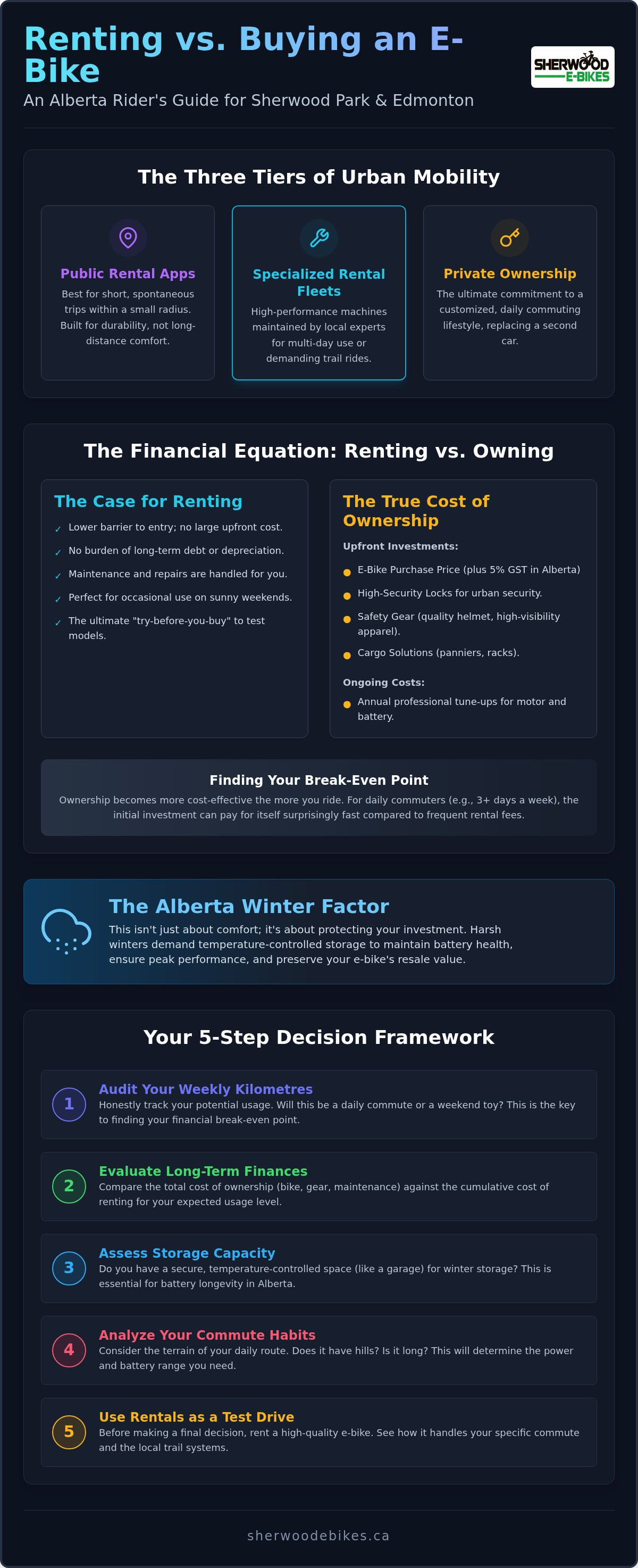
The market reflects this change clearly. The Canadian e-bike industry is projected to reach a value of USD 1.32 billion in 2026, driven by a 12.62% compound annual growth rate. In Sherwood Park, this growth is visible on every trail and parkway. As more residents look to reduce their carbon footprint and save on fuel, the conversation naturally turns to the best way to get started. Navigating the choice of renting vs buying an e-bike requires understanding the three distinct tiers of modern urban mobility:
- Public Bike Rental Apps: Best for short, spontaneous trips within a small radius.
- Specialized Rental Fleets: High-performance machines maintained by local experts for multi-day use.
- Private Ownership: The ultimate commitment to a customized, daily commuting lifestyle.
The Public Bike Rental Experience vs. Specialized Fleets
Public share programs and app-based scooters have their place, but they often fall short for the typical Sherwood Park resident. These generic units are built for durability and short bursts, not for the comfort required on a 15-kilometre trek into Edmonton. They often lack the power needed to tackle local inclines with ease. In contrast, a specialized rental fleet at Sherwood E-Bikes Ltd. provides access to professionally tuned, high-performance e-bikes. These machines offer superior battery range and ergonomic designs that make long-distance travel feasible. When you choose a local specialist for your ride, you're getting a vehicle that's been inspected by a technician who understands our specific trail conditions.
The "Try-Before-You-Buy" Movement
Renting has become the ultimate risk-free introduction to modern cycling technology. Many riders use a weekend rental as a practical trial run for their actual daily route. It's the best way to see if you can arrive at your destination without needing a shower or a change of clothes. Before you head out, it's helpful to review the e-bike rental requirements in Sherwood Park to ensure you're prepared for the road. This "try-before-you-buy" approach allows you to test different motor types and frame styles before making a significant financial commitment. It removes the guesswork and ensures that if you do eventually decide to purchase, you're choosing a model that fits your lifestyle perfectly.
The Financial Equation: Comparing Purchase Price vs. Rental Fees
Deciding between renting vs buying an e-bike often comes down to a simple spreadsheet calculation. While the initial capital for ownership is higher, the long-term value depends entirely on your frequency of use. If you plan to replace your car commute three days a week, the investment pays for itself much faster than you might realize. Conversely, if you only want to explore the Strathcona County trails on sunny long weekends, the rental model offers a lower barrier to entry without the burden of long-term debt or depreciation.
The True Cost of Ownership in Canada
Purchasing a high-quality machine from reliable brands like Envo or Rize ensures you have a vehicle built for northern conditions. Beyond the bike itself, owners must budget for essential gear to ensure a safe and practical experience:
- High-Security Locks: A non-negotiable expense for urban stops or office commutes.
- Safety Equipment: Quality helmets and high-visibility apparel for road safety.
- Cargo Solutions: Waterproof panniers or racks for grocery runs and daily essentials.
Don't forget to account for the 5% GST applicable on all e-bike purchases in Alberta. Owners should generally set aside a small annual budget for professional tune-ups to keep the motor and battery systems running at peak efficiency. These recurring costs are part of the trade-off for having a personalized ride available at your doorstep 24/7.
Rental Pricing and Flexibility
Renting provides a predictable expense structure that appeals to those who want a premium experience without a four-figure commitment. Most rental agreements provide peace of mind by including basic maintenance and the ability to swap models if your needs change. This flexibility is perfect for the "Weekend Warrior" who wants to enjoy the outdoors without worrying about secure storage or complex electrical repairs. It's an excellent way to test different frame styles before deciding if a permanent purchase fits your financial goals.
The "Daily Commuter" usually finds that ownership is the clear winner. When you calculate the cost per kilometre over a full riding season, owning your ride becomes significantly more affordable than paying daily fees. For many Albertans, the break-even point occurs when you commit to riding at least twice a week throughout the spring, summer, and autumn months. If your usage falls below that threshold, weighing the merits of renting vs buying an e-bike often reveals that a specialized rental fleet is the most logical choice.
Maintenance, Storage, and the Alberta Winter Factor
Alberta's climate dictates the rhythm of your riding season. While summer on the Strathcona County trails is pure joy, our six-month winters pose a serious threat to electrical components. This environmental reality is a major consideration when weighing renting vs buying an e-bike. For many, the choice isn't just about the ride; it's about what happens when the mercury drops below zero and the snow begins to pile up in the driveway.
Winterizing Your Investment
Lithium-ion batteries are the most expensive component of your ride. They are also highly sensitive to extreme cold. Leaving your battery in an unheated garage during a -35°C Edmonton cold snap can lead to permanent capacity loss. Owners must provide a temperature-controlled indoor space for storage and maintain a specific charge level, usually between 40% and 60%, during long periods of inactivity. Many locals find this logistical requirement a burden. Choosing a rental fleet allows you to enjoy the peak riding months and simply return the bike before the first snowfall. You eliminate the storage headache and the risk of battery degradation entirely. If you do own, staying on top of commuter e-bike maintenance is the only way to preserve your investment's resale value over time.
Maintenance: DIY vs. Professional Service
Ownership involves a level of mechanical responsibility that some riders find rewarding and others find tedious. You'll need to realize basic tasks like chain lubrication, monitoring tire pressure, and checking for loose bolts after bumpy trail rides. However, the electrical side is more complex. Accessing professional e-bike service is necessary for motor diagnostics and firmware updates that keep the system efficient. Renters bypass these chores. When you rent, you don't have to source specialized e-bike parts or worry about mechanical failures. The shop ensures the bike is in top condition every time you pick it up. This makes renting vs buying an e-bike a choice between total control and total convenience. If you prefer to spend your time riding rather than tinkering, the rental path offers a significant advantage in the Alberta context.
How to Decide: A 5-Step Framework for Choosing Your Ride
Choosing between renting vs buying an e-bike doesn't have to be a guessing game. By following a structured approach, you can align your decision with your actual daily habits rather than your aspirations. Use this 5-step framework to determine which path fits your Alberta lifestyle in 2026.
- Step 1: Audit your expected usage. Track your intended trips for one week. If you plan to ride more than 40 kilometres a week, the financial benefits of ownership start to outweigh the daily rental fees.
- Step 2: Evaluate your storage situation. Consider where the bike will live. A ground-floor garage with a power outlet is ideal for owners. Apartment dwellers may find the weight of a private e-bike difficult to manage, making a rental fleet more attractive.
- Step 3: Determine your mechanical comfort level. Be honest about your desire to perform basic maintenance. If you prefer to leave technical checks to the experts, renting ensures you always have a professionally tuned machine.
- Step 4: Analyze your long-term commitment. Ask yourself if you'll still be riding in two years. If you're new to the lifestyle, a rental period allows you to test your dedication without a large upfront investment.
- Step 5: Execute a trial month. Use a rental service for thirty days to see how an e-bike actually fits into your routine. This is the only way to realize if the model you like is the model you need.
Analyzing Your Commute
The terrain of your daily route plays a massive role in the renting vs buying an e-bike debate. If your commute through Sherwood Park involves gravel paths or steep inclines, you'll need a machine with a high-torque motor. In 2026, the 501-600 watt band of e-bikes is growing in popularity because it handles these conditions with ease. Testing your route helps you calculate the "sweat factor" to ensure you arrive at work looking professional. You can explore e-bike rental Edmonton spots to find the best trails for a practical trial run.
The Tech Obsolescence Trap
E-bike technology is evolving rapidly in 2026. Batteries are becoming lighter and motors are getting quieter every season. Renting allows you to always ride the latest models without worrying about the depreciation of older tech. However, buying makes sense if you have specific ergonomic needs. Owners can customize their ride with specialized saddles, adjustable stems, or specific handlebar grips that a rental fleet might not offer. If you're ready to commit to a personalized setup, start with a rental to find your perfect frame size before making the final purchase.
Why a Local Specialist is Your Best Resource for Rentals and Sales
While previous sections detailed the financial logic and storage requirements of renting vs buying an e-bike, the final factor in your decision is the support system behind your ride. Online retailers and big-box stores often lack the specialized knowledge required for our unique regional conditions. A local specialist understands the specific demands of the Strathcona County trail system and the nuances of the Edmonton commute. Having a physical location to visit provides a level of security that a digital checkout screen simply can't match.
Sherwood E-Bikes Ltd. bridges the gap between these two worlds by offering a premium rental fleet alongside a curated retail selection. This hybrid approach ensures you don't have to guess which motor or frame style fits your daily routine. By choosing a local centre, you're supporting the regional economy while securing a reliable long-term service partner. You gain a team committed to your success on the road, providing a stable point of contact for all your future cycling needs.
Expert Guidance and Test Rides
A fifteen-minute test ride at our showroom offers more clarity than hours of scrolling through online reviews. You can feel the immediate torque and handling characteristics of different models in person. Our specialists help match your height, weight, and intended use to specific frames from quality brands like Wolff or Aima. This personalized fitting ensures you don't end up with a bike that feels uncomfortable after the first five kilometres.
We also encourage the "try-before-you-buy" strategy to help you realize the best path forward. If you're still undecided on renting vs buying an e-bike, ask about our rental credit concept during your visit. Applying a portion of your rental fees toward an eventual purchase is a popular way for residents to transition into ownership with total confidence in their long-term investment.
Community and Long-Term Support
Renting or buying locally connects you to the growing Sherwood Park cycling community. You gain the peace of mind that comes with a local warranty and a repair shop that specializes in complex electrical systems. You won't have to worry about the logistics of shipping a heavy bike for a simple firmware update or motor diagnostic. We handle the technical details so you can focus on the ride. Take the next step toward a more efficient lifestyle by visiting our showroom or booking your rental online today.
Choose the Path That Fits Your Journey
Deciding between renting vs buying an e-bike ultimately depends on your commitment to the lifestyle and your ability to manage Alberta's seasonal challenges. For the daily commuter, ownership offers the best long-term value and personal customization. For those still testing their routes or lacking heated storage, a specialized rental fleet provides a modern, maintenance-free alternative. You now have the tools to evaluate your kilometres, storage capacity, and mechanical comfort to make an informed choice.
Sherwood E-Bikes Ltd. is a locally owned and operated specialist in Sherwood Park. Our expert technicians handle all electrical diagnostics on-site, and we are an authorized dealer for leading brands like Envo, Rize, and Wolff. Explore our rental fleet and find your perfect ride today!
The future of urban transit is here, and we are ready to help you navigate it with confidence. Visit us at the showroom to see how a shift toward electric mobility can transform your daily experience on the road.
Frequently Asked Questions
Is it cheaper to rent or buy an e-bike if I only ride 10 times a year?
Renting is significantly more cost-effective for someone riding only ten times a year. The upfront purchase price, combined with the cost of annual tune-ups and climate-controlled storage, far exceeds the expense of ten daily rental fees. You also avoid the long-term depreciation of the battery and motor. This makes the choice between renting vs buying an e-bike easy for occasional recreational users who want to avoid the responsibilities of ownership.
How much does a decent commuter e-bike cost to buy in Canada?
In 2026, a reliable commuter e-bike in Canada typically starts at approximately $1,199 for entry-level models. High-quality mid-range options often fall between $2,000 and $4,000; while premium specialized models can exceed $6,000. It is important to factor in the 5% GST in Alberta along with the cost of essential safety accessories like a helmet and a high-security lock to protect your investment.
What happens to the battery if I store my e-bike in an unheated garage during an Alberta winter?
Storing a lithium-ion battery in an unheated Alberta garage during sub-zero temperatures can cause permanent, irreversible damage to its capacity. Extreme cold prevents the chemical reactions needed to hold a charge, which often leads to a dead battery by the time spring arrives. Owners must remove the battery and store it in a temperature-controlled room at a charge level of 40% to 60% to ensure it survives the winter months.
Do I need special insurance if I buy my own electric bicycle?
No driver's license, registration, or specific provincial insurance is required for compliant e-bikes in Alberta. As long as the motor is 500W or less and cuts off at 32 km/h, it is legally treated as a standard bicycle. However, you should check with your home insurance provider to see if your private e-bike is covered for theft or damage while it is stored on your property.
Can I rent an e-bike in Sherwood Park to see if I can handle the commute to Edmonton?
Yes, you can rent a high-performance model in Sherwood Park to test your actual route to Edmonton before making a commitment. This is the most practical way to evaluate the "sweat factor" and see how long the trip takes during peak traffic hours. Using a specialized rental fleet for this trial run helps you decide between renting vs buying an e-bike based on real-world experience rather than guesswork.
What is the typical lifespan of an e-bike battery for an owner?
A well-maintained e-bike battery typically lasts between three and five years, or roughly 500 to 1,000 full charge cycles. After this point, you will likely notice a drop in range, even if the battery still functions. You can maximize this lifespan by avoiding extreme temperatures and keeping the battery charge between 20% and 80% during regular use throughout the riding season.
Are maintenance costs included in e-bike rental fees?
Yes, routine maintenance and electrical diagnostics are typically included in your rental fee. You won't have to pay for basic tune-ups, tire repairs, or firmware updates that owners must manage and fund themselves. This makes the rental model very attractive for those who want a predictable budget without the risk of unexpected mechanical or electrical repair bills.
Can I customize a rental e-bike with my own panniers or accessories?
Most rental e-bikes come equipped with standard rear racks that accommodate common panniers and bags. You can usually add your own non-permanent accessories like a phone mount or a water bottle cage, but it is best to check with the staff first. Just ensure you remove all your personal gear before returning the bike to the rental centre at the end of your term.


