

The best alternative to buying a Rad Power bike in Canada is an e-bike that suits your riding, not simply one with a similar look. Compare commuter, cargo, folding, fat-tire and moped-style options by range, payload, components, weight and fit. Each type serves a different purpose, from carrying family gear to handling mixed surfaces or daily urban trips.
It makes sense to compare your options before choosing: motor assistance is only one part of how a bike feels and performs. Frame fit, practical payload and components suited to your routes matter just as much. The right choice depends on where you ride and what you need to carry.
This guide compares options from AIMA, ENVO, Wolff and Letrigo, along with other e-bike styles, using the specifications that shape everyday use. See how range, carrying capacity, weight and equipment affect the fit for commuting, cargo trips and off-road rides, then use a simple decision guide to narrow your shortlist.
Key Takeaways
- Match the bike style to your main use, whether that’s commuting, carrying cargo, folding for storage or riding on rougher surfaces.
- Compare range, payload, weight and components together; a strong fit depends on how these features work for your routes and gear.
- Learn which trade-offs come with wider tires and heavier frames before choosing a bike for daily travel or off-road rides.
- Use terrain, riding habits and support needs to narrow the options that make sense for you.
- See how Sherwood E-Bikes Ltd.’s commuter models, parts, accessories and maintenance can support your next step.
Cargo, folding, commuter, fat-tire, and moped-style options
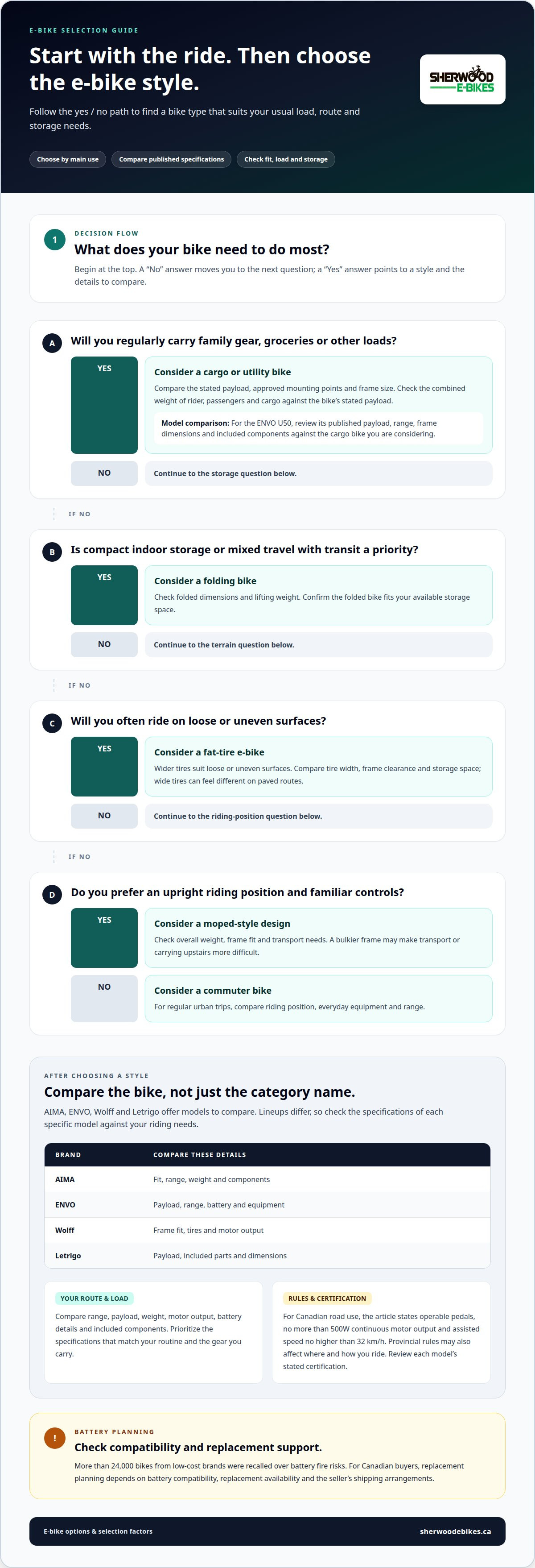
Different frame styles solve different problems. A cargo bike prioritizes carrying capacity, while a folding frame reduces storage space. A commuter model suits regular urban trips, and a fat-tire e-bike adds wider tires for loose or uneven surfaces. Moped-style designs often favour an upright position and familiar controls, but frame weight and storage still matter.
Start with what the bike needs to carry. Cargo and utility bikes can be set up for bags, groceries, child seats, or other loads, but accessories and approved mounting points vary by model. Compare the bike’s stated payload with the combined weight of the rider, passengers, and cargo. For an ENVO U50 cargo-bike comparison, focus on its published payload, range, frame dimensions, and included components against the cargo model you’re considering. Don’t assume that similar-looking frames carry the same load.
Folding bikes suit riders with limited indoor storage or a mixed commute involving transit. Check folded dimensions and lifting weight, then make sure the folded bike fits your storage space. A commuter bike usually prioritizes a practical riding position and everyday equipment. Fat-tire models handle more uneven surfaces, but wide tires can feel different on paved routes and need suitable storage clearance. Moped-style bikes can feel stable and accessible, yet their bulk may complicate transport or carrying upstairs.
Battery planning matters too. More than 24,000 bikes from low-cost brands were recalled over battery fire risks, so battery safety deserves attention. For Canadian buyers, shipping and replacement planning depend on battery compatibility, replacement availability, and the seller’s shipping arrangements.
| Option | Best fit | Compare before choosing |
|---|---|---|
| Cargo or utility | Family trips and loads | Payload, mounting points, frame size |
| Folding | Compact storage and mixed travel | Folded dimensions, lifting weight |
| Commuter | Regular urban riding | Position, equipment, range |
| Fat tire | Loose or uneven surfaces | Tire width, clearance, storage |
| Moped-style | Upright riding position | Overall weight, fit, transport |
| ENVO U50 cargo | Cargo-bike comparison | Published payload, range, components |
Choose by matching your usual route and load to the bike’s fit, capacity and storage demands.
Model-by-model alternatives and Canadian prices
Compare models by intended riding style, equipment and fit. AIMA, ENVO, Wolff and Letrigo are Canadian-market brands to consider. Their lineups serve different needs, so compare individual model specifications rather than assuming similar category names mean similar performance. A commuter frame, cargo setup and fat-tire design each bring different features to a shortlist.
For local riders, e-bike retailers serving Sherwood Park, Edmonton, Leduc, Camrose, Fort Saskatchewan, Ardrossan, St Albert, Vegriville, Morinville, Wetaskiwin, and Spruce Grove are relevant places to compare options. Retailers may carry different brands and model types. Local storefronts can help with frame-fit discussions, while online listings offer another way to review published specifications. Compare the exact model, not only its brand.
For Canadian road use, the stated target is operable pedals, no more than 500W continuous motor output, and assisted speed no higher than 32 km/h. Provincial rules may also affect where and how an e-bike can be ridden. Consider the rules that apply locally alongside the specifications for each model.
Build a comparison around range, payload, weight, motor output, battery details and included components. Then match those details to your routine. A utility bike’s payload matters for carrying bags, while frame fit and everyday equipment may matter more for commuting. Apply the same criteria to AIMA, ENVO, Wolff and Letrigo models to make their differences clearer.
| Brand or model family | Compare for | Useful specification checks |
|---|---|---|
| AIMA | Commuting and general riding | Fit, range, weight, components |
| ENVO | Commuting and utility use | Payload, range, battery, equipment |
| Wolff | Different riding styles | Frame fit, tires, motor output |
| Letrigo | Model-specific comparison | Payload, included parts, dimensions |
Certification information can help distinguish models. Review each e-bike’s stated certification alongside its motor and speed specifications. For example, compare the AIMA model details with another bike’s published equipment and fit, rather than relying on brand recognition. The AIMA electric bike details provide one reference point for that model-by-model comparison.
Keep your shortlist focused on intended use and documented features. A rider commuting between Sherwood Park and Edmonton may prioritize fit and everyday equipment, while someone carrying gear around Leduc or Camrose may focus on payload. Riders in Fort Saskatchewan, Ardrossan, St Albert, Vegriville, Morinville, Wetaskiwin and Spruce Grove can use the same criteria to compare models against their own routes and riding needs.
Price can help narrow a shortlist, but compare the same kind of purchase and check what is included. These figures provide a broad reference for comparing complete bikes; individual models may differ in equipment, fit and intended use. Consider whether the listed components suit your routine before treating a lower price as a better match.
A conversion kit is a separate option from buying a complete e-bike. Compare its cost with the requirements of your existing bike and the features of complete models, rather than assuming the kit offers the same setup. Keep the budget comparison tied to documented specifications, including battery details, motor output and included components, so price supports the model-by-model assessment rather than replacing it.
Product trade-offs such as weight and tire width
For riders replacing a fat-tire model, start with tire width, frame fit and total bike weight. Wider tires can offer a larger contact area, but they need more room around the frame and fork. A fat-tire e-bike may suit loose paths or uneven surfaces better than narrow commuter tires. The trade-off is added bulk when storing or moving the bike.
Compare frame sizes by rider fit, not by the frame’s label alone. Check the manufacturer’s height guidance, standover clearance, reach and handlebar position. A smaller frame can feel easier to manage, while a longer frame may change how you reach the controls. If two models use different sizing systems, compare their geometry charts rather than treating “medium” as equivalent.
Wheel and tire choices also affect how a bike feels on familiar routes. A wider tire can feel more planted on loose gravel, while a narrower option may suit pavement-focused riding. Tire pressure changes comfort and rolling feel, so follow the tire and bike makers’ guidance. Check clearance before considering a different tire size: the frame, fork and brakes set practical limits.
Motor torque, battery placement and frame mass shape handling together. A battery mounted high can feel different from one mounted low, especially during slow turns or when lifting the bike. A heavier setup can be harder to carry upstairs or load into a vehicle. Compare the complete bike’s listed weight, battery location and motor type instead of judging the motor alone.
- For rough paths: compare tire width, tread, clearance, and the riding surface you use most.
- For tight storage: compare overall dimensions, handlebar width, and the space needed to turn the bike indoors.
- For frequent lifting: compare total weight and battery removal, if the design allows it.
AIMA, ENVO, Wolff and Letrigo offer different model families, but their names alone don’t establish weight or tire specifications. Use each model’s published measurements to compare like with like. For example, place two fat-tire options side by side and record frame size, tire width, bike weight, motor details and battery position. That gives you a practical comparison without assuming that models share components.
North America’s varied riding conditions make intended use a useful filter, not a substitute for measurements. A bike for paved commuting may prioritize manageable weight and tire clearance, while off-road riding may favour a wider tire and suitable frame fit. Make a shortlist, then rule out any option that doesn’t fit your body, route, storage space or transport needs.
Choosing a bike for terrain, budget, and support needs
Start with your regular route, then match the bike to its surface and load. A commuter crossing paved streets has different needs from an off-road rider using loose gravel. For each option, compare tire type, frame fit, motor assistance, battery, carrying capacity and total weight. A cargo setup needs capacity for its intended load, while a compact commuter may be easier to store. Write down your main routes and typical gear before comparing e-bikes.
Build a budget around the complete setup, not just the bare bike. Include the model’s equipment, any accessories needed for your use, and future parts or maintenance. For example, a family carrying bags may need compatible cargo accessories; a commuter may prioritize lights, a lock and practical storage. These needs change a bike’s overall value. Compare models with similar equipment so the decision reflects your real riding needs.
Rebates and incentives are program-specific in Canada. Eligibility, qualifying models and application steps depend on the active program and location, so treat a rebate as separate from the bike’s core value. Base your shortlist on the bike’s fit, terrain suitability and capacity first; then assess any applicable incentive against its own terms.
AIMA, ENVO, Wolff, and Letrigo are Canadian-market brands to compare for parts and service support. Coverage is specific to the model and retail channel, so a brand name alone doesn’t establish which parts or service centres support a particular bike. Compare the support pathway for the exact model alongside its components and intended terrain.
- For paved commuting: prioritize a comfortable fit, practical equipment, and a frame suited to regular stops.
- For rough routes: compare tire design, frame fit, and the stability you need on your usual terrain.
- For cargo: match rated capacity to the rider, passengers, and gear you plan to carry.
- For ownership support: identify the model’s compatible parts and the service options available through its Canadian retail channel.
Use those checks to narrow your shortlist before weighing specifications. If you’re choosing an AIMA commuter, compare its fit and equipment against your route rather than choosing by brand recognition alone. An ENVO cargo model calls for a closer look at carrying capacity and accessory compatibility. For Wolff or Letrigo, apply the same model-level comparison. That keeps terrain, budget, stability and support needs in view without treating every bike as an equivalent option.
Choose the bike that meets your route and load requirements, with a clear support path for its specific components.
Compare AIMA, ENVO, Wolff and Letrigo models for their parts and service support. Support depends on the specific model and its Canadian retail channel.
Comparing a conversion kit with a complete bike means accounting for the kit and any additional equipment or support your intended use may require.
Range, payload, and component comparisons
Compare range claims under the same riding conditions. Assist level, rider and cargo weight, terrain, temperature and stops can all affect distance between charges. A commute with frequent starts differs from steady riding on level roads. For an AIMA or ENVO model, treat the published range as a comparison point, then consider how your route and load change battery use.
Payload is the next check. Add the rider, passengers, bags, and accessories, then compare that total with the model’s stated capacity. An ENVO U50 cargo setup and a commuter frame serve different load needs, so don’t assume a similar motor means similar carrying capacity. The frame, rack, and attachment points also determine how securely everyday cargo can be carried.
Components affect the ride and ongoing upkeep. Compare the motor type, battery placement, brakes, drivetrain, display and tire specification across AIMA, ENVO, Wolff and Letrigo models. A torque sensor responds to pedal force; a cadence sensor responds to pedalling movement. These systems feel different in use, so match the assistance style to your preferred control and riding rhythm.
Battery and warranty details deserve a separate comparison. A quality lithium e-bike battery often lasts 500 to 1,000 charge cycles, typically about 3 to 5 years of regular use. A typical new e-bike warranty is 1 to 2 years. Read what each warranty covers, including its terms for the battery, motor, and other components. Coverage can vary by model and purchase channel.
Use a simple comparison sheet before choosing:
- Range: note the stated distance and the riding conditions used for the estimate.
- Payload: compare the rated capacity with your expected rider, passenger, and cargo load.
- Battery: record capacity, placement, removal method, and replacement compatibility.
- Components: compare brakes, drivetrain, tires, display, and motor assistance system.
- Warranty: record duration, covered parts, and the process for a claim.
For example, a family considering an ENVO cargo model should weigh its load needs against its range and battery details. A commuter comparing Wolff and Letrigo models may care more about components, fit and daily charging routines. In either case, the full setup matters more than one headline specification. North America’s varied routes make a model’s fit for your actual riding especially relevant.
Retail support can also shape the ownership experience. Parts access and service options matter if a battery, brake, or drivetrain component needs attention. Check how a purchase channel handles compatible replacement parts and warranty service for the exact model. A clear support route adds practical value beyond the distance a bike delivers on a single charge.
Sherwood E-Bikes Ltd.
Sherwood E-Bikes Ltd. helps riders in Sherwood Park and Edmonton connect their shortlist with practical e-bike needs. Compare commuter options for daily routes, then consider how fit, carrying needs and riding conditions shape your choice. If you already own an e-bike, E-Bike Parts and Cycling Accessories can support your setup, while E-Bike Maintenance helps with ongoing upkeep.
Turn to Sherwood E-Bikes Ltd. to discuss commuter models, find parts for your riding setup or plan maintenance for an e-bike. A clear sense of your route, cargo needs and preferred riding position can help focus the discussion.
Contact Sherwood E-Bikes Ltd. to discuss your e-bike options and needs.
Make your next ride the deciding factor
Let your everyday riding needs guide the choice. Write down the features you consider essential and the compromises you can accept. This gives you a practical way to assess your shortlist without letting optional features distract from what matters on your regular routes.
Your shortlist can shape a useful conversation. Share the models you’re considering and describe how you expect to ride. Sherwood E-Bikes Ltd. can help you talk through your options. Talk through your e-bike shortlist.
Choose a bike suited to your routine and feel confident about your next step. Take your time, clarify your priorities and make room for more practical, enjoyable rides ahead.
Frequently Asked Questions
How do alternative e-bikes compare on range, motor power, payload, and warranty?
Compare each model’s published specifications, since range, motor output, carrying capacity and warranty coverage vary between bikes. For a practical comparison, assess whether the stated payload leaves room for your usual bags or child seat, and whether the motor and battery suit your route. Read warranty terms for covered components and claim conditions. A commuter model and a cargo model may meet very different needs, even within the same brand.


