

The Tern GSD can carry up to two children with an appropriate seating arrangement, and its rear rack is rated for up to 100 kg. For a Tern GSD vs Cube Cargo bike comparison for two child seats in Edmonton, the key is matching each bike’s passenger limits and compatible seating setup to your children’s combined weight and ages.
Choosing a Tern GSD vs Cube Cargo bike for two child seats in Edmonton means looking beyond whether two seats can fit. Passenger support, the space children need, and room for family gear all matter. Compare the exact models and intended setup to work out which design better suits your household’s rides.
Key Takeaways
- Calculate the full load, including riders, bike, accessories and cargo, rather than comparing passenger weight alone.
- Assess child-seat compatibility alongside the support a passenger setup needs, including a handhold, foot support and foot and leg protection.
- Match the seating arrangement to your children’s ages: setups for two young children differ from those for a younger child and an older one.
- Compare the Tern GSD and Cube Cargo using each specific model’s passenger limits, seat compatibility and the family gear you plan to carry.
- Use the GSD generation and passenger arrangement to narrow down which two-seat configurations may suit your family.
1. How much passenger weight can I carry on a GSD?
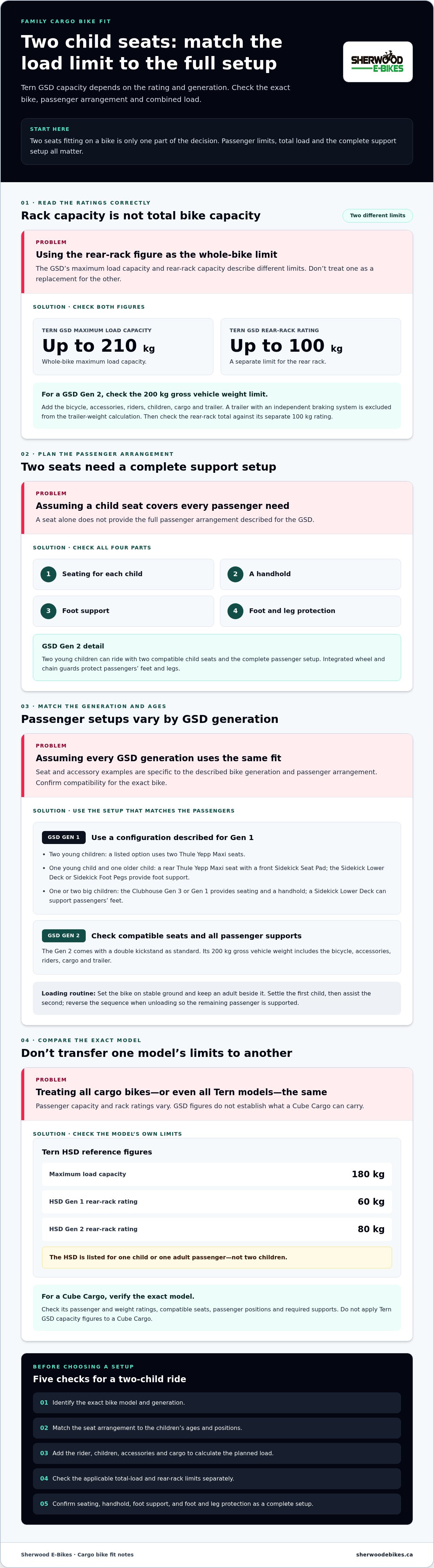
For the Tern GSD, separate total bike load from rear-rack capacity. The GSD’s maximum load capacity is up to 210 kg, while its rear rack can carry up to 100 kg. These figures describe different limits, so don’t treat the rack rating as the bike’s total capacity.
Generation matters, too. The Tern GSD Gen 2 can carry up to two children with an appropriate seating arrangement. Its maximum gross vehicle weight is 200 kg, including the bicycle, accessories, riders, cargo and trailer. A trailer with an independent braking system is excluded from the trailer-weight calculation.
See how cargo-bike designs can feel on a ride:
Calculate a planned load in stages. Add the rider, each child, the seat or passenger accessories, and any bags or other cargo. For a Gen 2 GSD, compare that combined load with the 200 kg gross vehicle limit. Then check the rear-rack total against its separate 100 kg rating. Both limits matter when children ride behind you.
The Tern HSD illustrates why model names and generations matter. Its maximum load capacity is 180 kg, and the HSD Gen 1 rear rack is rated for 60 kg. The HSD Gen 2 rear rack is rated for 80 kg. The HSD is listed for one child or one adult passenger, not two children.
For a GSD Gen 1 carrying children, make sure the passenger setup provides foot support. Passenger capacity still depends on the exact bike and accessories, so use the relevant model’s rating rather than assuming every GSD generation shares one limit. Tern advises that most riders can comfortably carry 80% of their own weight, but that guidance doesn’t replace the bike’s load limits.
Warranty coverage, maintenance, battery replacement, and repair costs in Canada depend on the bike model, warranty terms, parts, and work required. Compare the written coverage and service needs for the specific Tern GSD and Cube Cargo rather than assuming the costs are the same.
Whether a Cube Cargo can carry two children depends on the exact model and compatible seating arrangement. Check that model’s passenger and weight ratings, and don’t apply Tern GSD capacity figures to a Cube Cargo.
2. Child-seat compatibility and safety requirements
Two seats need more than enough room on the rear rack. The Tern GSD Gen 2 can be configured for two young children using two compatible child seats, but the complete passenger setup also needs suitable seating, a handhold, foot support, and foot and leg protection. Treat these as connected parts of one arrangement. A seat alone doesn’t provide every feature required for carrying passengers on this bike.
Start with the exact GSD generation, then match the seats and passenger accessories to that bike. The GSD Gen 1 has different setup examples from the Gen 2. Tern says the GSD Gen 1 can use the Clubhouse Gen 3 or Gen 1 for seating and a handhold when carrying one or two big children. For two young children, a listed Gen 1 option uses two Thule Yepp Maxi seats. These examples are specific to the described configurations, not a universal fit list for every cargo bike.
Use this sequence to assess compatibility before settling on a family setup:
- Identify whether the bike is a Tern GSD Gen 1 or Gen 2.
- Match each child’s age and passenger position to the relevant seat arrangement.
- Account for seating, handhold, foot support, and foot and leg protection together.
- Compare the complete setup with the bike’s applicable load limits.
For a Gen 1 GSD carrying one young child and one older child, the described arrangement combines a rear Thule Yepp Maxi child seat with a front Sidekick Seat Pad. The Sidekick Lower Deck or Sidekick Foot Pegs provide foot support in that setup. For one or two big children, the Clubhouse provides the seating and handhold; a Sidekick Lower Deck can support passengers’ feet. Choose parts for the specific arrangement instead of mixing examples from different configurations.
Before each ride, inspect the seats and passenger supports. Confirm that each child has a secure seating position, a handhold, and foot support that protects their feet and legs. Tern advises riders to check local regulations before carrying passengers on a bicycle and recommends that riders and passengers wear an approved helmet. Keep these checks in mind whether a trip is across an Edmonton neighbourhood or farther afield.
Assess a Cube Cargo with the same fit-first method: identify the exact model, then check compatible seats and passenger supports as a complete setup. Don’t assume a Tern accessory or seat arrangement fits a Cube. The bike’s design, accessory fit, passenger positions, and stated load limits determine whether a particular arrangement works.
3. Child-seat setups for young children
Plan each ride around how the children will board, sit, and get off. With two passengers, set the bike on stable ground before helping either child. The Tern GSD Gen 2 comes with a double kickstand as standard, which supports loading routines. Keep one adult beside the bike, settle the first child, then assist the second. Reverse the sequence when unloading so the remaining passenger is supported.
Passenger protection differs by generation. The GSD Gen 2 has integrated wheel and chain guards to protect passengers’ feet and legs. For the GSD Gen 1, Sidekick Wheel Guard L or Cargo Hold 52 Panniers can provide foot and leg protection. These options serve a different purpose from a seat or handhold, so account for passenger protection separately when planning accessories.
For either bike, choose seats and passenger supports as a complete arrangement. A GSD passenger setup needs seating, a handhold, foot support, and foot and leg protection. With a Cube Cargo, consider how the passenger area accommodates both children and their feet, and whether each child has a handhold and protection. Treat weather covers as a separate comfort choice, matching the cover to the seat or passenger area and expected conditions.
- Make sure each child has a defined seat and position.
- Keep feet clear of wheels, chains, and moving parts.
- Arrange handholds and foot support for both passengers.
- Consider rain and wind exposure when selecting weather coverage.
Before setting off, check that bags and clothing cannot catch near the GSD’s chain or wheels. Make sure the children can reach their handholds and place their feet on the intended supports. In a Cube Cargo, check that one child’s movement does not obstruct the other’s space or the rider’s view. Assess the actual setup, not just the number of seats.
As children grow, reassess their seating positions and support needs. A child who once sat comfortably may need a different foot position or more room beside a sibling. Review the complete arrangement before changing seats or accessories, and keep passenger protections in place. For Edmonton rides, consider how easily a weather cover can be fitted and removed as conditions change.
Use the same routine with a GSD or Cube Cargo: prepare the bike, secure passengers, protect their feet, and unload carefully. The right arrangement gives each child a suitable place without blocking the other passenger or limiting the rider’s access.
4. Choosing a cargo bike for family use
The Tern GSD is a longtail cargo e-bike, while the Cube Cargo has a front-loading box design. That difference affects where children and cargo sit, as well as visibility, loading, and turning feel. Compare both bikes with the intended passenger setup, since an unloaded test ride won’t reflect the same balance or handling.
The GSD weighs about 33-38 kg, and its listed maximum range is up to 130 miles. Typical real-world range is around 90 miles, while its motor is listed with maximum torque up to 85 Nm. These specifications help frame the comparison, but they don’t establish how a Cube Cargo will perform. Check the exact Cube model’s figures and consider how both children and family gear affect your planned rides.
When comparing a Tern GSD vs Cube Cargo bike for two child seats in Edmonton, consider your routes and the bike’s total load. Range depends on the model, battery, assistance level, route, and load. Hill-climbing depends on motor output and gearing under load. Compare those details with your regular routes, including hills you expect to ride with both children aboard.
Map your usual Edmonton trips, noting surfaces, traffic, and places to stop. Check whether each bike’s length and width suit your storage area, doorway, and parking spot. A front box and a longtail frame can create different access and storage challenges. Measure your home storage space, then plan how you’ll position and secure the bike between rides.
- Compare each model’s overall dimensions with your storage and parking spaces.
- Consider hills, road surfaces, traffic, and stopping points on regular routes.
- Assess how each design accommodates children and family cargo together.
- Compare the exact models’ stated motor, battery, and load specifications.
Plan for Edmonton winters, too. Snow, ice, and slush can affect comfort and control, so consider the surfaces on your regular routes and whether a clearer alternative is available. Check that your storage space can accommodate the bike, child seats, and cargo accessories. When bulky family gear begins crowding the garage or entryway, looking at practical home storage ideas—such as the raised flooring solutions installed by JR Loft Boarding—can help free up essential ground-level space. These everyday logistics can matter as much as the ride.
Compare handling in practice, not just on paper. The GSD weighs about thirty kilos, and careful cornering is advised. A front-loading Cube Cargo carries children in a different position, so compare sightlines, turning space, and parking effort. A controlled test ride with the intended seats and representative cargo can help you assess steering and manoeuvring.
A Tern GSD vs Cube Cargo bike for two child seats in Edmonton is best compared by exact model, loaded setup, and riding conditions. Use those factors to decide which design suits your family’s daily trips, storage, and winter routine.
5. Which Tern GSD models fit two child seats, and what are their passenger and weight limits?
Both the Tern GSD Gen 1 and Gen 2 have described arrangements for carrying two young children. The Gen 2 can also carry one adult passenger, giving families another option as passenger needs change. Choose the generation and arrangement around who will ride, rather than treating “two seats” as a complete description of passenger capacity.
Passenger setups can vary according to a child’s size and the bike’s configuration. That distinction helps clarify which arrangement applies to a growing passenger. A child’s age alone doesn’t describe the setup: consider whether each passenger will use a child seat or another passenger position, and whether their combined load suits the particular bike and accessories.
To compare GSD configurations, separate three decisions:
- Passenger mix: Decide whether the bike will carry two young children, an older child, or an adult passenger.
- Bike generation: Identify whether you have a GSD Gen 1 or Gen 2 before selecting a configuration.
- Complete load: Include passengers, the bike, accessories, and cargo when assessing the intended ride.
For a family choosing between generations, think beyond the first planned trip. A setup for two young children may not suit the same passengers as they grow. The Gen 2’s described older-child category provides a useful reference point for that change. Revisit the seating arrangement as passenger needs shift, and don’t assume that a configuration selected for one age or passenger mix automatically fits another.
Assess weight for the exact bike and riding arrangement. Passenger weight is only part of the load: seats, protective accessories, and family cargo count too. List who will ride and what you’ll carry, then compare the full setup with the applicable limits for the specific GSD. This helps distinguish passenger arrangements from weight ratings.
Use model-specific information when comparing the GSD Gen 1 and Gen 2. Note the generation, passenger positions, chosen accessories, and the intended use of each seat. If the plan includes an adult passenger, distinguish that use from carrying two young children. These details give a clearer picture of which GSD configuration fits the family’s actual passenger mix.
For two child seats, the relevant question is not simply whether a GSD can carry two children. Consider which generation and passenger arrangement match the children’s needs, then assess the complete loaded setup. The Gen 2’s defined older-child category and adult-passenger option also help families think ahead as their riding plans evolve.
Sherwood E-Bikes Ltd.: E-Bike Parts
After comparing family cargo-bike setups, Sherwood E-Bikes Ltd. can help with your next steps. Explore its E-Bike Parts and Cycling Accessories for replacement components or everyday riding gear. E-Bike Maintenance can also support ongoing care for your e-bike.
If you’re also considering an electric bike for commuting, Sherwood E-Bikes Ltd. offers Commuter E-Bikes. Think about which parts, accessories, or maintenance support suit your chosen bike and the way you ride around Edmonton.
Contact Sherwood E-Bikes Ltd. to explore your options.
Plan your family’s next ride
Start with how your household plans to ride, rather than a feature list alone. Consider who will use the bike, how routines may change, and what would make riding practical from the first trip. Those priorities give you a clear basis for comparing options and choosing a setup for everyday use.
A Tern GSD vs Cube Cargo bike for two child seats in Edmonton is most useful to compare against your family’s priorities. Bring questions about the bike layout, passenger setup, and the rides you expect to make. Sherwood E-Bikes Ltd. can help you explore the next steps: visit the showroom in Sherwood Park to discuss your setup.
Contact Sherwood E-Bikes Ltd. for family cargo bike advice and take the next step toward rides that fit your family’s routine.
Frequently Asked Questions
How much passenger weight can I carry on a GSD?
The passenger allowance is the portion of the bike’s rated load left after accounting for the bike, accessories, and cargo. For a useful trip estimate, weigh each rider in their usual riding clothes and include bags, locks, and other onboard items. Base the calculation on the planned ride, since a school run with supplies may create a different load from a short outing.
Can both bikes carry children?
Both bikes may suit families looking to carry children, but passenger arrangements depend on the exact model and compatible equipment. Think through your routine: whether children need to board from one side, whether you carry school bags, and how you’ll park at your destination. These details help distinguish a practical setup from one that only seems suitable on paper.
Which One Offers Better Value?
Better value depends on what matters to your household over time. Compare the equipment included with each bike, the accessories needed for your planned use, and how well each design serves errands beyond carrying children. Consider storage space and the kinds of trips you expect to make. A like-for-like comparison is more useful than comparing model names alone.
Which bike is easier to ride?
The easier bike to handle is the one you can manoeuvre confidently in your usual situations. Pay attention to starting, stopping, tight turns, parking, and walking the bike through your storage area. If possible, assess each model with its intended passenger equipment installed. This gives you a more relevant sense of everyday handling than trying a bike unloaded or without accessories.
What child seats are compatible with the Tern GSD and Cube Cargo, including mounting requirements?
Seat compatibility depends on the exact bike model, seat, and mounting arrangement. Before choosing, compare the seat maker’s fit information with the bike’s intended passenger setup. Check that the installed seat leaves room for the second passenger and does not interfere with access, controls, or cargo placement. Keep the bike and seat instructions together so you can assess the combination as a whole.
What are the current prices in Canada for the Tern GSD and Cube Cargo?
There is no single Canadian price for every Tern GSD or Cube Cargo model and configuration. For a useful budget comparison, compare the exact bikes and include the equipment your family plans to add, such as child seats and carrying accessories. Distinguish included equipment from optional items to compare complete setups rather than base models with different equipment.


