

If your e-bike battery isn’t charging in St. Albert, start with the basics: connect the charger to the battery before plugging it into household power, check the charger light, and make sure the battery has been sitting somewhere dry and at room temperature. Most charging problems come down to the charger, the connection or the battery’s temperature before they come down to a failed battery.
A battery that won’t charge is frustrating, especially when you’re ready to ride. Temperature, charger connections and battery condition all affect charging, so work through simple checks before assuming the battery is finished.
This guide explains how to inspect the battery and charger safely, how cold and heat affect charging, and what a voltage check can and can’t tell you. You’ll also find a step-by-step troubleshooting sequence and the signs that call for professional e-bike maintenance rather than another charging attempt.
Key Takeaways
- Inspect the battery, charger, cables and charging port for visible damage before trying to charge.
- Store and charge the battery indoors in a dry, room-temperature space; follow the temperature range printed on your battery or in its manual.
- Cold and heat both change how a lithium-ion battery charges, so let it reach room temperature before troubleshooting.
- A multimeter can show whether voltage is present, but it can’t prove the battery will accept or hold a charge.
- If basic checks don’t find the problem, Sherwood E-Bikes Ltd. offers E-Bike Parts and E-Bike Maintenance to help with the next step.
1. Battery and charger safety
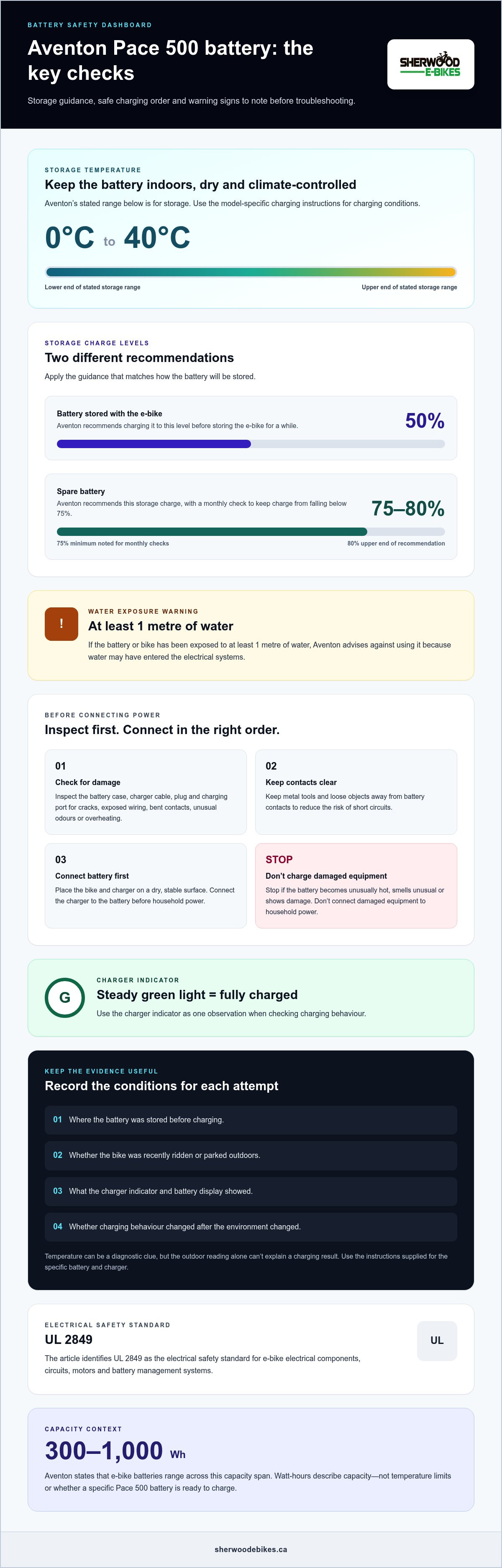
Before troubleshooting, check the battery case, charger cable, plug and charging port. Look for cracks, exposed wiring, bent contacts, unusual odours or signs of overheating. Don’t connect damaged equipment to household power, and keep metal tools and loose objects away from battery contacts to avoid a short circuit.
UL 2849 is the electrical safety standard for e-bike electrical systems, covering components, circuits, motors and battery management systems. When you replace a battery or charger, choosing certified parts matched to your bike is one of the simplest ways to reduce risk. If a battery or bike has been submerged, don’t use or charge it until it has been inspected, because water may have reached the electronics.
How much does a replacement e-bike battery or charger cost in Canada? It depends on the voltage, capacity, connector and mounting style your bike needs. Confirm those details before comparing prices; a charger is not interchangeable just because its plug fits.
Can I charge the battery while it’s on the bike? Many e-bikes allow it. Charge with the bike stationary and dry, connect the charger to the battery first, then plug into the wall. Remove the battery only if access or your manual requires it.
Use the same careful sequence every time you charge:
- Place the bike or battery and charger on a dry, stable surface.
- Check the battery contacts and charger plug for debris or damage.
- Connect the charger to the battery before household power.
- Stop if the battery becomes unusually hot, smells unusual or shows damage.
For storage, a partial charge is generally easier on lithium-ion cells than leaving the battery full or completely empty. If the bike will sit for weeks, top the battery up to roughly half and check it monthly so it never drains to zero. Your battery manual may give a specific storage level; follow it where it differs.
Which shops near St. Albert or Edmonton service e-bike batteries? Look for a shop that can test battery and charger systems, not just look them over. Ask whether they check the charger output, the connections and the battery’s charging response.
Is my battery or charger covered by warranty? That depends on your bike’s warranty terms and the cause of the fault. Keep your purchase records and note the battery model, charger details and symptoms before making a claim.
2. Charging temperature range
What temperature should an e-bike battery be when it charges? Follow the range printed on your battery or charger, or in the manual. As a general rule, lithium-ion batteries charge best at room temperature, and many battery management systems will refuse or slow charging when the cells are too cold or too hot.
For troubleshooting, the battery’s own temperature matters more than the outdoor reading on a weather app. A bike left in a garage, shed or vehicle may be much colder or warmer than one stored inside. Sunlight, insulation and how long it sat there all affect what the battery experienced.
Temperature is most useful as a clue when you record it alongside charging behaviour. Note where the battery was kept, whether the bike was just ridden, and whether charging behaves differently after the battery has warmed up or cooled down. Several comparable observations tell you more than one.
Keep a simple record for each attempt:
- Where the battery was stored before charging.
- Whether the bike had recently been ridden or parked outdoors.
- What the charger indicator and battery display showed.
- Whether charging changed once the battery reached room temperature.
If charging seems to fail only after the bike has been parked outside, that points to temperature rather than a defective battery. If the same symptom happens after the battery has been indoors overnight, temperature probably isn’t the full story.
In St. Albert, a bike might move between a heated home, a cold garage and sub-zero riding conditions in a single day. That history is useful context, but it isn’t a diagnosis on its own. Record the conditions and the charging response before changing more than one thing at a time, and if temperature doesn’t explain the fault, move on to the charger, connection and battery checks below.
Battery capacity is a separate detail. E-bike batteries commonly range from about 300 to 1,000 watt-hours, but capacity tells you how far you can ride, not whether the battery is ready to charge. Don’t use watt-hours as a substitute for the temperature guidance on your battery.
3. Temperature effects on charging
Cold slows the chemical reactions inside a lithium-ion battery. As the cells cool, their ability to accept and release energy drops. You might see slower charging progress or a battery indicator that seems slow to respond. That behaviour alone doesn’t mean the battery has failed.
Heat is a different concern. High temperatures stress the cells and electronics, and charging adds warmth of its own. A battery that feels unusually hot, shows swelling or gives off an unusual smell should not be charged. Stop using it and keep it away from sunlight and heat sources.
Look for patterns rather than one-off results. Compare how the charger indicator behaves after a cold ride against how it behaves after the bike has been indoors, and note whether the battery display changes during charging. These details help separate a temperature-linked symptom from a charger or connection problem.
Assess temperature effects without changing several conditions at once:
- Record whether the battery was cold, warm or at room temperature before charging.
- Note the charger light and battery display when connected.
- Compare with another attempt after the battery has reached room temperature.
- Stop if the battery becomes unusually hot or shows physical changes.
Cold also makes a battery seem weaker during a ride. You may notice less assistance or a faster drop in displayed charge on a chilly morning. That’s normal for lithium-ion cells and usually recovers once the battery warms up; one cold ride isn’t proof of permanent damage.
Winter commuters in St. Albert see sharp swings between outdoor riding and indoor parking, which makes temperature a real diagnostic factor. It doesn’t replace checking the charger and electrical connections, though. If the same charging symptom continues across different conditions, temperature is unlikely to be the cause.
4. Testing battery voltage with a multimeter
A digital multimeter can show whether voltage is present at an approved battery output. It can’t prove the battery will accept or hold a charge. The battery management system can also affect the reading, so interpret any result alongside the display, charger light and symptoms.
Start by finding the battery’s nominal voltage on its label or in its manual. Use that figure to interpret the reading; don’t borrow a threshold from a different battery. If the label or manual doesn’t identify safe test points, don’t probe the battery terminals.
Before measuring, disconnect the charger and switch off the bike. Check the meter leads for damage, then set the meter to DC voltage, not current or resistance. If your meter needs a manual range, choose one above the battery’s stated voltage. Keep the probes apart until you’re ready.
Test only contacts your manual clearly identifies for measurement. Match red to positive and black to negative, taking care not to bridge terminals. Hold the probes steady, read the display, then remove them. A negative reading usually means the probes are reversed.
Treat the result as one clue, not a verdict. A reading near the stated voltage shows voltage is present but says nothing about usable capacity. A low or missing reading could mean a deeply discharged battery, protection electronics that have shut the output off, a poor connection or another fault. The meter can’t tell these apart on its own.
Keep a short record so you can compare the reading with charging behaviour:
- Battery model and label information.
- Meter setting and displayed voltage.
- Whether the battery was connected to the bike or charger.
- Charger indicator and bike display at the time.
Never open the battery case, push probes into the charging port, or force contact with recessed pins. A slipped probe can short the contacts, and opening the case exposes the cells. Stop if contacts are damaged, wet or unclear. If the battery still won’t charge, a qualified technician can test the charger, connections and management system properly.
5. How to troubleshoot an e-bike battery that won't charge
Work through the problem one change at a time and record what happens. That’s the fastest way to separate a charger fault from a battery connection issue or a problem elsewhere in the electrical system.
Start with the charger. Chargers are not universal, so match the voltage, connector and output on the charger label to your battery. Don’t test with an unrelated charger, even if the plug fits; the wrong output can damage the battery.
Next, check that the battery is properly seated and latched. A removable battery that isn’t fully engaged may not connect reliably. Then see whether the bike powers on and whether the display responds, which helps separate a charging symptom from a power-on problem.
Plug into an outlet you know works and watch the charger indicator. Record exactly what you see: no light, a light that changes, or a battery display that doesn’t move. Don’t rely on the light alone; consider the charger and battery together, especially if the bike display says something different.
Keep a short log for each attempt:
- Note the bike model and the charger model on its label.
- Record whether the battery is seated and whether the bike powers on.
- Describe the charger indicator without guessing a cause.
- Record the battery display before and after charging.
- Stop if the equipment becomes hot, damaged or behaves strangely.
If the charger light responds but the battery display doesn’t change, don’t keep swapping chargers. If the charger shows nothing at a working outlet, the charger may need testing. If the battery runs the bike but won’t take a charge, note that too; it gives a technician a much better starting point than “the battery is dead.”
Bring the charger, battery and your notes when you arrange a diagnostic. If the fault continues, book an e-bike service assessment to find out which part of the charging system needs attention.
Sherwood E-Bikes Ltd.: E-Bike Parts
Sherwood E-Bikes Ltd. offers E-Bike Parts and E-Bike Maintenance for riders tracking down a charging fault. If your checks point to a damaged component, or the battery still won’t charge, our service team can assess the electrical system and recommend the next step. Bring the charger and battery, along with the indicator behaviour and any multimeter reading you recorded. Clear symptoms help us tell a charger issue from a battery or connection fault. We also carry Commuter E-Bikes and Cycling Accessories for riders thinking about their next bike.
For help with e-bike maintenance and parts, contact Sherwood E-Bikes Ltd.
Plan your next ride with a clear path forward
A charging fault is also a good moment to think about how your e-bike fits your routine. If your battery isn’t charging in St. Albert, use the notes you’ve gathered to guide your next decision instead of replacing parts without a clear reason.
Sherwood E-Bikes Ltd. offers E-Bike Maintenance and E-Bike Parts for service and components, and Commuter E-Bikes if you’re considering a different setup for regular trips. Choose the step that fits your plans, whether that’s fixing the current issue or planning ahead.
Contact Sherwood E-Bikes Ltd. to discuss your e-bike needs. With a clear next step, you can get back to dependable rides.
Frequently Asked Questions
How can I tell whether my e-bike battery or charger is faulty?
Start by ruling out the power source. Try another working outlet, inspect the charger and battery connectors for dirt, moisture, looseness or damage, then reconnect and check the indicator lights against your manual, since light patterns vary between brands. A technician can test the battery and charger separately with proper diagnostic equipment. Never open the battery casing.
Where can I get an e-bike battery diagnosed or repaired near St. Albert, Alberta?
Sherwood E-Bikes Ltd. in Sherwood Park offers electrical-system diagnostics and replacement-part installation as part of its maintenance service, and works on all e-bike brands. It’s a nearby option for riders in St. Albert, Edmonton, Leduc, Camrose, Fort Saskatchewan, Ardrossan, Vegreville, Morinville, Wetaskiwin and Spruce Grove. Visit 2008a Sherwood Dr., Sherwood Park, AB, Canada, T8A 0Z1, or call (587) 269-2453 before bringing the battery in, and ask whether it can be repaired or needs replacement.


