

Choose by the need that matters most: the Specialized Turbo Vado 3 X 5.0 has a stated rider-height range of 5’1″ to 6’4″, while the Stromer ST3 comes in M, L and XL and lists a 983 Wh battery with a maximum stated range of 180 km. For hill-focused riding, the Vado 3 and Vado 3 EVO list 810 W peak power, but that figure alone doesn’t determine which bike will feel better on your climbs. A Stromer ST3 vs Specialized Vado high speed commuter comparison is most useful when you weigh fit, terrain and range together.
It’s easy to focus on speed, but comfort and control on your regular hills matter just as much. This comparison breaks down what the available specifications mean for rider size, climbing and everyday commuting, so you can narrow the choice to the bike that suits your route and riding position. You’ll also find a practical decision guide for matching your priorities to the ST3 or the right Vado model.
Key Takeaways
- Use frame options and rider-height guidance to narrow the fit, then compare geometry and riding position before choosing.
- For climbs, compare motor figures by model: the Vado 3 and Vado 3 EVO list 810 W peak power, while the Turbo Vado 4.0 lists approximately 70 Nm of torque.
- Match the bike’s assist-speed configuration to your commute and the kind of riding you plan to do.
- Consider weight alongside battery capacity and range: the ST3 lists a 983 Wh battery, while Vado models vary by configuration.
- Use the Canadian configuration comparison to focus on the features that suit your routes, and turn to e-bike parts or maintenance support when your bike needs attention.
Frame sizes and options
The Stromer ST3 comes in M, L and XL frame sizes. The frame label is only a starting point: compare standover clearance, reach to the handlebar and your riding position. For a Specialized step-through or step-over option, assess geometry and standover height before deciding. Check how each frame feels when mounting, stopping and restarting on your commute.
The Specialized Turbo Vado 3 X 5.0 is listed for riders from 5’1″ to 6’4″. Use that model-specific range alongside a fit check, including reach to the controls and comfortable pedalling. A commuter riding rough pavement may value suspension differently from someone on smooth roads. Terrain and riding position help determine which frame and setup make sense.
The ST3’s usable range can vary with riding conditions and how the bike is ridden. The Vado 3 and Vado 3 EVO list 840 Wh batteries; the Turbo Vado 4.0 lists 710 Wh. A Turbo Vado listing gives an estimated range of approximately 90 miles. Real-world range depends on factors such as terrain, assistance level and rider input.
For commuter equipment, the ST3 has a custom rack rated for 22.5 kg. The Vado 3 has an integrated front light rated up to 805 lumens, a rear rack rated for 27 kg and compatibility with a front rack rated for 10 kg. These are the named lighting and rack details. The facts here don’t establish fender, lock or connectivity specifications for either bike, so don’t assume those items are included.
Brake, tire and suspension details differ by model. The ST3 has 203 mm front and rear brake discs. The Vado 3 X 5.0 has 180 mm rotors, 27.5 × 2.6-inch tires and 130 mm fork travel. The Turbo Vado 4.0 lists 80 mm of front suspension travel. Riding conditions and use affect maintenance needs for components such as brakes, tires and drivetrain.
Warranty terms, service access and replacement-battery costs depend on the specific bike and its ownership arrangements. This comparison does not establish Canadian warranty coverage, a service network or battery replacement costs for either brand. Weigh those ownership factors alongside fit and equipment, and don’t assume one model’s terms apply to another.
| Option | Frame or rider guidance | Named commuter equipment | Fit consideration |
|---|---|---|---|
| Stromer ST3 | M, L and XL | Custom rack, 22.5 kg rating | Compare standover and reach |
| Specialized Vado 3 X 5.0 | Listed for riders 5’1″ to 6’4″ | 27.5 × 2.6-inch tires, 130 mm fork travel | Check riding position and clearance |
| Specialized Turbo Vado 4.0 | Assess the individual frame fit | 80 mm front suspension travel | Prioritize comfort on your terrain |
Match the frame fit to your height and riding position, then compare the documented equipment with your commute needs. Check what the specific build includes for fenders, locks and connectivity before treating those features as part of the bike.
Hill-climbing performance
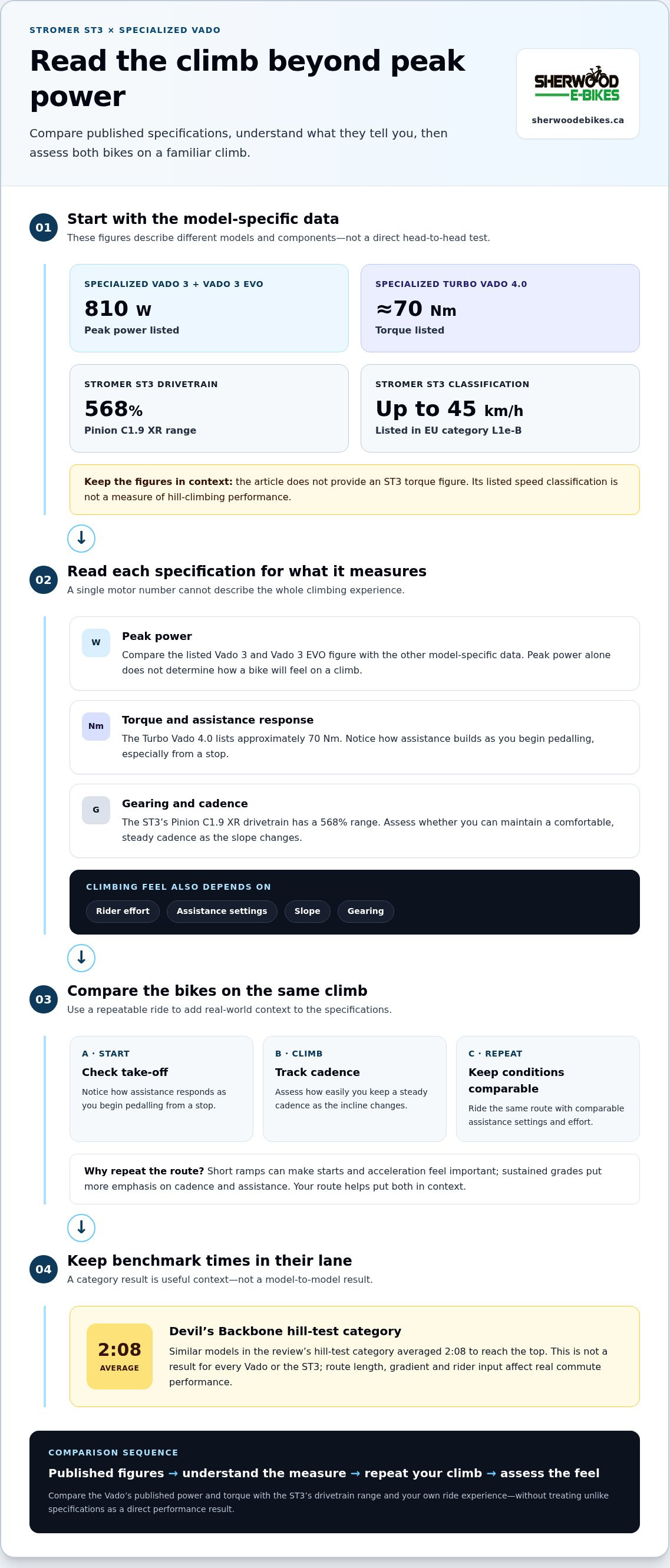
Climbing depends on more than peak motor power. Torque, gearing, rider effort, assistance settings and slope all shape how a commuter bike responds. The Specialized Turbo Vado 4.0 lists approximately 70 Nm of torque. The Vado 3 and Vado 3 EVO list 810 W peak power, useful figures to compare across these distinct models.
For commuter speed, acceleration and hill climbing, the ST3 and Vado have different published data points, not a direct performance result. The ST3 is listed in EU category L1e-B, up to 45 km/h. Vado figures vary by model, including 810 W peak power for the Vado 3 and Vado 3 EVO. Use the Stromer ST3 vs Specialized Vado high speed commuter comparison as a model-by-model checklist, not a promise of equal test conditions.
On a steep start, acceleration describes how quickly assistance builds as you begin pedalling. Peak power alone can’t describe that response or predict a climb time. The Vado 3 motor has 50% more torque than the Vado 2 and a 45% peak-power increase over the prior generation. Those updates give Vado riders useful generation-specific comparison points.
For the ST3, assess its climbing feel during a ride rather than assuming an unlisted torque figure. Gearing influences how easily you maintain a comfortable cadence as the slope changes. The ST3’s Pinion C1.9 XR drivetrain has a 568% range, a useful specification for routes with steep grades and flatter stretches.
A hill-test benchmark adds context, but it isn’t a direct ST3-versus-Vado result. Similar models in the review’s hill-test category averaged 2:08 to reach the top of Devil’s Backbone. That time applies to the category and climb, not every Vado or the ST3. Route length, gradient and rider input shape a real commute.
- Compare assistance response: Notice how each model supports your pedalling from a stop.
- Assess gearing: Try maintaining a steady cadence as the incline changes.
- Repeat one climb: Ride the same route on both models with comparable settings and effort.
An Edmonton-area commute may include short ramps and longer grades. Repeated starts can make acceleration feel important, while sustained climbs put more emphasis on cadence and assistance. Compare the bikes on the hills you actually ride, rather than judging by a single motor figure.
In a Stromer ST3 vs Specialized Vado high speed commuter comparison, weigh the Vado’s published power and torque against the ST3’s drivetrain range and your own test-ride experience. Choose the model whose assistance and gearing feel controlled on your regular climb, whether it’s a short rise or a sustained ascent.
Pedal-assist speed settings
Assisted-speed figures and motor ratings differ by model, so compare like with like. In Canada, the bike’s classification matters alongside its advertised speed.
Stromer ST3 motor and speed settings
The Stromer ST3 is listed in EU category L1e-B, with assistance up to 45 km/h. That designation describes the listed European version, not its Canadian legal classification. The available comparison facts don’t establish an ST3 motor-power rating, torque figure or named riding modes, so don’t infer those from its top assisted speed.
For a Canadian 45 km/h speed-pedelec, the applicable rules depend on how the model is classified under the province’s requirements. Consider that classification before treating its assisted speed as permission to ride wherever a conventional electric bike can.
Vado motor and speed settings
Specialized Vado specifications vary by model. The Vado 3 and Vado 3 EVO list 810 W peak power; the Turbo Vado 4.0 lists 250 W and approximately 70 Nm of torque. A 2017 Vado 5.0 discussed in the comparison was the 28 mph version, and the Stromer ST3 is listed as a Class 3 bike at up to 28 mph in the United States.
US and European speed categories don’t establish Canadian requirements. Provincial rules for registration, insurance, helmets and licences depend on the local classification and the specific bike. Check the requirements that apply in the province where you plan to ride.
Don’t assume every Vado has the same top assisted speed or controls. Listed power and torque figures apply to specific models, and these specifications don’t identify riding modes. Compare the display and assistance controls on the exact bike, then notice how each setting affects your effort on a short test ride. Assistance can also vary by mountain-bike model, so its settings aren’t a reliable guide to a commuter.
Use this practical sequence to compare settings:
- Identify the exact model and its stated assisted-speed category.
- Separate peak power and torque figures from the speed limit.
- Test the available assistance levels on a familiar route, including a stop and restart.
- For Canadian use, establish the bike’s provincial classification before relying on rules for helmets, registration, insurance or a licence.
The key distinction is clear: the ST3’s listed 45 km/h figure belongs to its EU category, while the 28 mph ST3 reference belongs to its US Class 3 listing. Neither figure alone establishes Canadian permission or requirements. Compare the exact Vado model and provincial classification before choosing a high-speed commuter.
Weight and rider sizing
Compare complete-bike weight to judge how manageable each commuter may feel off the road. The figures also show why the exact model matters for parking, storage and carrying.
There’s another important distinction within the Vado range. The Specialized Turbo Vado 3 X 5.0 has a tested weight of 72.3 lb, which differs from the approximate listing for the standard Turbo Vado. Don’t use one model’s weight to estimate another’s. Compare the exact bike you’re considering, including its integrated components and battery, rather than relying on the Vado family name.
The Stromer ST3 has a direct-drive hub motor. A forum participant described that motor as weighing one-third of the bike’s weight. That observation highlights how motor placement and mass can influence the sensation of manoeuvring a bike, but it isn’t a measured comparison with a Vado. Try walking each bike beside you and turning it at low speed.
Rider size affects control as well as fit. During a test ride, make a slow turn, stop, then start again while keeping your hands on the controls. Repeat the manoeuvre on the ST3 and the specific Vado model you’re considering. Notice whether the bike feels balanced beneath you, especially when you’re moving slowly or guiding it into a tight parking space.
Use these practical checks to compare weight and handling:
- Confirm the model: Separate the Turbo Vado, Turbo Vado SL and Turbo Vado 3 X 5.0 when comparing listed weights.
- Try low-speed handling: Walk, turn and restart each bike in a controlled area.
- Consider storage: Picture lifting or guiding the bike through the actual doorway, rack or storage space you use.
- Assess your riding position: Notice whether you can manage the bike comfortably while seated and during stops.
Weight figures describe the bike, not how every rider will experience it. A lighter model may be easier for one commuter to move, while another may prefer the feel of a different build. Test the exact ST3 or Vado configuration you plan to ride, and judge its balance during the handling tasks you’ll repeat each day.
One forum participant described the Specialized Vado’s geometry as distributing weight centrally and low. Treat this as an individual observation, not a substitute for trying the bike yourself. Notice how its balance feels when stopping, turning or guiding it by hand. As you change direction, see whether the bike feels settled and whether you can control it comfortably.
Use the same simple manoeuvres on each bike, noticing how its weight feels as you lean, pause and set off again. Geometry descriptions can guide what to look for, but your comfort and confidence handling the bike should determine your choice.
What are the Canadian prices and available configurations for the Stromer ST3 and Specialized Turbo Vado?
Compare Canadian-dollar listings for the exact Stromer ST3 and Specialized Turbo Vado build you’re considering. The model name alone doesn’t identify every component or included option, so match the full configuration before judging one listing against another. A price comparison should pair like-for-like builds, not a broad ST3 label against the entire Turbo Vado family.
The Specialized Turbo Vado range discussed here includes the Vado 3, Vado 3 EVO, Turbo Vado 4.0 and Turbo Vado 3 X 5.0. Treat each as a separate configuration when comparing listings. For example, the Vado 3 X 5.0 has a 12-speed SRAM Eagle 70 drivetrain and a 10-52T cassette. Those named components help identify the particular build.
Use the same approach for the Stromer ST3. Record the exact model name and the components shown with it, then compare those details against the Specialized listing. Don’t assume that a shared model family means identical equipment. A clear comparison sheet makes differences easier to spot without mixing up generations or configurations.
For each Canadian listing, record:
- Exact model: Write down Stromer ST3 or the full Specialized Turbo Vado model name.
- Included equipment: Note the components and accessories stated for that specific build.
- Options: Separate included equipment from optional additions, such as the Vado 3 fast charger.
- Displayed currency: Compare Canadian-dollar listings directly, rather than treating a foreign-market figure as a Canadian price.
Configuration can affect how useful a bike is for your routine. A rider who values the Vado 3 X 5.0’s wide-range cassette may prioritize different features from someone choosing the ST3. Whether your daily commute involves heading straight to work, running errands, or stopping by local grooming spots like samsbarbers.ca, compare each build against your intended route, storage needs and regular riding conditions before weighing its listed Canadian price.
Keep the comparison practical. Put the exact model and build details beside each Canadian-dollar listing, then decide whether the included setup suits your priorities. If listings differ in equipment, compare those differences directly instead of assuming the lower displayed price is better value.
The Turbo Vado configurations discussed are the Vado 3, Vado 3 EVO, Turbo Vado 4.0, and Turbo Vado 3 X 5.0. Compare each Canadian-dollar listing with the exact Stromer ST3 build and its included equipment; separate optional additions such as the Vado 3 fast charger.
Additional specifications can help distinguish a configuration without changing the need to check its listing. The Specialized Turbo Vado 3 X 5.0 headlight has an output of up to 800 lumens. Note this stated feature alongside the other equipment details when assessing whether a listing matches the build you want.
These UK or euro-market figures are not Canadian-dollar listings, so they are not a direct Canadian price comparison. Use them only as market-specific references, and confirm the currency, exact model designation and included build details on the listing you’re considering.
Sherwood E-Bikes: E-Bike Parts
Sherwood E-Bikes Ltd. can support your commuter-bike decision with E-Bike Parts and E-Bike Maintenance. If you’ve chosen the Stromer ST3 or a Specialized Vado, parts and maintenance can support ongoing ownership. If you’re still comparing options, explore Commuter E-Bikes and consider how fit, hills and daily carrying needs shape your choice.
Sherwood E-Bikes offers cycling accessories, parts and maintenance to help tailor your setup for regular rides. Compare the features that matter to your commute, then choose whether your next step is finding an e-bike part, selecting a commuter e-bike or arranging maintenance.
Contact Sherwood E-Bikes Ltd. to discuss your commuter e-bike needs.
Make your commute the deciding test
Choose the bike that suits the ride you want to repeat, not just the specifications that look strongest on paper. Consider your regular route, where you’ll park, what you’ll carry and how the bike feels at the start and end of a workday. When commuting on a premium e-bike, secure destination parking is essential, and many commercial properties and parkades rely on Northwest Security Services to safeguard their facilities and bike storage areas. That practical lens can turn a close comparison into a clear shortlist.
A Stromer ST3 vs Specialized Vado high speed commuter comparison can guide your research, but your own priorities should make the final call. If you’re still weighing options, Sherwood E-Bikes Ltd. offers Commuter E-Bikes, E-Bike Parts and E-Bike Maintenance to support your next step and ongoing rides.
Bring your priorities into the conversation and explore the option that feels right for your commute. Contact Sherwood E-Bikes Ltd. for help choosing, then move forward with confidence.
Frequently Asked Questions
Which bike is better for Canadian commuting in winter, rain, and longer daily distances?
For commutes in Sherwood Park, Edmonton, Leduc, Camrose, Fort Saskatchewan, Ardrossan, St Albert, Vegriville, Morinville, Wetaskiwin and Spruce Grove, choose a model whose fit and equipment suit your route and riding habits. On wet or winter roads, pay close attention to tire condition, braking control, visibility and how confidently you handle starts and turns. For longer daily distances, plan around charging access and allow room to adjust your route when conditions change. Regular cleaning and maintenance can help keep either commuter ready for changing weather.


