

The bike with the bigger motor numbers isn’t automatically the better fit. In a Bulls Lacuba EVO vs Gazelle Medeo mid-drive motor comparison, the BULLS LACUBA EVO LITE stands out on paper with a Brose Drive S Mag rated at 250 watts nominal, 570 watts peak and 90 Newton metres of torque, paired with a 750 Wh battery. The right choice still depends on the specific Medeo version and the kind of riding you do.
It’s easy to focus on motor output alone, but assistance feel, battery capacity, supported speed and hill response all shape the ride. A motor that suits a steep daily commute may feel different from one that works well for steady city travel or longer rides.
This comparison helps you assess the BULLS LACUBA EVO and Gazelle Medeo by specifications, Canadian e-bike rules, motor feel, supported speed, estimated range and climbing ability. It also offers a practical way to match each bike’s strengths to your route, riding style and priorities.
Key Takeaways
- Compare the exact BULLS LACUBA EVO and Gazelle Medeo versions, since equipment and motor behaviour can vary by model.
- Use Canadian power-assisted bicycle limits as a baseline when judging whether a bike’s assisted speed and motor rating suit your riding.
- Consider how torque- and cadence-based assistance respond to your pedalling style, not just the motor’s power figures.
- Plan around riding conditions when estimating range: assist level, terrain, rider input and battery capacity all affect how far a charge goes.
- For hills, weigh motor response alongside gearing and how steadily you can pedal; the strongest fit depends on your routes and riding priorities.
Bike specifications and legality
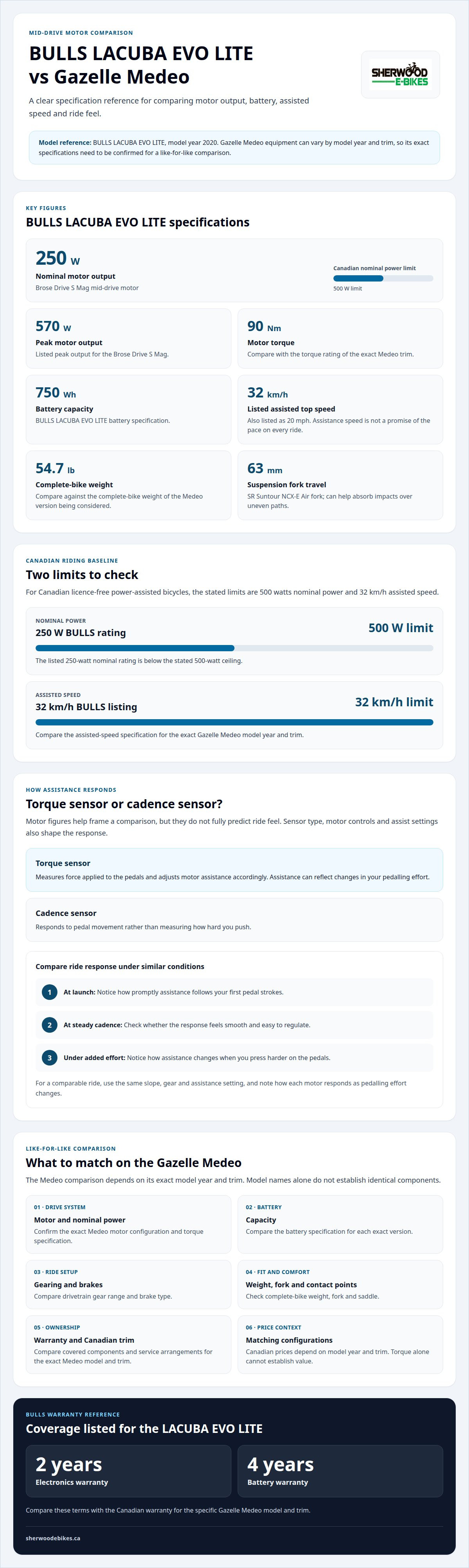
The BULLS LACUBA EVO LITE pairs a Brose Drive S Mag mid-drive motor with a 750 Wh battery. Its nominal output is 250 watts, with 570 watts peak output and 90 Newton metres of torque. These figures provide a defined reference point for comparing a specific Gazelle Medeo.
The LACUBA EVO LITE uses an SR Suntour NCX-E Air suspension fork with 63 millimetres of travel. That component can help absorb impacts over uneven paths. Gearing, brakes and saddle also affect control and comfort, but those details should be compared against the exact Medeo trim. Compare the drivetrain’s gear range, brake type and contact points, not just motor specifications.
The Medeo comparison depends on its exact trim, including gearing and brakes, so compare those specifications before deciding which setup suits your riding.
The BULLS model-year reference is the 2020 LACUBA EVO LITE. To identify Canadian trim differences, compare that designation with the precise model year and trim printed for the Gazelle Medeo you’re considering. Match motor, battery, gearing, brakes and frame equipment by version; model names alone don’t establish identical components.
The BULLS LACUBA EVO LITE has a two-year electronics warranty and a four-year battery warranty. For a Gazelle Medeo, compare the Canadian warranty terms for the exact model and trim, including covered components and service arrangements.
| Option | Motor and battery | Weight and comfort | Model-year reference |
|---|---|---|---|
| BULLS LACUBA EVO LITE | Brose Drive S Mag; 250 W nominal; 750 Wh battery | 54.7 lb complete; 63 mm suspension fork | 2020 |
| Gazelle Medeo | Compare the motor and battery for the exact trim | Compare complete-bike weight, fork and contact points | Match the Canadian model year and trim |
For Canadian licence-free power-assisted bicycles, the stated limit is 500 watts nominal power and 32 km/h assisted speed. The LACUBA EVO LITE’s 250-watt nominal motor falls below that power ceiling, and its listed assisted top speed is 32 km/h. Compare both bikes’ nominal ratings and assisted speeds when assessing their fit for Canadian riding.
Use each bike’s exact model name or specification sheet to compare them. Start with model year and trim, then check nominal motor power, supported speed, battery, weight, gearing, brakes and warranty. This helps you compare like with like and judge whether each configuration suits your routes.
Torque and cadence sensor ride feel
The Brose Drive S Mag gives the BULLS LACUBA EVO LITE a stated torque figure to compare with the Gazelle Medeo’s exact motor configuration. Torque describes rotational force at the motor, while nominal and peak output describe electrical power. These figures help frame the comparison, but they don’t fully predict how assistance will feel on a ride.
A torque sensor measures force applied to the pedals and adjusts motor assistance accordingly. A cadence sensor responds to pedal movement rather than measuring how hard you push. In practice, torque-based assistance can reflect changes in your effort, while cadence-based assistance responds to pedalling motion. The motor’s control system and assist settings also shape its response.
For the BULLS, the listed 90 Newton metres of torque indicates its motor’s rated turning force. Compare that figure with the torque specification for the specific Gazelle Medeo trim, not a different Medeo model year. A higher torque rating can be relevant for starts, steep sections and carrying extra load, but gearing, cadence and rider input also shape performance.
If both configurations are available, compare them on the same ride. Use the same slope, gear and assistance setting, and notice how each motor responds as you start pedalling and increase pressure. On a flat path, assess whether assistance feels predictable at a steady cadence. On a climb, see whether it supports your effort without requiring abrupt changes in pedalling.
- At launch: Notice how promptly assistance follows your first pedal strokes.
- At steady cadence: Check whether the motor’s response feels smooth and easy to regulate.
- Under added effort: Pay attention to how assistance changes when you press harder on the pedals.
Canadian prices for the BULLS LACUBA EVO and Gazelle Medeo depend on model year and trim. Compare listings for matching configurations; torque alone can’t establish value.
To assess torque per dollar, divide each bike’s torque rating by its current Canadian price, then compare matching trims. The result is a simple ratio, not a complete measure of value. Battery capacity, gearing, brakes, component condition and warranty coverage can all affect the buying decision. Price alone can’t tell you how a motor feels, just as a higher torque figure can’t describe the whole bike.
For the Bulls Lacuba EVO vs Gazelle Medeo mid-drive motor comparison, separate measurable output from personal ride feel. Use the BULLS specification as a reference, confirm the exact Medeo motor and sensor type, then compare starts, steady pedalling and climbs under similar conditions. This connects the figures to the riding response you’ll notice on your own routes.
Assisted top speed
The BULLS LACUBA EVO LITE has a listed assisted top speed of 20 mph, or 32 km/h. That figure describes the speed at which its motor provides assistance, not a promise that every ride will reach it. Your pace also depends on pedalling, route conditions, wind and the bike’s load. For a Gazelle Medeo, compare the assisted-speed specification for the exact model year and trim you’re considering.
In Canada, licence-free power-assisted bicycles are limited to 500 watts nominal power and 32 km/h assistance. The LACUBA EVO LITE’s 250-watt nominal motor is below that power limit, and its listed 32 km/h assisted speed matches the stated speed ceiling. A motor’s peak output is a separate measure; don’t substitute peak watts for nominal watts when comparing the Canadian limit.
Assistance cutoff matters most when you’re riding steadily near the limit. As the bike reaches its supported speed, the motor stops adding assistance, though pedalling can still move the bike. This helps explain why two e-bikes with the same supported-speed figure can feel different. Assistance delivery, gearing, riding position and rider effort all affect how easily they maintain pace.
Check the Gazelle Medeo’s specification label or model documentation for its supported-speed rating. Compare that figure with the BULLS listing, and confirm that the Medeo motor rating is expressed in nominal watts. A shared model name doesn’t mean different model years or trims have the same speed setting or motor equipment.
- Compare matching versions: Record the BULLS and Gazelle model year and trim before comparing speed.
- Separate power measures: Use nominal output for the Canadian licence-free limit, not peak output.
- Read the speed as assistance: A 32 km/h rating marks assisted speed, not a guaranteed cruising pace.
For commuting around Edmonton or Sherwood Park, consider how often your route lets you ride near the assistance ceiling. Frequent stops, intersections and turns can make smooth starts and predictable assistance more useful than a top-speed figure alone. On a long, open route, the 32 km/h supported speed may matter more to your riding rhythm.
A Bulls Lacuba EVO vs Gazelle Medeo mid-drive motor comparison should therefore separate legal limits from real-world pace. The BULLS LACUBA EVO LITE has a listed 32 km/h assisted speed and 250 watts nominal output. Compare those figures against the exact Medeo version, then consider how your route, pedalling and preferred cruising speed shape the practical difference.
Estimated riding range
The BULLS LACUBA EVO LITE has an estimated range of 40 to 100 miles, or 64 to 161 kilometres. Its battery is rated at 750 watt-hours. That published span gives a useful planning reference, not one fixed distance for every ride. The lower estimate and upper estimate reflect different demands on the battery. For comparison, use the range and battery details for the specific Gazelle Medeo model year and trim.
Battery capacity is only one part of estimating range. Assist level, terrain, rider input, stops and carried load all affect energy use. Repeated climbs demand more from the motor than steady riding on level ground, and frequent acceleration uses energy differently from maintaining a consistent pace. That’s why the same BULLS battery can support different distances on different routes.
For a fair BULLS and Gazelle comparison, start with each bike’s stated range and battery capacity. Then consider how closely the estimate reflects your regular ride. A commuter travelling mainly on level roads has different needs from a rider tackling sustained hills or carrying cargo. Compare range figures under similar conditions rather than setting one bike’s best-case estimate against the other’s more conservative figure.
Plan around your usual riding pattern. Note the climbs, stop-and-go sections, expected load and assist level you prefer. Then compare that profile with the BULLS LACUBA EVO LITE estimate and the corresponding Gazelle Medeo range information. Long climbs and high assistance place more demand on the battery than a flatter ride with lower assistance.
- Battery: Compare the 750 Wh BULLS battery with the capacity listed for the exact Medeo trim.
- Terrain: Mark steep sections and repeated climbs on your normal route.
- Assist: Consider the assistance level you actually use, not only the lowest setting.
- Load: Account for your riding gear or cargo when assessing each bike’s range estimate.
- Distance: Compare the route you ride with the published estimate, rather than treating the maximum as typical.
The BULLS estimate spans 40 to 100 miles, so the distance you plan to cover matters. A shorter daily trip and a longer outing place different demands on battery capacity. For a Gazelle Medeo, assess its matching model-year estimate against the same route, assistance and load. That keeps the comparison focused on your actual riding needs.
Range is most useful as a planning tool, not a standalone score. Match each bike’s battery and stated estimate to your route profile, then weigh the terrain and assistance you expect to use. The 750 Wh BULLS LACUBA EVO LITE provides a clear reference point; the best fit depends on how its estimate compares with the exact Medeo configuration and your regular rides.
Hill-climbing performance
The BULLS LACUBA EVO LITE combines a Brose Drive S Mag mid-drive motor with 90 Newton metres of torque and 570 watts peak output. Those figures help describe its climbing setup, but they don’t determine how quickly every rider ascends. Slope, gearing, rider effort, cargo and assistance settings also affect the climb. For the Gazelle Medeo, compare the motor figures for the exact model year and trim.
A mid-drive motor works through the bike’s drivetrain, so gear choice matters on climbs. Shift to an easier gear before your cadence becomes strained, then keep pedalling steadily. The right gear helps you use the motor while maintaining control. Starting a steep section in a high gear can make pedalling harder, even with motor assistance.
Your weight and any carried load add to the demands of a climb. Compare the Medeo’s weight and gearing for the exact trim you’re considering. A motor’s torque figure alone can’t show which complete bike will feel easier on your usual ascent.
Use a familiar hill to compare both bikes under similar conditions. Keep the route, rider, load and assist setting consistent. Start in a manageable gear, pedal smoothly and note how each motor responds as the slope changes. Repeat the climb in another assist setting only after the first comparison. This makes it easier to distinguish the effects of gearing and assistance.
- Before the climb: Select an easier gear and choose a consistent assistance setting.
- During the climb: Notice whether the motor response stays predictable as you pedal.
- After the climb: Compare effort, control and gear use, not just elapsed time.
For Edmonton-area routes, consider the kind of ascent you ride most often. A short, steep section tests low-speed response and gear selection. A longer climb puts more emphasis on sustained pedalling and managing assistance. If your rides include cargo, repeat the comparison with a similar load. This gives you a more relevant result than comparing unloaded bikes on different hills.
Assess the Gazelle Medeo using the same steps, with its specific torque, gearing and weight details. If specifications vary by trim, compare each version separately. Don’t assume the same model name means the bike will climb the same way across model years.
In this Bulls Lacuba EVO vs Gazelle Medeo mid-drive motor comparison, the BULLS figures are a useful starting point, not a complete verdict. Match each bike’s gearing to your climbs, then compare both on the same route. Choose the setup that lets you maintain a comfortable cadence and controlled effort on the hills you actually ride.
Sherwood E-Bikes: E-Bike Parts
Sherwood E-Bikes Ltd. offers E-Bike Parts and E-Bike Maintenance to help keep your e-bike in service. After comparing the BULLS LACUBA EVO and Gazelle Medeo, use the motor, battery and drivetrain details you’ve gathered to guide parts and maintenance decisions. For daily travel, explore Commuter E-Bikes; Cycling Accessories can help equip your ride for regular use.
Turn to Sherwood E-Bikes Ltd. for e-bike parts, maintenance, commuter bikes or cycling accessories. Share what you ride and what you need, and focus your comparison on the setup that suits your routes.
Contact Sherwood E-Bikes Ltd. or visit sherwoodebikes.ca to explore your next step.
Choose the ride that fits your next step
The right choice starts with your everyday ride, not the biggest specification on a chart. Consider your routes, how you want assistance to respond, and what matters most on climbs or longer trips. Then compare the exact model year and trim you’re considering, so your decision reflects the bike you’d actually ride.
If you’re ready to discuss your e-bike needs, contact Sherwood E-Bikes Ltd. A focused conversation can help you move from comparing specifications to choosing a ride that fits your plans. Take your questions with you, and keep moving towards your next ride with confidence.
Frequently Asked Questions
What motor, torque, and battery does the BULLS Lacuba EVO use?
The 2020 BULLS LACUBA EVO LITE is equipped with a Brose Drive S Mag motor rated at 90 Newton metres of torque. Its battery is rated at 37.5 volts and 20 amp-hours. These details help identify the specific configuration, which matters when looking at a used bike or comparing model labels. Check that the bike is the LITE version before applying these specifications to it.
How do the Lacuba EVO and Gazelle Medeo compare in motor assist feel and hill climbing?
The BULLS LACUBA EVO LITE is a specific Brose-equipped configuration, while “Gazelle Medeo” covers versions with different equipment. No single answer applies to every pairing. Focus on the exact bikes available and how each fits your needs, whether you carry a work bag or ride with a child seat. That context makes the comparison more useful than choosing a general winner.
What are the real-world range estimates for the BULLS Lacuba EVO and Gazelle Medeo?
The BULLS LACUBA EVO LITE’s estimated range is 40 to 100 miles, or 64 to 161 kilometres; use the estimate for the specific Gazelle Medeo version you’re comparing. For trip planning, map your intended stops and charging opportunities before setting out. Treat the lower end of the BULLS estimate as the more conservative planning reference, especially for a route where turning back or charging would be difficult.


