

There’s no automatic winner in a Trek Verve+ versus Specialized Turbo Como comparison for senior riders in Edmonton: the right choice depends on comfortable fit, easy mounting and the assistance you want. The Specialized Turbo Como 3.0 has a 530 Wh lithium-ion battery, while an e-bike’s practical range varies with rider weight, terrain, tire pressure, assistance level, wind and temperature. Compare how each bike feels on the road, not just its listed features.
When comparing the Trek Verve+ vs Specialized Turbo Como for senior riders in Edmonton, look beyond battery capacity. A bike that feels easy to mount and dismount, with handlebars comfortably within reach, can make everyday rides more enjoyable.
This guide compares battery range, motor power, rider fit and adjustability, with Edmonton riding conditions in mind. You’ll learn what to assess on each model and how a hands-on test ride can help you choose a bike that suits your needs.
Key Takeaways
- The Specialized Turbo Como 3.0 has a 530 Wh battery, but your practical range also depends on riding conditions and assistance settings.
- Compare how each bike’s frame, tyres and suspension features address your comfort and ease-of-mounting needs.
- Look beyond motor labels: the Trek Verve+ “s” models are noted for extra upper-end power from the Sport motor.
- Assess handlebar reach, saddle height and riding position during a test ride to judge fit and adjustability.
- Use the comparison to identify the features that matter most for your Edmonton routes and everyday rides.
1. Battery range
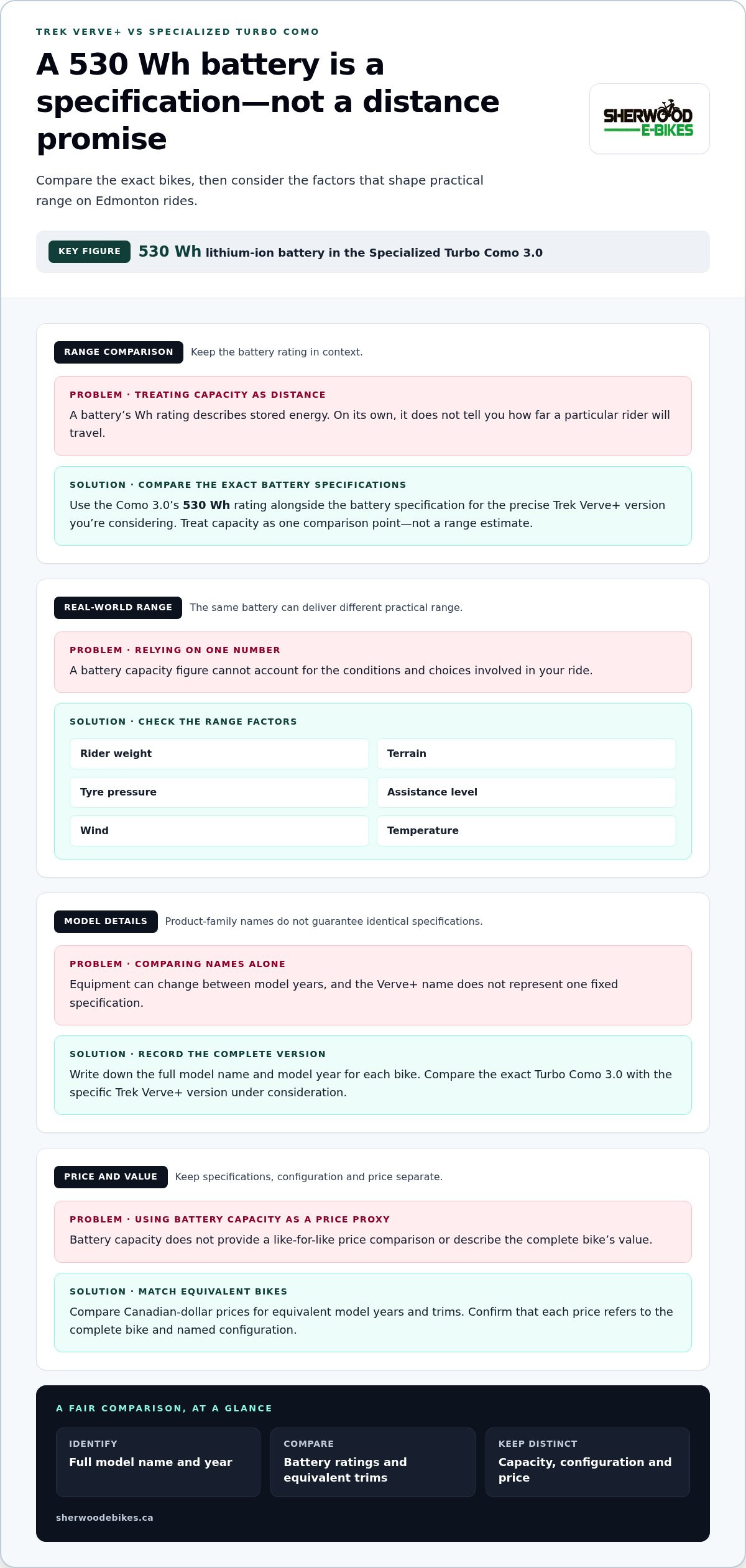
The Specialized Turbo Como 3.0 has a 530 Wh lithium-ion battery. For a fair Canadian comparison, match it with the precise Trek Verve+ model and model year, then compare their battery specifications and Canadian-dollar prices. Battery capacity alone doesn’t set a bike’s retail price, and a capacity figure cannot provide a like-for-like price comparison.
Read the battery rating as one specification, not a distance promise. Wh describes stored energy capacity; it doesn’t tell you how far a particular rider will travel. The Como 3.0’s 530 Wh rating gives you a concrete figure to compare with the battery rating for the exact Verve+ version you’re considering. Avoid treating the Verve+ name as one fixed specification.
Use model-year details to keep the comparison accurate. Bikes with the same family name can differ in equipment from one year to another. Record the complete model name and year for each bike before comparing battery figures, especially when comparing different versions or a new bike with a prior-year model.
When comparing prices, use Canadian-dollar prices for the same model year and trim. Confirm that each price refers to the complete bike and named configuration. Don’t use battery capacity as a proxy for value: it describes the battery, not the full bike specification or retail price.
- Identify each version. Write down the full Trek Verve+ and Turbo Como model names and model years.
- Compare battery ratings. Use the Como 3.0’s 530 Wh figure and the matching Verve+ battery specification.
- Compare prices fairly. Put Canadian-dollar prices for equivalent model years and trims side by side.
- Keep specifications separate. Battery capacity, model configuration and retail price describe different parts of the comparison.
For the reader asking about Canadian prices and specifications, the concrete battery specification here is the Specialized Turbo Como 3.0’s 530 Wh lithium-ion battery. A useful price comparison requires matching the exact Trek and Specialized versions and their Canadian-dollar prices; the battery rating doesn’t supply those prices. Use those matching details to judge the two bikes as complete options, rather than choosing by battery capacity alone.
2. Electric bikes recommended for seniors
The model versions named in this comparison are the Specialized Turbo Como 3.0 and Trek Verve+ “s” variants. These model names give you a starting point, but Canadian availability depends on the specific model year and retailer. Compare the exact versions being considered, rather than treating either product family as one fixed bike.
A recommendation for a senior rider should reflect comfort, control and planned trips. Consider how each bike feels during everyday starts and stops, and whether its controls are straightforward to use. A model that suits a flat neighbourhood route may feel different on a longer ride or a hillier Edmonton route.
An Edmonton-area test ride or purchase requires a retailer carrying the particular Trek Verve+ or Specialized Turbo Como version you want to try. The comparison information here does not identify a local retailer carrying either model. A useful ride should let you experience the exact bike, rather than a different model from the same family.
Local prices and promotions vary by model year, configuration and retailer. Compare Canadian-dollar prices for the same versions, and distinguish a sale offer from the equipment included with the bike. A lower advertised price may refer to a different configuration, so compare the full model name and included components before judging value.
Service options and warranty coverage are specific to the bike and seller. Review the written warranty terms for the exact model, including the components covered, and establish what service is available for that bike. Keep those details with the purchase quote so support and cost are part of the same decision.
When choosing between the Como 3.0 and a Verve+ “s” model, match the bike to your intended use. Think about whether you’ll ride mainly on city streets, recreational paths or routes with climbs. Then consider what riding position and level of assistance feel manageable for your usual pace and distance.
A short comparison record can make the decision easier. Note the exact model year, configuration, quoted price, promotion details, service terms and warranty coverage for each option. This helps you compare like with like when models are described differently or offered in different configurations.
Use the Specialized Turbo Como 3.0 and Trek Verve+ “s” as specific examples, not automatic recommendations for every senior rider. The best choice depends on how the actual bike suits your planned rides and personal preferences. A clear, model-by-model comparison helps keep the decision focused on your needs, ensuring you find the right fit through trusted local resources like Sherwood E-Bikes Ltd.
A forum member recommended Trek Verve+ “s” models for their extra upper-end power. Canadian legislation does not currently require UL certification for every electric bicycle sold in Canada.
3. Electric-bike selection criteria
For a Trek Verve+ or Specialized Turbo Como, consider mounting, control, braking, charging access and visibility together. Choose a bike you can manage in your routine, and follow the manufacturer’s battery-care instructions.
Start with the rides you expect to make around Edmonton. An errand bike needs to carry what you regularly bring, while a recreational ride may call for a different setup. Picture a typical outing: where you’ll stop, what you’ll carry and whether you’ll ride alone. This practical plan helps you prioritize useful features over specifications you may rarely need.
Plan for storage before choosing a model. Consider where you’ll park the bike and whether you can reach the battery and charging connection there. If you share a garage or storage area, allow room to move the bike in and out. Convenient charging and workable storage can matter as much as the ride itself.
Check whether the display and assistance controls suit you. On each model, find out how to view riding information and change assistance. Consider whether the screen is easy to read and the controls feel intuitive without distracting you from the route. These details can affect how confidently you ride familiar Edmonton streets.
Consider what you’ll carry, too. If you plan to bring groceries or personal items, decide how to carry them without interfering with steering or access to the controls. Identify your needs before choosing accessories: a regular shopping trip and a light recreational ride may call for different carrying arrangements.
Use these criteria to organize your comparison:
- Purpose: Match the bike to your usual Edmonton trips and what you plan to carry.
- Storage: Consider parking space and convenient battery-charging access.
- Controls: Check that the display is readable and assistance settings are easy to understand.
- Routine: Include battery care and visibility in your everyday riding plan.
Finally, consider how you’ll maintain the e-bike over time. Think about whether you’re comfortable with routine battery care and whether access to maintenance matters for your planned use. Compare the Trek Verve+ and Turbo Como as complete options for your routines, not just as a list of specifications. A short list of priorities helps you assess each consistently.
The poster described the Specialized Como as having a wider tire and front suspension fork, while the Trek Verve has a suspension seat post. Wider tires at the right pressure can improve comfort on rough pavement and recreational paths. Consider the surfaces you expect to ride and check the recommended tire pressure before setting out.
Braking is another practical comparison point. For older riders, hydraulic disc brakes can provide controlled stopping with less hand force than many mechanical brake systems. Integrated lights and tires with reflective sidewalls are useful safety features to prioritize on an e-bike. Assess these alongside fit, controls and storage, and consider whether they suit your usual routes and conditions.
4. Motor power
The Trek Verve+ “s” models use a Sport motor associated with extra upper-end power; the Specialized Turbo Como comparison depends on the exact model. The Como 3.0 battery capacity is 530 Wh, but battery capacity and motor power don’t establish range or hill-climbing performance by themselves.
For riding in Alberta and Edmonton, distinguish a bike’s legal classification from its brand name. Follow applicable helmet requirements and posted trail or path restrictions, and assess motor power and assisted speed under the rules for that classification. A Trek or Specialized badge alone doesn’t determine which rules apply.
Power figures help compare motors, but they don’t tell you everything about the riding experience. Motor response, assistance settings and how support is delivered affect how a bike feels when starting, climbing or accelerating. The available comparison identifies the Trek Verve+ “s” Sport motor as the upper-end power distinction. It does not establish an equivalent specification for every Verve+ or Turbo Como.
Test motor response on a gentle incline and then on flat ground. Notice whether assistance builds smoothly as you start pedalling and whether the selected setting feels manageable. A senior rider who prefers gradual support may value predictable response over maximum output. Another rider may prefer stronger assistance on routes with climbs or frequent stops.
Hill climbing depends on more than the motor label. Your assistance setting, pedalling effort, route gradient, rider and cargo weight, and battery charge all affect how a climb feels. Compare the bikes on the same slope and in similar assistance settings. Notice whether you can maintain a comfortable cadence without feeling rushed by the motor.
Battery capacity and motor output measure different things. The Como 3.0’s 530 Wh figure describes battery capacity, not the motor’s power or a guaranteed distance. Range varies with riding conditions, while power influences the assistance available. Use both specifications, alongside a test ride, rather than treating either figure as a complete performance score.
On Canadian product labels, check the exact model and motor specification before comparing versions. The Verve+ “s” designation matters because the Sport motor is the noted difference; don’t assume it applies to every Trek Verve+ model. Likewise, compare the specific Turbo Como version rather than applying one model’s specification to the entire line.
During a test ride, compare three moments: starting from a stop, climbing a familiar incline and easing off assistance. Notice whether the motor response feels controlled and whether you can pedal comfortably as support changes. These observations translate motor specifications into the riding feel you want on Edmonton streets and paths.
5. Rider fit and adjustability
For senior riders comparing the Trek Verve+ and Specialized Turbo Como in Edmonton, fit matters. Check saddle height, handlebar reach and riding position on both models. A bike that feels comfortable while stationary may feel different once you start, turn and stop.
Start by checking how easy it is to mount and dismount. A step-through frame can make mounting easier by reducing the need to swing a leg high over the saddle. Once seated, see whether you can reach the handlebars without leaning forward or stretching your shoulders. Repeat the assessment after riding, when you’ve also experienced the bike’s controls and balance in motion.
Handlebar reach is an important comparison point. The Specialized Turbo Como has a nonstandard stem and handlebar setup that may be difficult to change if it doesn’t suit you. Changing handlebars or the stem can significantly alter riding position. Assess how the current setup feels and whether adjustments would improve the fit.
Don’t assume an upright posture will suit every rider. One Trek Verve 3 owner found the bike too upright and sold it. That individual experience doesn’t determine how the model will fit you, but it shows why a test ride matters. Check whether you can maintain a relaxed, controlled position without feeling cramped or overextended.
Use the same checks on each bike:
- Saddle: Adjust its height so your legs feel comfortable while pedalling.
- Reach: Hold the handlebars and assess shoulder and arm comfort.
- Controls: Check that you can reach the brakes and assistance controls.
- Position: Ride, turn and stop to assess comfort beyond the showroom floor.
A professional fitting or test ride can help you assess saddle height, handlebar reach and riding position. Compare the Trek Verve+ and Como under similar conditions. If one bike feels uncomfortable, note the specific issue, such as handlebar distance or posture, instead of relying on a general impression. This gives you a clearer basis for comparing fit and adjustability.
Notice how the bike feels after several minutes, not just during the first few metres. On an Edmonton test route, include a turn and a stop to assess your reach while steering and braking. The better choice is the bike that supports a comfortable position and lets you operate its controls naturally.
Sherwood E-Bikes: E-Bike Parts
Sherwood E-Bikes Ltd. offers e-bike parts for maintenance and practical upgrades. If your comparison has clarified the fit and riding position you want, the store’s e-bike maintenance service can help with ongoing care, while cycling accessories can support your everyday setup. Riders still considering a city-focused option can explore commuter e-bikes.
For a Trek Verve+ or Specialized Turbo Como, use your test-ride notes to identify what you need next: replacement parts, maintenance or useful accessories. A clear list of priorities keeps your decision focused on your riding routine, comfort and intended use.
Contact Sherwood E-Bikes Ltd. to discuss your e-bike parts, maintenance or accessory needs.
Make your next ride your guide
Picture the rides you want to make part of everyday life. Think about the destinations you’d choose, the pace that feels comfortable and the support you want from your bike. That personal picture can turn a model comparison into a decision that fits your routine.
For your Trek Verve+ versus Specialized Turbo Como choice as a senior rider in Edmonton, focus on the bike you’ll feel ready to ride regularly. Sherwood E-Bikes Ltd. offers e-bike parts, commuter e-bikes and e-bike maintenance to support different stages of your e-bike journey. Whether you’re considering a commuter option or planning care for your current ride, choose a next step that matches your needs.
Explore your e-bike options with Sherwood E-Bikes Ltd. and move towards rides that feel right for you.
Frequently Asked Questions
How do the Trek Verve+ and Specialized Turbo Como compare in step-through frame height, weight, and rider fit?
There isn’t one frame-height or weight comparison that applies to every Verve+ and Turbo Como version. Compare the exact model and frame size, then check step-through clearance while mounting from the side you normally use. A lower, easier step-over can matter if lifting your leg is uncomfortable. Once seated, confirm you can place your feet securely when stopped and reach the controls without leaning forward.
Which bike has the most comfortable upright riding position, saddle, and suspension for senior riders?
Comfort depends on your proportions and posture, so neither model is automatically the better fit for every senior rider. The Trek Verve’s suspension seat post and Specialized Como’s front suspension fork address bumps differently. On a test ride, compare how each feels over the same uneven surface, then check whether the saddle and handlebar position remain comfortable. A familiar route can make the differences easier to judge.
What are the payload limits, maximum rider weights, and suitable frame sizes for each model?
Payload limits and maximum rider weights depend on the exact model version, so don’t apply one figure across the Verve+ or Como range. Match the frame size to the rider using that bike’s sizing guidance, and distinguish rider weight from total permitted load, which may include carried items. For example, if you plan to carry a bag, account for its weight within the bike’s stated payload limit.
What are the Canadian prices and specifications of comparable Trek Verve+ and Specialized Turbo Como models?
The Specialized Turbo Como 3.0 has a 530 Wh lithium-ion battery. Compare it with the exact Trek Verve+ model and year, using Canadian-dollar prices for equivalent model years and trims; no specific prices are provided.
Which Trek Verve+ models and Specialized Turbo Como models are currently available in Canada?
The models named are the Specialized Turbo Como 3.0 and Trek Verve+ “s” variants. Canadian availability depends on the specific model year and retailer.


