

The fastest or most powerful model isn’t automatically the best e-bike for men. Choosing a bicycle ebike starts with how you plan to ride: commuting, exploring off-road routes, carrying cargo or sharing rides with family. The right fit depends on how the bike’s design and features meet those everyday needs.
It makes sense to compare speed and motor power first, but range, riding position and practical add-ons can matter just as much once you’re on the road or trail. This guide explains how e-bike speed, motor power, battery capacity, bike styles and accessories shape the riding experience, so you can narrow your options with confidence. You’ll also see how choices such as a frame bag, a more relaxed saddle or basic maintenance tools can support different routines. Whether you’re planning an urban commute, a family outing or an off-road adventure around Sherwood Park and nearby communities, start with the rides you want to make possible.
Key Takeaways
- In Ontario, e-bikes must have a maximum assisted speed of 32 km/h, according to the Government of Ontario.
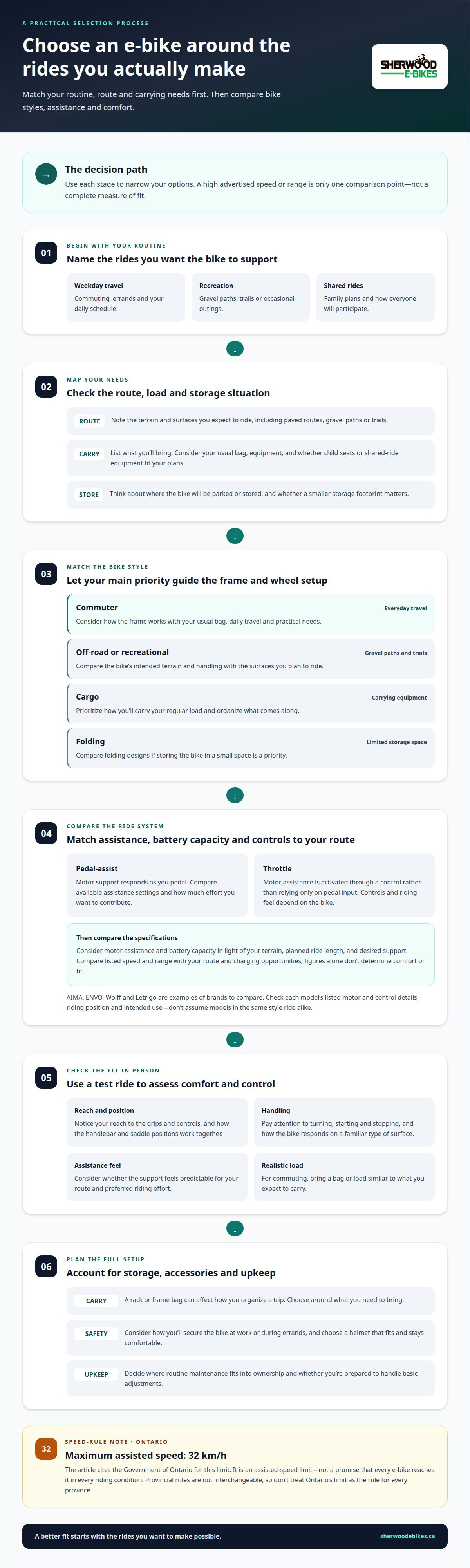
- Start with your usual routes and what you plan to carry to narrow down the bike style that suits your routine.
- Compare motor assistance and battery capacity in light of your terrain, ride length and how much support you want while pedalling.
- Choose accessories and spare parts around practical needs, such as a more relaxed saddle, frame storage or tools for basic adjustments.
- Sherwood E-Bikes offers commuter e-bikes, e-bike parts, maintenance and cycling accessories for riders refining their setup.
How fast can an electric bike go?
An electric bike’s assisted speed depends on its system and the rules where you ride. Before choosing a model, compare how its assistance works, what it is designed for and which features it supports.
Pedal-Assist and Throttle Operation
Pedal-assist systems provide motor support as you pedal. Assistance settings affect how much effort you contribute, so compare the available settings and consider your usual riding conditions. A commuter may value predictable support in stop-and-go traffic, while a rider tackling steep routes may pay closer attention to responsiveness and torque.
Throttle operation activates motor assistance through a control, rather than relying only on pedal input. The exact controls and riding feel depend on the bike. Before choosing, identify whether you prefer to pedal for motor support, use a throttle, or have both options. Then consider the route, desired effort and handling you want from the electric bike.
Comfort-focused electric cruisers suit riders who want a relaxed position for casual trips. Assess how the handlebar and saddle positions work together and whether the controls are easy to reach. For hills, consider motor response and torque alongside the bike’s intended use. A description such as “powerful” alone won’t tell you how the assistance will feel on your regular route.
AIMA, ENVO, Wolff, Letrigo and Rize are examples of brands to compare, but a name alone won’t tell you whether a bike meets your needs. Look at each model’s listed motor and control details, riding position and intended use. Compare specifications rather than assuming every bike in the same style rides alike.
Canadian E-Bike Speed Limits
In Ontario, e-bikes must have a maximum assisted speed of 32 km/h, according to the Government of Ontario. This is an assisted-speed limit, not a promise that every model reaches that speed in every riding condition. Check how the bike’s assistance behaves as you approach its supported limit, and distinguish motor assistance from speed gained through pedalling.
Canada-wide and provincial rules are not interchangeable. A speed limit that applies in Ontario should not be treated as the rule for every province. Federal and provincial requirements depend on the province and the e-bike’s classification. Consider the bike’s operating details when deciding where and how to ride.
Licence, registration and insurance requirements also depend on the rules in the province where you ride and the vehicle’s classification. An Ontario speed limit does not answer those separate questions across Canada. Treat speed, classification and riding requirements as distinct considerations when choosing an electric bike.
Choosing a bike for different lifestyles
Start with the rides you want the bike to support. A weekday commute, family outing and off-road weekend call for different priorities. Note your usual trip, where you’ll park or store the bike, and what you expect to carry. This helps you compare models against your routine rather than choosing by appearance or a single headline specification.
For commuting, consider how the bike fits your route and daily schedule. Think about mounting and dismounting in work clothes, where your bag will sit, and what you need to carry with you. A rack or frame bag can change how you organize a trip. A commuter model may suit regular travel, but the best setup depends on your storage and carrying needs. Exploring dedicated setups at an experienced retailer such as Pedalinx Bike Shop can also help you compare frame designs and accessories suited to daily city travel.
Recreation calls for different priorities. If you plan to ride gravel paths or trails, compare the bike’s intended terrain and handling with the routes you expect to use. Families should consider how everyone will participate and whether child seats or other shared-ride equipment fit their plans. For occasional outings, rentals offer a way to try an electric bike before choosing one for regular use.
Treat advertised top speed and range as comparison points, not a complete measure of fit. First identify models suited to your intended riding, then compare their listed figures and controls. A higher advertised speed may matter less than comfort and predictable handling on your route. For range, consider whether the stated capability suits the distance you plan to travel between charging opportunities.
A test ride reveals details a specification sheet can’t. Notice your reach to the grips and controls, how the bike turns, and whether starting and stopping feel comfortable. If you’ll commute, bring a bag or load similar to what you expect to carry. For recreation, pay attention to how the bike responds on a surface like the one you plan to ride.
Include upkeep and safety gear in your decision. Consider how you’ll secure the bike at work or during errands, and choose a helmet that fits and stays comfortable while riding. Ask yourself where routine maintenance fits into your ownership plans, and whether you’re prepared to handle basic adjustments. A model that suits your routine should be practical to store, equip and maintain, not just enjoyable on a test ride.
If you’re comparing Rize models, review the Rize e-bike options alongside your intended routes and carrying needs. Use your notes to narrow the choice, then focus on the model that best fits the trips you want to make.
Commuter, fat-tire, folding and cargo e-bikes
Choose a frame and wheel setup to suit your transportation needs, terrain and storage space. Commuter, touring, off-road, cargo and folding designs serve different routines. First decide whether your priority is carrying equipment, handling rough surfaces, storing the bike in a small space or riding regularly on paved routes. That priority makes it easier to compare styles without assuming one design suits every ride.
A commuter e-bike supports everyday travel, such as getting to work or running errands. Consider whether its frame suits your usual bag and whether the controls are easy to reach during frequent stops. A fat tire ebike has oversized, extra-wide tires for added traction on unstable surfaces. Compare its size and intended terrain with your routes, especially if you’ll move between pavement, packed paths and looser ground.
Touring designs suit riders who want to carry supplies on longer outings. Check how bags attach and whether they leave room for items you need to reach during a ride. Off-road models are intended for trail use, so consider terrain, tire tread and handling together. Cargo e-bikes prioritize carrying capacity. Think about loading access, where the load sits and whether your errands or family trips need that space. If you are comparing electric utility against traditional lightweight tarmac efficiency, reviewing setups from dedicated cycling shops like Chain Driven Cycles can clarify how drop-bar geometry handles long pavement routes.
Folding e-bikes address storage and transport constraints. Consider where you’ll keep the folded bike, how its folding mechanism works and whether you can manage it comfortably. Compare the folded shape with your actual storage area, such as a hallway cupboard or vehicle cargo space. Folding designs vary, so assess the specific frame rather than assuming all models fold or travel alike.
Hub motors can also be fitted to recumbent bicycles and trikes. A recumbent changes your sitting and steering position; a trike adds another wheel and a different balance profile. With either layout, consider how you’ll start, turn and park, particularly in confined spaces. If the model has a throttle, check whether its controls suit your riding style and how you’ll use them when starting.
For a local test ride in Sherwood Park, Edmonton, Leduc or St. Albert, bring a bag similar to the one you’ll carry. Try mounting, starting, turning and stopping, then assess visibility and access to the controls from the saddle. Ask to ride on a surface like the one you expect to use, such as pavement or an uneven path. This lets you compare fit and handling in practice.
To judge affordability, compare the complete setup rather than the model name alone. Consider whether the bike meets your carrying needs as sold or calls for added equipment, and include the parts needed for your planned use. A commuter design may be more practical than a cargo frame if you rarely transport bulky items. The best value is a model whose design serves your regular transportation needs without unnecessary features.
Motor power and battery capacity
Motor output and battery energy answer different questions: how the bike assists and how much stored energy it has. Compare both with the demands of your intended rides.
A motor’s power rating describes its electrical output, but not the full riding experience. Torque, gearing and assistance controls also affect the bike’s response. For example, assess how smoothly support begins when you pedal from a stop, especially on routes with frequent intersections. A torque sensor measures pedal force and adjusts motor assistance to match your input.
Use model specifications to make a direct comparison. The ENVO Stax Pro has a 500W power output, a motor rating to consider alongside the bike’s controls and intended use. Don’t treat wattage alone as a measure of hill-climbing ability or acceleration. Look for the motor’s torque information and how the assistance is delivered, then consider whether those details suit your riding preferences.
Dual-Battery Capacity and Range
A dual-battery e-bike has two battery packs, but how they connect and supply energy depends on the system. Compare each pack’s stated capacity and the combined capacity, using the same unit where possible. Capacity may be shown in watt-hours or amp-hours. Watt-hours account for voltage as well as amp-hours, making them useful for comparing stored energy across systems.
Check how the second battery is mounted and whether it affects the bike’s weight or balance. Follow the manufacturer’s instructions for charging and using both packs. A dual-battery setup can provide more stored energy, but it doesn’t establish a fixed distance for every ride. Your route and assistance settings still affect energy use.
Battery Range
Use a battery’s stated range as a planning guide, then check the assumptions behind the estimate. Look for details about assistance settings and riding conditions. If your route includes steep sections or a heavy load, account for those demands when estimating the remaining charge at your destination. A familiar route is a practical benchmark when comparing models.
Before deciding, map your planned ride and note charging opportunities, such as at home or work. Compare that routine with each model’s battery capacity and charging process. If you’ll make return trips before recharging, consider the day’s total riding rather than a single leg. This turns a broad range estimate into a useful planning question.
For battery care, follow the bike manufacturer’s instructions and use the specified charger. Before charging, check the battery casing, charger and cables for visible damage. Keep charging equipment orderly and disconnect it as directed when charging is complete. These checks make charging a regular part of bike care.
EBike accessories and spare parts
The right accessories help an electric bicycle suit your commute, workshop routine or outdoor plans. Start with the need: comfort, storage, visibility or basic adjustments. Then check how each item fits your bike. A saddle, frame bag and folding tool serve different purposes, so choose around the rides and maintenance you actually do.
For a more relaxed seating position, consider the Selle Royal Avenue Relaxed Saddle, Unisex, Black. A saddle affects your position and where your weight rests, so compare its shape with your riding posture and current seat. Check that the replacement fits your seatpost and bike before installing it. Fit matters more than appearance alone.
Storage can make daily trips and longer rides easier to organize. The DEUTER MONDEGO FRAME BAG offers a frame-mounted way to carry ride essentials. Before choosing a bag, check the available frame space and the placement of cables, battery components and bottle cages. Keep frequently used items accessible, and ensure the bag won’t obstruct controls or affect handling.
DIY riders can carry folding tools for routine adjustments. The Park Tool AWS-11 Folding Hex Wrench Set is a compact option for hex fasteners. Park Tool’s AWS-9.2 combines 4mm, 5mm and 6mm hex wrenches, a flat blade and T25. The TWS-2 Folding Torx Wrenches cover T7, T9, T10, T15, T20, T25, T27, T30 and T40. Match each tool to the fastener you need to work on.
Use a tool only on a fastener with the matching shape and size. A proper fit helps prevent damage to the tool or component. Keep adjustments within your skill level, particularly around electrical parts, brakes and motor connections. A folding wrench set supports basic mechanical work, but it does not replace the correct procedure for servicing an electric bicycle’s electrical system.
Replacement parts need careful matching. Compare the component type, dimensions and connection points with the part already on your bike. Replacing a Selle Royal Avenue Relaxed Saddle, for example, is different from choosing a crankset or brake pad. Record the part name and relevant markings before ordering to avoid selecting a component based on appearance alone.
Build a practical kit around your riding routine: a suitable saddle for comfort, a frame bag for essentials and correctly matched tools for minor adjustments. Add accessories only when they meet a real need. For outdoor rides, prioritize what you’ll carry and how you’ll secure it; for commuting, focus on items that support regular use and easy access.
Sherwood E-Bikes: E-Bike Parts
Sherwood E-Bikes offers e-bike parts and cycling accessories to suit your setup. Turn to its E-Bike Maintenance service when your bike needs attention, or explore Commuter E-Bikes for regular trips. The right replacement part depends on your bike’s existing components, so bring the model details or part information when discussing what you need.
Practical additions such as a frame bag or a saddle suited to your riding position can help tailor your setup. If you do your own maintenance, choose folding tools that match the fasteners on your bike. Compatible parts and accessories help you build a setup around commuting, recreation or upkeep.
Contact Sherwood E-Bikes or visit sherwoodebikes.ca to discuss e-bike parts and accessories.
Make your next ride fit your routine
Choosing a bicycle ebike that suits your routine is a practical starting point, not a commitment to one fixed setup. Think about the trips you want to make easier, then identify what would improve each ride: a comfortable fit, useful carrying space or support for regular travel. Your needs may change as commuting gives way to recreation or errands become longer outings, so prioritize a bike and equipment that suit your plans now.
Sherwood E-Bikes offers E-Bike Parts, Commuter E-Bikes and E-Bike Maintenance for different stages of ownership. Bring details of your intended use and current setup to the store. This gives you a clearer basis for exploring a suitable bike, replacement part or maintenance service without guessing what will fit.
Ready to take the next step? Contact Sherwood E-Bikes to discuss your e-bike plans, and move toward rides that work for you.
Frequently Asked Questions
What’s the best e-bike for men?
The best choice depends on fit and intended use, not simply gender. Compare frame geometry, riding position and handlebar reach, then consider whether you’ll commute, carry cargo or ride trails. For example, someone with a longer torso may prefer a different reach from another rider of the same height. A test ride helps you assess comfort, control access and how easily you can mount the bike.
Can I leave my e-bike outside overnight?
Storing an e-bike indoors is generally a better way to protect it from weather and theft. If it must stay outdoors, use a secure, covered location and follow the manufacturer’s storage instructions. Bring a removable battery inside for storage or charging only if the bike’s instructions allow it. Before riding again, check the frame, battery housing and electrical connections for visible damage or moisture.
What is the best long-range electric bicycle?
The best long-range model is one whose battery and riding setup suit your route. Compare battery capacity, assistance settings and whether the model supports a second battery. Then account for hills, cargo, frequent stops and charging access along the way. A loaded weekend tour has different demands from a short, flat commute. Treat advertised range as an estimate, not a guaranteed distance.
What’s the difference between a 500W and 750W e-bike?
Motor power ratings describe output, but they don’t tell you exactly how either bike will feel. Compare torque, controller response, gearing and battery alongside wattage. A rider carrying cargo or climbing hills may prioritize support under load, while a commuter may prefer smooth, predictable assistance. Also consider the e-bike’s intended use and the rules where you ride.
Where should I ride the e-bike?
Choose routes where cycling is permitted, and follow local signs and posted rules. For a first ride, select a familiar route with predictable surfaces and room to practise starting, turning and stopping. In Sherwood Park or Edmonton, plan around your bike’s handling and intended use. A commuter model may suit paved travel, while an off-road model is better matched to suitable trails.
Why is UL 2849 certification important for e-bikes?
UL 2849 gives you a specific certification to look for when comparing an e-bike’s electrical system. Check the exact model’s certification rather than assuming that one certified component means the complete bike carries the same certification. Certification is useful information for comparing products, but it doesn’t replace following the manufacturer’s charging and care instructions. Review the bike’s documentation alongside its battery and charger information.
What is the difference between a bicycle and an e-bike?
An e-bike adds an electric motor that assists the rider, while a bicycle without that system relies on the rider’s pedalling alone. On an e-bike, the motor works alongside your input rather than removing the need to operate the bike. For example, pedal-assist adds support as you pedal. Controls, assistance settings and motor operation vary between models, so compare those details before choosing.
What types of e-bikes are available in Canada?
Options include commuter, cargo, folding, fat-tire, touring and off-road models, as well as trikes and recumbent designs. Each style suits different priorities, such as compact storage, carrying loads, varied terrain or a particular riding position. A folding model may suit limited storage, while a cargo model is designed for carrying items. Compare the frame layout and intended riding conditions to narrow your choice.


