

A loss of motor assist doesn’t automatically mean the controller has failed. If you’re dealing with e-bike controller problems in Ardrossan, first check the battery fit, display and visible connections. Note any error code or unusual power behaviour before deciding what needs attention.
It’s understandable to suspect the controller when an e-bike cuts out or the display stops communicating. But a loose plug, poor battery connection or damaged cable can cause similar symptoms. Checking accessible connections first can help narrow down the issue.
This guide explains how to inspect the battery and its terminals, check display and controller connections, and recognize signs of interrupted communication or abnormal current. You’ll also learn when basic connection checks aren’t enough and professional diagnostics are needed. The goal is to identify a useful next step without replacing parts based on guesswork.
Key Takeaways
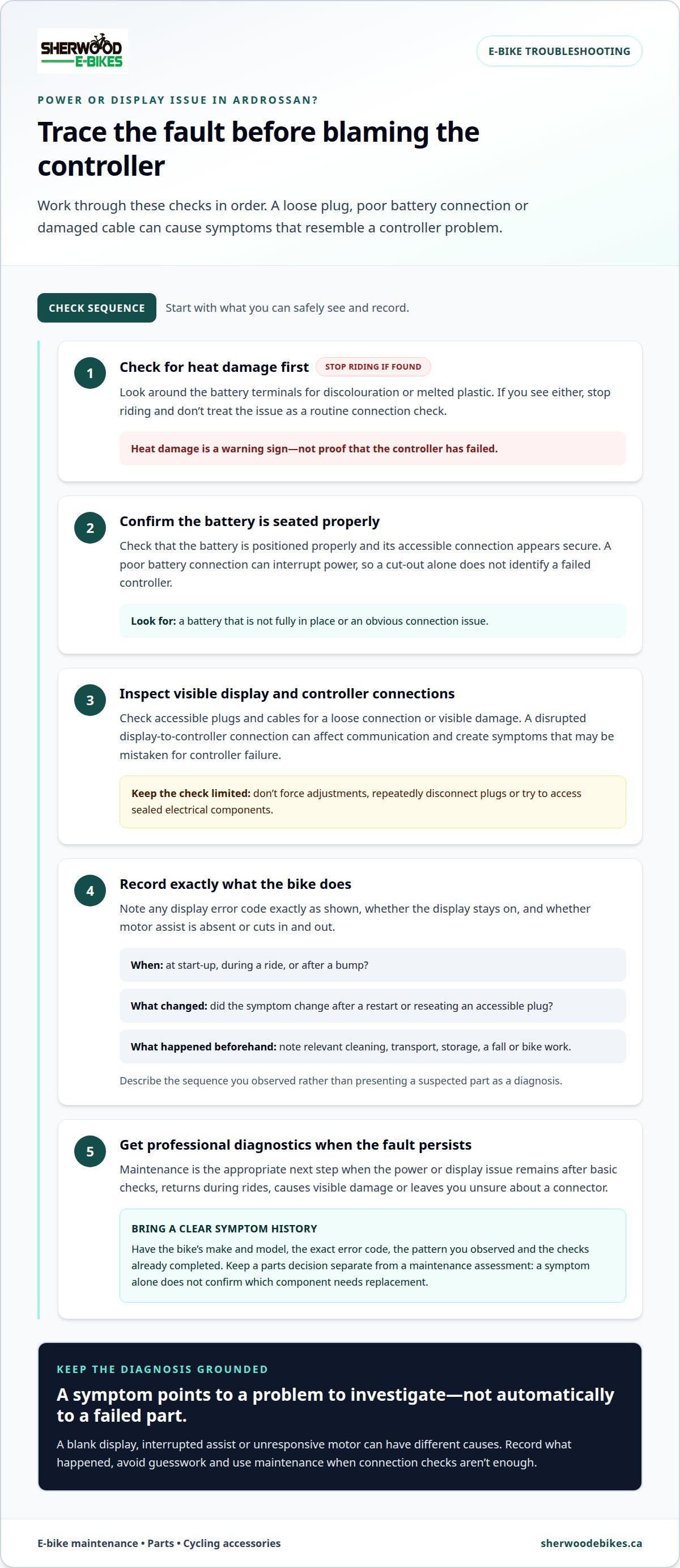
- Start with the battery fit and visible connections; a loose or damaged connection can interrupt power without proving the controller has failed.
- Look for discolouration or melted plastic around battery terminals, and stop riding if you find signs of heat damage.
- A display communication error can point to a disrupted connection between the display and controller; note whether it returns after reconnecting accessible plugs.
- Pay attention to recurring power cuts, unusual current errors, or motor wiring issues, since these symptoms may need professional diagnostics.
- Sherwood E-Bikes Ltd. offers e-bike maintenance and parts to support the next step when connection checks don’t resolve the problem.
Sherwood E-Bikes
Sherwood E-Bikes Ltd. provides E-Bike Maintenance when connection checks haven’t resolved a power or display issue, or when the fault keeps returning. If you’re in Ardrossan or nearby communities such as Sherwood Park, Edmonton, Leduc, Camrose, Fort Saskatchewan, St Albert, Vegreville, Morinville, Wetaskiwin or Spruce Grove, describe what the bike is doing and what you’ve already checked. That gives you a practical starting point for deciding whether maintenance or a parts question is the right next step.
An electrical symptom doesn’t identify a failed part on its own. A blank display, assist that cuts out or a motor that doesn’t respond can have different causes. Replacing a component without understanding the symptom may not solve the problem. Sherwood E-Bikes Ltd. offers E-Bike Maintenance, E-Bike Parts and Cycling Accessories. Each serves a different need, so be clear about whether you need maintenance, a replacement part or an accessory.
When maintenance is the right next step
E-Bike Maintenance is relevant when a power or display problem persists after basic connection checks, returns during rides or prevents you from relying on the bike as expected. It’s also appropriate if you notice visible damage or aren’t sure what a connector or component does. A recurring electrical fault is a reason to discuss maintenance, not assume one specific part has failed. Describe the pattern you’ve observed and the checks you’ve already completed.
Keep your description factual. Note whether the bike powers on, whether the display stays active, whether assist works consistently, and whether the issue occurs at startup or during a ride. Record any error code shown on the display. If the symptom appears after a bump, in wet conditions or under a particular riding demand, mention that without assuming it caused the fault. A repeatable pattern can make the problem clearer.
It’s useful to describe what changed before the problem began. Mention recent cleaning, transport, storage, a fall or work on the bike, if relevant. Don’t present a guess as a diagnosis. “The display turns off when I ride over uneven ground” is more useful than “the controller is broken” because it reports what happened without assuming why. If the issue comes and goes, explain when it returns and what the bike does just before and after the interruption.
Share the bike’s details and symptom history
For a productive conversation, have the bike’s make and model available, along with a concise account of its behaviour. If you know its age or have records of earlier maintenance, those details may help put the current symptom in context. You don’t need to take the system apart to prepare. A clear description of what you observed is more useful than a speculative diagnosis or an attempt to access sealed electrical components.
When an error code appears, record it exactly as displayed and explain whether it stays on or disappears after a restart. If the display works intermittently, describe that rather than reporting only its latest state. Do the same for assist: say whether it is absent altogether, cuts in and out, or works at some times but not others. These distinctions keep the discussion focused on the fault pattern.
If you’ve already reseated an accessible plug or checked that the battery is positioned properly, say so. Note what changed afterward, even if nothing improved. Avoid repeated disconnections, forceful adjustments or replacing parts just to see whether the issue disappears. Unrecorded changes can make the original symptom harder to understand and add another variable.
Separate what you observed from what you suspect. You may reasonably suspect the controller when the motor stops responding, but that observation doesn’t establish the cause. Describe the sequence: what the display showed, what the motor did and whether the behaviour changed after restarting. This helps keep the discussion open to other connections or components that may be involved.
Separate maintenance from a parts decision
E-Bike Parts are relevant when a replacement component is identified as the appropriate next step. A fault symptom alone doesn’t establish which part is needed. A display, cable, battery contact or controller may be part of the system being investigated, but don’t assume any one is the cause just because the bike lost power. Understanding the problem first helps avoid treating a parts purchase as a substitute for maintenance assessment.
If you have a specific part in mind, bring the bike’s make and model and explain why you believe that component is needed. The exact match matters: e-bike electrical components can be system-specific, and a similar-looking plug or part name doesn’t establish compatibility. Sherwood E-Bikes Ltd. offers E-Bike Parts, but a replacement should match the bike’s actual needs, not a guess based on a general symptom.
Parts and maintenance serve different purposes. A replacement part addresses a component need; maintenance is appropriate when the cause is uncertain or the system needs attention. If you’re unsure which applies, describe the symptoms and what you’ve already checked. This keeps the next step focused on the bike’s condition rather than committing prematurely to a replacement.
For example, a connector may appear damaged, but that visible issue may not explain every symptom. Describe what you can see and what the bike does, and keep the parts decision separate from assumptions about the rest of the system. This matters especially with intermittent faults: the bike may behave normally during one check and fail again later. A concise history gives context that a single observation cannot.
Don’t buy or install an electrical component based only on a general description of the problem. The bike’s system and the component’s intended connection both matter. If you’ve already obtained a part, keep its details available when discussing the bike, but don’t treat having it as proof that it’s the right solution. Match any parts decision to the actual need instead of replacing components one after another without a clear reason.
Keep accessory needs separate from electrical faults
Cycling Accessories can support how you use and maintain your e-bike, but an accessory won’t fix a controller, display or battery communication fault. If the electronics behave inconsistently, describe that issue separately from comfort, carrying or everyday-riding needs. Keeping those requests distinct makes the reason for your conversation clearer and prevents an accessory choice from being mistaken for maintenance.
For example, a commuter may want an accessory for daily practicality while also dealing with an intermittent display. Those are separate needs. Explain the electrical issue first, including when it occurs, then describe what you need from an accessory. An accessory should suit your riding and your bike, while a recurring electrical symptom calls for maintenance attention. One should not be assumed to solve the other.
This distinction matters for riders who depend on an e-bike for routine travel. A persistent fault can affect confidence in the bike, but choosing accessories or considering another bike won’t identify the cause. Keep troubleshooting separate from shopping decisions until the current bike’s condition is clearer.
If you have both kinds of needs, prepare separate notes. For the fault, record the conditions under which it occurs and any display message. For an accessory, consider the practical task it needs to serve. Keeping these details apart helps focus the discussion and avoids treating a convenience item as a solution to an electrical problem.
Consider another bike only when it fits the need
A persistent fault can lead you to consider whether your current bike still suits your regular trips. That’s a separate decision from diagnosing an electrical problem. Sherwood E-Bikes Ltd. offers Commuter E-Bikes for everyday travel, but exploring that option won’t diagnose a fault on a bike you already own. Clarify whether you need maintenance support for your current bike or are also considering a different commuting setup.
For a commuter-bike discussion, identify the practical demands of your routine: the kinds of trips you take, what you need to carry and what matters most in day-to-day use. Keep those needs specific. The right bike depends on how you plan to use it, and a controller symptom doesn’t establish which replacement bike would suit you. A new-bike conversation addresses a separate travel decision; maintenance addresses your existing bike’s condition.
You don’t need to decide between maintenance and another bike before asking for help. Explain both concerns if they apply. This separates what belongs with E-Bike Maintenance from what belongs in a discussion about Commuter E-Bikes. Keeping the choices distinct supports an informed decision and avoids treating an unexplained fault as an automatic reason to replace the bike.
A different bike can make sense if your travel needs have changed, but it shouldn’t distract from an unresolved fault if you still plan to ride your current one. Describe your immediate concern first. If you’re also considering a commuter option, raise it separately so the fault and your future riding plans each get attention.
Make the next step useful
Before reaching out, prepare a short note with the bike’s make and model, the symptom, when it occurs, any displayed error and the connection checks you’ve completed. Include a photo of visible damage only if you can take it without dismantling the bike. Don’t open the controller or disturb wiring to gather more information. A concise, accurate description is enough to begin a useful conversation about the next step.
If the issue involves a recurring interruption, explain how it affects the bike’s use. If the bike powers up but assist is inconsistent, distinguish that from a bike that won’t start at all. If the display shows an error, copy the code rather than relying on memory. These details don’t prove the cause, but they define the problem clearly and keep decisions about maintenance or parts grounded in what the bike actually does.
A clear symptom history can keep the discussion focused on the bike rather than a premature guess about parts. Include what you observed, what you’ve tried and whether the problem has changed. If you’re unsure of a technical term, describe the behaviour in plain language. You don’t need to name a suspected component unless you have a reason; report the display and motor behaviour as accurately as possible.
Once the issue is understood, the appropriate offering may be E-Bike Maintenance or E-Bike Parts. Commuter E-Bikes address a distinct everyday riding need, while Cycling Accessories may suit a separate practical requirement. Each serves a different purpose, and none should be treated as a guaranteed fix for an electrical fault. Explain what you’re experiencing and the outcome you need, then discuss the next step without guessing at a replacement component.
For riders in Ardrossan and the surrounding communities, Sherwood E-Bikes Ltd. can be part of the decision when an e-bike fault needs maintenance attention or when a parts question remains after basic checks. Bring a clear description of the symptoms and any error shown. Contact Sherwood E-Bikes Ltd. to discuss the next step.
Choose a Clear Next Step
Let the bike’s behaviour guide the next step. If the fault continues, don’t treat a suspected controller issue as a confirmed diagnosis. A clear account of the symptoms can help determine whether you need maintenance support or have a separate question about parts.
Sherwood E-Bikes offers E-Bike Maintenance and E-Bike Parts, as well as Commuter E-Bikes for everyday riding. If controller or display problems are disrupting your rides in Ardrossan, or in Sherwood Park, Edmonton, Leduc, Camrose, Fort Saskatchewan, St Albert, Vegreville, Morinville, Wetaskiwin or Spruce Grove, describe the symptoms and what you’ve already observed. Contact Sherwood E-Bikes to discuss the next step, focusing on the riding problem rather than committing to a replacement before the cause is understood.
Contact Sherwood E-Bikes Ltd. for help and take the next step towards getting back to confident riding.
Frequently Asked Questions
Can an e-bike controller be repaired, or does it need replacement?
The available information doesn’t establish that a controller can be repaired or must be replaced. Check accessible connections first, and seek professional diagnostics if the problem persists. Replace a component only when it’s identified as the appropriate next step.
What are common e-bike controller problems?
Power cuts, a blank or inconsistent display, and lost motor assist can result from loose or damaged connections and don’t by themselves prove controller failure. Error 21 points to current outside the expected range, while error 30 indicates interrupted communication between the controller and display.
What error codes or symptoms indicate an e-bike controller failure?
Error 30 indicates unstable or interrupted controller-display communication; if it persists, seek professional diagnostics. Error 21 indicates current outside the expected range and should be inspected if it repeats. Error 23 points to motor phase wiring, so stop riding until it is inspected; these codes do not alone confirm controller failure.


