

A mark on a RadWagon 4 frame may be paint damage, but a suspected crack shouldn’t be treated as cosmetic. A professional RadWagon 4 frame crack inspection in Sherwood Park can help distinguish the two and identify whether the frame needs attention before the next ride.
It’s understandable to focus on the visible mark. A careful assessment also checks frame welds and other areas where cracks may appear, since dirt, lighting, and the mark’s position can affect what is visible. If you suspect a structural crack, don’t ride the bike until it has been assessed.
This guide explains how a professional cleans and examines the frame, what signs can help distinguish chipped paint from a crack, and why riding with suspected frame damage carries risk. You’ll also learn which areas deserve close attention and what to expect from an inspection, so you can make a safer decision about your RadWagon 4.
Key Takeaways
- Pay close attention to welds and high-stress frame areas, including the motor mount, bottom bracket and head tube.
- Learn what an inspector looks for to distinguish a paint chip or scratch from a possible structural crack.
- A suspected frame crack can worsen under riding loads, so stop riding until the frame has been assessed.
- Know how a professional inspection considers the mark’s location, surrounding welds and visible changes to the frame.
- Understand when e-bike maintenance support can help you decide on a safe next step for your cargo bike.
Common e-bike frame crack locations
A cracked RadWagon 4 frame may be repairable, or it may require replacement. The decision depends on the crack’s location and extent, surrounding damage, and whether a repair can restore structural integrity. Because the RadWagon 4 frame is made from 6061 aluminium alloy, a visible mark alone cannot establish a safe repair. A RadWagon 4 frame crack inspection in Sherwood Park can assess the mark in context.
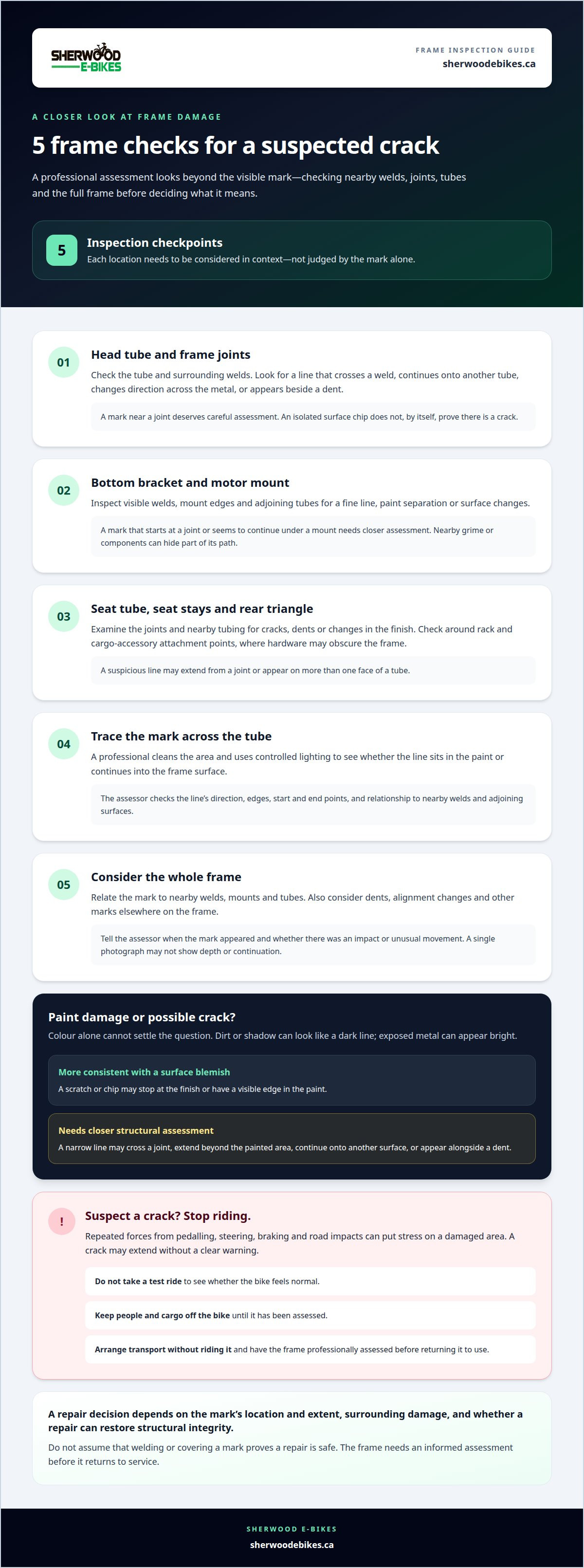
- Inspect the head tube and its frame joints. The head tube connects the front fork and handlebar assembly to the main frame, so an assessor examines the tube and surrounding welds. Look for a line that crosses a weld, continues onto an adjoining tube, or appears beside a dent. A paint scratch that stops at the surface differs from a line that follows a joint or changes direction across the metal.
The inspector also considers the mark’s position relative to the steering assembly. Damage near a joint deserves careful assessment because the surrounding structure affects how the frame carries load. An isolated chip on an exposed surface does not prove there is a crack. Don’t dismiss a line crossing a weld as paint damage without closer examination.
- Examine the bottom bracket and motor-mount area. The crankset and motor attach near this part of the frame, making the bottom bracket a key inspection point. An assessor checks visible welds, mount edges, and adjoining tubes for a fine line, paint separation, or surface changes. A mark starting at a joint and extending into a tube needs more attention than a shallow scrape on an exposed face.
The assessment should cover the structure surrounding the mark, not just its most visible point. Grime or nearby components can obscure a crack’s path. A line that appears to continue under a motor mount or along a weld needs assessment before the bike returns to use. Its location and pattern help distinguish a surface blemish from possible structural damage.
- Check the seat tube, seat stays, and rear triangle. The seat tube meets other frame members, while the seat stays connect the rear wheel area to the main frame. A professional examines these joints and nearby tubing for cracks, dents, or changes in the finish. Pay attention to rack and cargo-accessory attachment points, where hardware can hide parts of the frame during a visual inspection.
The RadWagon 4’s rear section supports the wheel and attached loads. The assessor should inspect around rack attachment points and the seat-tube junction, rather than stopping at an obvious surface mark. A scratch may follow the direction of contact. A crack can extend from a joint or appear on more than one face of a tube.
- Trace each suspicious mark across the tube. A professional cleans the inspection area and uses controlled lighting to see whether a line sits in the paint or continues into the frame surface. The assessor compares its direction and edges, then checks how it relates to nearby welds. A chip often has a visible edge in the finish; a suspected crack may form a narrow line across a joint or beyond the painted area.
Don’t judge by colour alone. A dark line can be dirt or a shadow, while a bright mark can be exposed metal rather than a structural split. The assessor records where the line starts and ends, then checks adjoining surfaces for continuation. This helps distinguish cosmetic damage from a pattern that needs further structural evaluation.
- Assess the whole frame before deciding what the mark means. A frame inspection should relate the suspicious location to nearby welds, mounts, and tubes. For example, a line near the bottom bracket has a different context from a scratch at the centre of a tube. The inspector considers dents, alignment changes, and additional marks elsewhere on the frame.
For a RadWagon 4 frame crack inspection in Sherwood Park, tell the assessor when the mark appeared and whether the bike experienced an impact or unusual movement. That context helps focus the assessment without assuming the cause. One photograph may not show depth or continuation, so the professional considers the full visible area, not only the clearest image.
A repair decision also depends on whether the damaged area can be properly assessed and whether the repair would restore the frame’s structural integrity. A visible crack near a weld may raise different concerns from a surface scratch. Don’t assume welding or covering the mark proves a repair is safe; the frame needs an informed assessment before it returns to service.
Risks of riding with a suspected crack
- Stop riding as soon as you suspect a frame crack. A hairline crack can affect how the frame carries forces from pedalling, steering, braking, and road impacts. Continued riding puts repeated stress on the damaged area. The line can extend, and the frame can lose strength without giving a clear warning beforehand.
Do not take a RadWagon 4 on a short test ride to see whether it feels normal. A crack can remain difficult to detect through handling alone. Park the bike and arrange a professional assessment before riding again. This precaution applies even when the mark looks narrow or the bike still steers normally.
- Keep people and cargo off the bike until it is assessed. A loaded RadWagon carrying children and groceries can weigh more than 100 lb. That load adds stress to the frame while the bike moves, turns, and crosses uneven ground. A suspected crack near a joint or attachment point deserves particular care because the damage can affect a part supporting the bike’s structure.
Remove the bike from family transport plans rather than carrying a child for a short trip. Avoid loading panniers, cargo, or other items onto the frame. Reducing the load does not make a cracked frame safe to ride; it only avoids adding unnecessary force while the bike is parked.
- Arrange transport without riding the bike. If the RadWagon 4 needs an inspection, move it using a method that does not put a rider on the frame. A vehicle or suitable cycle transport arrangement can prevent additional riding stress. Keep the bike stable during handling and avoid lifting it by a damaged tube or suspected crack.
Tell the person handling the bike where the mark appears. For example, say whether it is near the bottom bracket, head tube, or rear rack attachment. That detail helps prevent pressure on the affected area during loading and unloading. Don’t use the suspected frame section as a tie-down point.
- Describe what happened before the mark appeared. Give the inspector a clear account of any hard pothole or curb impact, sudden noise, or change in handling. A sharp click, for example, can help identify which area to focus on. Explain whether the sound occurred while pedalling, braking, or crossing an obstacle.
Include changes you noticed after the impact, such as a new line near a weld or a visible shift in a mounted component. Avoid presenting a guess as a diagnosis. A concise sequence of events gives the professional useful context and helps them assess the frame’s condition more accurately.
- Have the full affected area assessed, not just the visible line. A crack near the bottom bracket can extend beyond the easiest area to see. One account described a hidden bottom-bracket crack growing half an inch within three weeks after an initial inspection missed it. This illustrates why a brief glance at one surface cannot establish that a frame is sound.
The professional should examine the mark, nearby welds, and adjoining frame surfaces. The location and direction of a line matter, as do any dents or changes around a joint. Keep the RadWagon 4 parked while that assessment takes place. Do not treat a small visible mark as proof that damage is minor.
- Keep the bike out of service while the inspection is unresolved. A suspected crack is not cleared just because it stays the same size during a stationary check. Riding adds movement and load that a parked bike does not experience. A later trip across rough pavement can place different forces on the frame than a smooth indoor roll.
Mark the bike as unavailable to other household riders, especially where children share the RadWagon 4. Store it where nobody will mistake it for a ride-ready bike. Resume riding only after the professional assessment determines the frame is suitable for use and any necessary work is complete.
- Follow the inspection outcome rather than trying a quick fix. Paint, tape, or adhesive can cover a mark without restoring the frame’s strength. A suspected structural crack needs an assessment that considers its position, extent, and surrounding material. Don’t sand, drill, heat, or paint over the area before inspection, as these actions can obscure visible evidence.
If the assessor identifies structural damage, follow the recommendation for the RadWagon 4 instead of testing a repair through riding. A crack can compromise control if the frame’s behaviour changes under load. Keeping the bike parked protects the rider and passengers while the next step is decided.
Sherwood E-Bikes Ltd.
Sherwood E-Bikes Ltd. offers E-Bike Maintenance for riders who need help deciding what to do after finding a suspicious frame mark. A RadWagon 4 frame concern should be assessed before the bike returns to riding. Maintenance support gives you a place to discuss the bike’s condition and the practical next step, without treating a visible mark as a diagnosis.
Bring the bike with the affected area easy to identify. Explain when you first noticed the mark, whether the bike took an impact, and whether you heard a sound or felt a change in handling. These details give the mechanic useful context. They don’t replace an assessment of the frame, but they can help keep the discussion focused on your concern.
- Describe the concern clearly. Point out the mark and its location, such as near a weld, motor mount, or rear rack attachment. Say whether it appeared after a pothole, curb strike, or other incident. Include any change in how the bike sounds or handles. A specific account helps distinguish the frame concern from unrelated service needs, such as a loose accessory or drivetrain issue.
If the mark is difficult to describe, note what makes it stand out. It may cross a joint, follow a weld, or sit beside a dent. Keep your explanation factual and mention when you first observed it. This helps the mechanic understand what you’ve noticed without assuming a particular impact caused structural damage.
- Keep the bike parked while the concern is unresolved. Don’t ride the RadWagon 4 to test whether the mark affects its handling. A frame under load experiences forces that a stationary bike does not. If you need to bring it in, arrange transport without riding it. This matters especially when the bike carries a child seat, groceries, or other cargo.
Tell other household riders that the bike should remain unused until the concern is assessed. A family member may not know why it was parked, particularly if the mark is difficult to see. Clear communication helps prevent a short errand or test ride from adding load before you understand the frame’s condition.
- Use maintenance support to clarify the next step. E-Bike Maintenance addresses a bicycle’s upkeep and condition. Sherwood E-Bikes Ltd. provides maintenance and repair services, including tune-ups and electrical diagnostics, to help assess the bike’s condition and plan service. A frame mark may need assessment beyond routine maintenance, so don’t treat a tune-up or replacement part as proof that structural damage is resolved.
Ask for recommendations that address the concern being assessed. For example, a brake adjustment addresses braking performance, while a frame concern relates to the bicycle’s structure. Keeping those needs separate makes it easier to understand what each service recommendation addresses and whether the bike is ready to ride.
- Separate frame concerns from parts needs. Some e-bike issues involve a replaceable part; a structural frame problem is different. Sherwood E-Bikes Ltd. offers E-Bike Parts for maintenance needs, but changing a component does not repair a crack in the frame. The affected area and the mechanic’s assessment determine whether a part is relevant or whether the frame needs a separate decision.
Describe any other issue separately, such as a worn component or loose accessory. That gives the mechanic a clearer picture and helps prevent a parts question from being mistaken for a frame assessment. If the visible mark is your main concern, keep it at the centre of the discussion.
- Follow a clear ride-or-park decision. Before using the RadWagon 4 again, make sure the frame concern has been addressed in the service plan. If the assessment identifies structural damage, keep the bike parked while the appropriate next step is determined. Don’t cover a mark with paint or tape and assume that the frame is ready for use.
When discussing the outcome, focus on what the assessment means for the bike’s use and any recommended work. A replacement accessory or routine adjustment does not resolve a separate structural concern. Keep the bike out of service until the frame question has been addressed.
Useful details include the bike’s model, the mark’s location, and what happened before you noticed it. A clear photo can show the visible area, but it cannot establish the depth or extent of a crack. Keep the mark visible and avoid sanding or painting it before discussing the concern. This gives the mechanic a useful starting point and preserves the area’s appearance for assessment.
Maintenance needs can also extend beyond the frame. If the RadWagon 4 has a worn component, accessory issue, or another service concern, describe each item separately. Sherwood E-Bikes Ltd. offers E-Bike Maintenance and E-Bike Parts for different needs, so a clear description supports a more useful discussion of what each recommendation addresses.
For families and cargo-bike riders, pausing use can disrupt daily travel. Still, transporting a bike for assessment is different from carrying passengers on a frame with suspected damage. Keep children and cargo off the RadWagon 4 until the frame concern has been addressed. That gives you a clearer basis for deciding how to manage the bike’s next use.
If a visible frame mark has left you unsure about the next step, contact Sherwood E-Bikes Ltd. to discuss E-Bike Maintenance for your RadWagon 4.
Frequently Asked Questions
How can a professional tell a paint scratch from a frame crack?
A professional examines the mark’s edges, depth, direction, and relationship to nearby welds. A scratch usually affects the finish, while a crack can continue through or beneath it. The inspector may clean the area and use angled light to reveal surface changes. A mark that crosses a weld or appears on adjoining surfaces needs closer assessment than an isolated scuff from a rack or accessory.
How often should I check my e-bike frame for cracks?
Inspect the frame every 200 miles or monthly, and check it right after a hard pothole or curb impact. A quick look during routine cleaning can help you notice a new mark sooner. Cargo use, frequent rough surfaces and changes in handling are useful reasons to pay closer attention between scheduled checks. Stop riding if you find a suspected crack, rather than waiting for the next inspection interval.
Is it safe to ride an e-bike with a hairline crack?
No. Don’t ride an e-bike with a suspected hairline frame crack. Pedalling, braking, and road impacts place changing loads on the frame, which can worsen existing damage. A hairline mark’s small appearance doesn’t establish that it is harmless. Keep the bike parked and arrange an assessment before using it again, even for a short trip or a ride without cargo.
During a professional RadWagon 4 frame inspection, what cracks or defects should be checked?
The inspection should cover the frame’s welds, joints, tubes, and attachment areas, including the head tube, bottom bracket, motor mount, and rear rack connections. The professional also looks for dents, distortion, finish separation, and marks that continue across adjoining surfaces. For a cargo bike, the frame inspection should account for areas that support mounted accessories, since hardware can conceal part of a joint.
How often should a RadWagon 4 frame be inspected, and what signs mean stop riding?
Check the frame every 200 miles or monthly, and inspect it immediately after a hard impact. Stop riding if you notice a line that may be a crack, a new dent, visible distortion, or a sudden change in handling or sound. A new click after striking a curb, for example, calls for parking the bike until the frame has been assessed.
Is it safe to transport or ride a RadWagon 4 with a suspected frame crack?
Don’t ride it, even to reach a repair shop. Transport the RadWagon 4 without placing a rider or cargo on it, and avoid securing straps over the suspected damage. If you’re loading the bike into a vehicle, support it at sound parts of the frame and keep the affected area visible. Tell the person handling it where you found the mark.


