

The lowest monthly payment can still lead to the wrong family cargo e-bike. Before comparing financing, map the trips you expect to make: who will ride along, what you will carry, and where the bike will fit at home and on your regular routes. If you are considering a family cargo e-bike Camrose, everyday fit matters as much as the payment.
Weigh the bike’s family-carrying setup against the amount you would repay over time. This guide helps you identify the features your routine calls for, compare product information, and plan a budget around the purchase and the lender’s full terms, including the APR.
You will also find a practical way to assess whether a bike suits your family’s trips before committing. We cover what to compare and how a test ride at Sherwood E-Bikes Ltd.’s Sherwood Park showroom can help you assess fit and handling. Shoppers from Camrose, Sherwood Park, Edmonton, Leduc, Fort Saskatchewan, Ardrossan, St Albert, Vegriville, Morinville, Wetaskiwin and Spruce Grove can use these steps to plan their next move without letting a monthly payment decide for them.
Key Takeaways
- List your regular family trips, riders and cargo needs before narrowing your options.
- For a family cargo e-bike Camrose shortlist, compare product-page details with your household’s priorities rather than assuming a bike’s capacity or passenger setup.
- Assess the lender’s full offer, including APR, repayment schedule and total amount payable, not just the monthly payment.
- Compare Aima, Letrigo and Rize using details supported by their relevant product pages.
- Shortlist a bike, review its details, compare lender terms and use a showroom test ride to assess fit and handling.
Family cargo e-bike in Camrose: start with the family’s everyday needs
Match the bike to your regular family journeys before comparing payment options. A family cargo e-bike Camrose households consider should suit the people and belongings it will carry, the trips you expect to make, and the space available for storage. List your frequent uses, then separate daily essentials from occasional plans. This gives you a practical shortlist without assuming one cargo-bike layout suits every family.
Cargo bikes come in different designs for carrying people or goods. The overview of cargo bike designs and uses can help you understand the range of layouts before comparing specific products. Use it as background, and rely on each product’s own information for its specifications and intended setup.
Which family trips should a cargo e-bike handle?
Map the journeys you make often, not just the rides you might take someday. Note your usual destinations, approximate trip length, and how often you would carry passengers, groceries, bags or other belongings. Also consider where you will store and secure the bike between rides. Its shape and storage needs can affect how easily it fits into your household routine.
- Daily essentials: regular errands, school trips or other recurring journeys.
- Occasional needs: recreational rides or less frequent trips with extra belongings.
- Storage: the space available where you keep and secure the bike.
This list helps you focus on relevant configurations before comparing prices. If you plan to carry a passenger, check that the product information describes a suitable passenger setup. Alberta rules permit passengers only when the e-bike has a designated seat for each passenger.
Who needs to fit the bike and its riding setup?
The primary rider should assess reach to the handlebars, seating comfort, mounting and dismounting, and access to the controls during a test ride. If more than one adult may ride, have each person consider their fit rather than assuming one setup will feel right for everyone. Sherwood E-Bikes Ltd. offers showroom test rides and personalized advice to help you assess fit and handling.
Consider how your needs may change. Children grow, passenger needs shift, and family routines evolve. Check whether the bike’s documented passenger and accessory options suit your plans. Confirm compatibility in the product information for the exact bike and accessories; do not assume that a seat, rail or other item will fit because it works with a different model. A clear needs list gives you a stronger basis for comparing options.
Compare family cargo e-bike features by fit, carrying needs, and product details
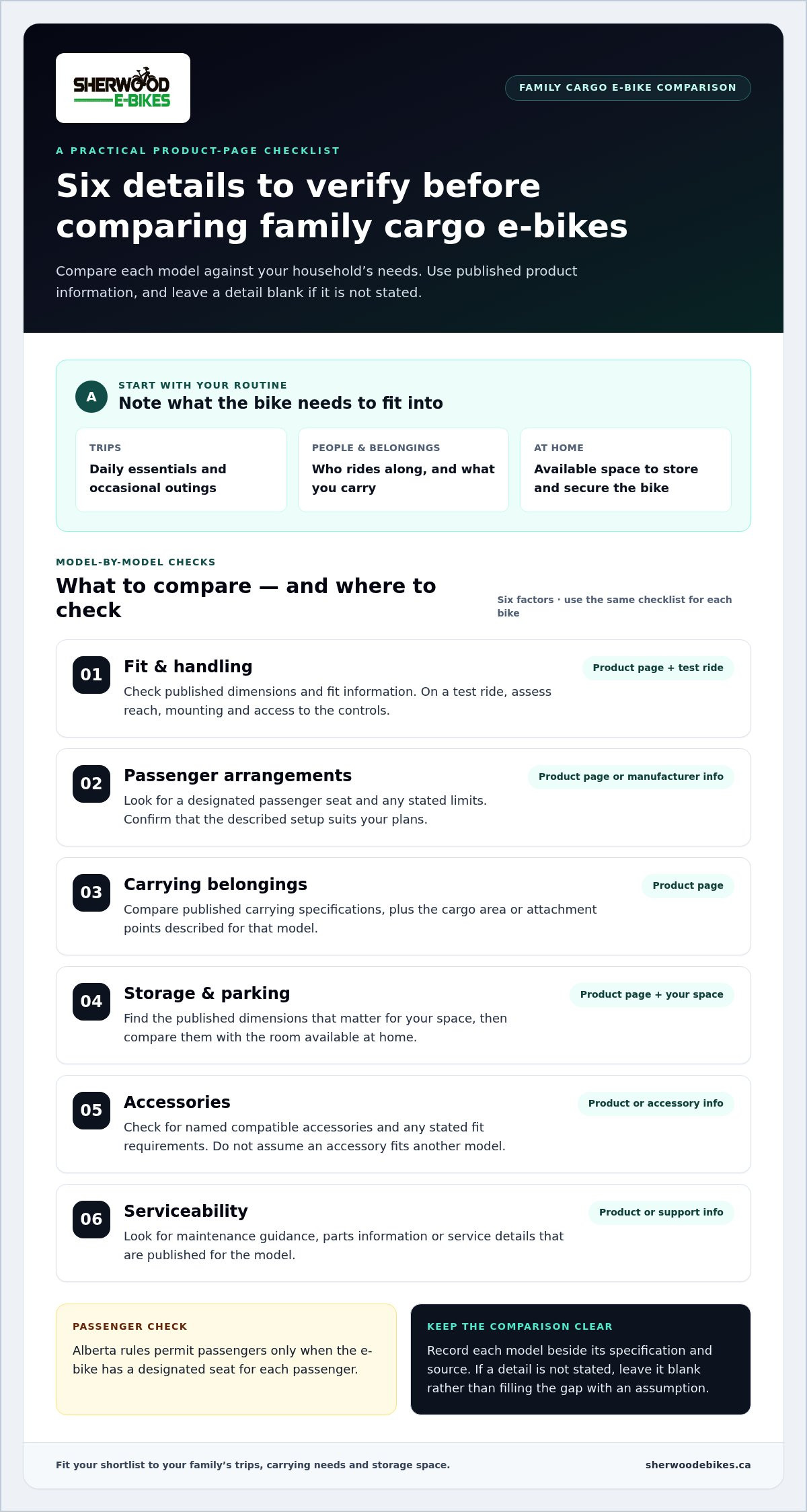
Once you have defined your household’s needs, compare bikes using the same checklist. A familiar brand name or a bike’s appearance does not establish its passenger setup, capacity, dimensions or accessory compatibility. Use current product information for each model and record where each detail comes from. If a specification is not stated, leave it blank rather than filling the gap with an assumption.
Build a comparison table before weighing prices. It makes differences easier to spot and shows which details to examine during a test ride or product review.
| Family need | Product detail to check | Source of that detail |
|---|---|---|
| Fit and handling | Published dimensions and stated fit information; assess reach, mounting and control on a test ride. | Product page and your own test ride |
| Passenger arrangements | Whether the product information describes a designated passenger seat and any stated limits. | Product page or linked manufacturer information |
| Carrying belongings | Published carrying specifications and the cargo area or attachment points described for the model. | Product page |
| Storage and parking | Published length, width or other dimensions that matter for your storage space. | Product page; compare with your available space |
| Accessories | Named compatible accessories and any stated fit requirements. | Product page or linked accessory information |
| Serviceability | Published maintenance guidance, parts information or service details. | Product page or linked support information |
How does the layout fit your household routine?
Compare the layouts described on the product pages, then picture an ordinary outing: loading belongings, arranging any passenger setup described for that model, parking and putting the bike away at home. Consider whether your household can manage those tasks in the spaces you use. Do not assume a child seat or accessory will fit because a bike appears to have room for it; look for model-specific compatibility information.
Which specifications belong on your shortlist?
Record each model name beside its published dimensions, motor details, battery specifications and carrying figures. Add the product page or linked manufacturer source for each detail. This makes it easier to compare like with like and revisit information without relying on memory. For example, review the Letrigo e-bike details and Rize e-bike details, then note only the specifications stated on each page. These links are starting points for reviewing product information, not proof that either model has a particular family-carrying configuration.
Keep gaps in the information visible. If a page does not provide a detail you care about, mark it “not stated” rather than treating the blank as a feature or limitation. Compare published information first, then use a showroom test ride and personalized advice from Sherwood E-Bikes Ltd. to assess practical fit and handling. This gives your family cargo e-bike Camrose comparison a sound basis before you consider financing.
Financing a family cargo e-bike: compare the full commitment, not just payments
First settle on a bike that suits your needs, then compare the written financing offers available to you. A payment that looks manageable on its own does not show the full cost of borrowing. Review the complete agreement and use its figures, not an estimated rate or payment, to make your decision.
Which financing terms should you compare before deciding?
Read the lender’s written offer and agreement. Compare the stated interest rate, fees, repayment period, payment frequency and total amount you will repay. Check the schedule and all terms before accepting, including any conditions that affect payments. A smaller payment made more frequently or over a longer period can represent a different overall commitment. Compare the total repayment as well as the amount and timing of each payment.
Use this checklist with the actual documents for the offer you are considering:
- Record the purchase amount. Note the bike amount and any confirmed accessories you plan to include. Record amounts in C$.
- Enter the down payment. Use the figure stated in your plan or lender offer, then note the amount left to finance.
- Write down the payment schedule. Record the payment amount, frequency and repayment period exactly as shown.
- List interest and fees. Copy the stated rate and each applicable fee from the offer. Do not fill gaps with estimates.
- Compare total repayment. Record the total payable under the offer and read the agreement’s terms before deciding.
Keep the documents beside your notes so you can trace each figure to its source. If offers use different payment frequencies or repayment periods, compare their total repayment and schedules instead of judging by one payment figure.
How can a household set a workable purchase budget?
Build the budget around a bike that suits your routine, not the largest payment a lender might permit. Include the purchase amount and only the accessories you have confirmed you need and intend to buy. Then consider routine ownership needs in your household plan without assuming a set maintenance cost. This gives you a clearer picture of the commitment beyond the initial purchase.
Compare each proposed payment with your own monthly household budget. Account for existing commitments and planned expenses rather than relying on a generic affordability benchmark. If a payment leaves too little room for those priorities, revisit the bike choice, down payment or timing before signing. Keep your shortlist and the lender’s written terms together so the product and financing remain part of one decision.
Before committing, you can book a showroom test ride to assess a shortlisted bike’s fit and handling.
Compare family cargo e-bike options available to Camrose-area shoppers
Compare shortlisted bikes against your household’s priorities, not a brand’s reputation or a model’s name. A brand page can help you begin, but it does not establish that a specific bike is designed for family carrying. Confirm details on the relevant product page and separate stated specifications from questions the page leaves open.
Use this comparison worksheet for Aima, Letrigo, Rize or any other option you are considering. Add details only when the product information supports them. “Not stated” means the page does not provide the information; it is not proof of a limitation.
| Option | Confirmed product details to record | Unknowns to research | Household priorities to compare |
|---|---|---|---|
| Aima | Copy only specifications shown on the relevant product page. | Family-carrying arrangement, passenger details, accessory compatibility or any specification not stated. | Fit with regular trips, carrying needs, storage and planned budget. |
| Letrigo | Record the exact product name and published specifications. | Any passenger, cargo, dimension or compatibility detail not stated. | How documented details align with your household’s intended use. |
| Rize | Note product-page details without assuming a family configuration. | Any information needed for comparison that the page does not provide. | Fit, carrying needs, storage and budget based on your priorities. |
How should you compare shortlisted models side by side?
Compare like with like: a published dimension against the same dimension, and a stated carrying specification against another stated carrying specification. Keep missing details distinct from stated limits. Then rate each option against your trip patterns, carrying requirements, storage space and budget. Avoid calling one model “best” if the available information does not support that conclusion; one bike may suit a household’s priorities better than another.
When is a test ride useful before a commitment?
A showroom test ride lets the primary rider assess fit, balance, controls and handling directly. Bring that rider and explain how your family plans to use the bike, so the discussion can focus on the setup and product details you are comparing. Camrose-area shoppers can include Sherwood E-Bikes Ltd.’s Sherwood Park showroom in their regional search.
Sherwood E-Bikes Ltd. offers showroom test rides and personalized advice to help you assess a shortlist in person. Use the showroom test-ride booking page to plan a visit and discuss how your priorities compare with the product information.
Choose your family cargo e-bike and plan the next step with Sherwood E-Bikes
You have defined your household’s priorities and reviewed product information. Now bring those findings together: shortlist options, review each bike’s stated details, compare any lender offer separately, and try a suitable bike in person. Sherwood E-Bikes Ltd.’s showroom test rides and personalized advice can help you assess rider fit and handling as you refine your choice.
Keep the process focused. Write down what you know, mark what remains unanswered, and avoid treating an unverified product feature or financing term as settled.
- Shortlist: Keep the options that match your household’s intended use and practical priorities.
- Review product details: Save the relevant product pages and note the specifications that matter to your comparison.
- Compare lender terms: Use the actual written offer to review its schedule, fees and total repayment.
- Try the bike: Use a showroom test ride to assess fit, controls, balance and handling for the primary rider.
What should you bring to a family cargo e-bike consultation?
Bring concise notes to keep the conversation specific. Include the product pages you shortlisted, the specifications you are comparing, and a brief outline of regular trips, intended loads, storage needs and the primary rider’s fit priorities. If you are weighing a lender offer, bring the relevant documents or a written summary of its terms. Keep account numbers and other sensitive personal information private.
Identify questions that could affect your decision, such as a product detail you have not found or a handling concern you want to assess on a test ride. This keeps the discussion focused on the bike and use case in front of you.
How can you leave with a clear next-step plan?
Before you leave, note your preferred option and the product information that supports it. Record details you still need to compare, what you observed during the test ride, and which lender terms you have reviewed. Keep product suitability and financing as separate parts of the decision: a payment schedule does not establish that a bike fits your household, and a good test ride does not determine whether a loan agreement works for your budget.
Ready to assess a shortlisted bike in person? Book an e-bike test ride through the e-bike booking calendar and bring your notes. Use the visit to focus on fit and handling, then make your decision with the product details and lender documents in hand.
Make your next ride a confident one
The right choice is the one that works for your household now and as your routines evolve. Take your shortlist to the showroom and use a test ride to judge the bike for yourself. Personalized advice can help you focus on practical questions about your intended use. Sherwood E-Bikes also offers e-bike maintenance and rentals to support your riding needs.
For a family cargo e-bike Camrose families can choose with confidence, let the product details, your test-ride experience and the lender’s written terms guide your decision. Keep your priorities in view and take the time you need to compare the details.
Book an e-bike test ride at Sherwood E-Bikes and take the next step toward finding a bike that fits your family’s plans.
Frequently Asked Questions
How do I choose a family cargo e-bike in Camrose?
Choose a family cargo e-bike in Camrose by matching the product’s documented setup to your household’s routine. List regular trips, then mark which needs are essential and which are occasional. For example, separate a daily carrying requirement from an accessory you might want later. Check the exact product page for relevant specifications, and have the primary rider assess the bike in person before deciding.
Can you finance a family cargo e-bike through Sherwood E-Bikes Ltd.?
If you are arranging financing for a purchase, assess the lender’s written agreement. Note the interest rate, fees, schedule, repayment period and total amount payable, then compare those terms with your household budget before accepting. Keep the lender’s figures in your own records and avoid sharing account numbers or other sensitive personal information during a product discussion.
What should I compare when buying a family cargo e-bike?
Compare details that affect your intended use and record where each specification appears. If one product page states a dimension and another does not, mark the second as “not stated” rather than treating the missing detail as a restriction. Check each accessory’s product information separately. This gives you a clearer basis for comparing models and helps focus follow-up questions on details that could affect your decision.
Is a test ride useful before buying a family cargo e-bike?
Yes. A test ride lets the primary rider judge how the bike feels in practice. Check whether the controls are comfortable to reach, the riding position feels natural, and the bike responds as you start, turn and stop. Note questions that arise, then compare your observations with the product information. Sherwood E-Bikes Ltd. offers showroom test rides and personalized advice.
How can I compare e-bike financing offers responsibly?
Compare each offer using the lender’s documents, not just the payment amount shown in an advertisement or estimate. Record the rate, fees, payment frequency, repayment period and total repayment for each offer. Make sure you understand the schedule and applicable terms before agreeing. Then consider whether the required payments fit your household budget alongside other planned expenses.
What information should I bring when shopping for a family cargo e-bike?
Bring saved product pages or a written shortlist, along with notes about what you still need to learn. A simple sketch or measurements of the space where you plan to store the bike can help you assess practical fit. If you are comparing a lender offer, bring a summary of its terms rather than documents containing unnecessary personal or account information.


