

An e-bike is a bicycle with working pedals and an electric motor that assists your pedalling. In Alberta, qualifying power bicycles are treated as bicycles rather than motor vehicles, and motor assistance must stop at 32 km/h. That distinction helps explain which rules apply when you ride.
Choosing among electric bikes in Alberta involves more than picking a motor and battery. The right style depends on where you ride, what you carry and how much assistance you want. Local trail access and equipment rules can also affect your plans.
This guide covers electric bike styles, Alberta’s power-bicycle rules and assisted-speed limit, plus what to consider for commuting, cargo trips and off-road rides. You’ll also learn how local sales, rentals, parts and maintenance can support riding around Sherwood Park, Edmonton, Leduc, Camrose, Fort Saskatchewan, Ardrossan, St Albert, Vegriville, Morinville, Wetaskiwin and Spruce Grove.
Key Takeaways
- Match commuter, cargo, folding or mountain styles to your route, carrying needs and preferred riding position.
- Alberta’s power-bicycle definition includes specific limits for motor power, weight and top speed, while assistance must stop at 32 km/h.
- Trail and bike-park access varies by network, so choose off-road routes with their access rules in mind.
- Compare fit, comfort and intended use when choosing a bike, saddle or carrying accessory for everyday rides.
- Local e-bike parts, maintenance, commuter bikes and cycling accessories can help support your setup and keep it ride-ready.
Commuter, cargo, folding, mountain, and speed-pedelec types
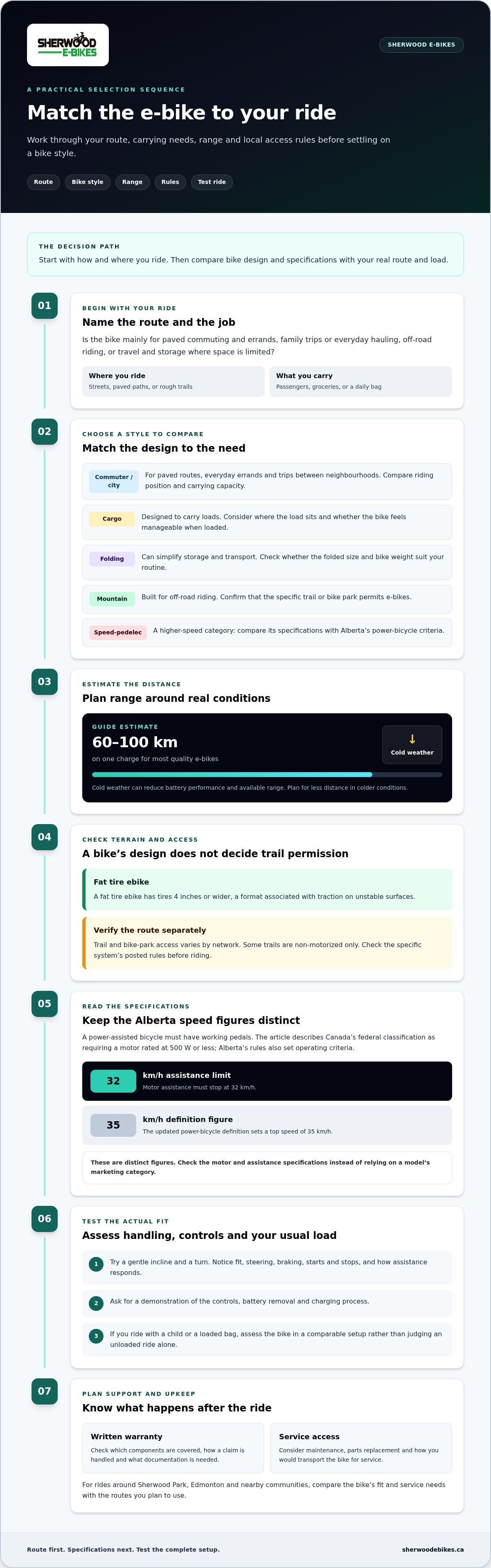
Choose an electric bike by matching its design and equipment to your route, passengers, cargo and storage needs. A commuter setup for Edmonton streets differs from a mountain bike intended for rough trails.
For range, the guide’s real-world estimate for most quality e-bikes is 60-100 km on one charge. Cold weather can reduce battery performance and available range, so plan for less distance in colder conditions.
Commuter and city bike options
Commuter and city electric bikes suit paved routes, everyday errands and trips between neighbourhoods. Compare riding position and carrying capacity, and consider how the bike fits your daily route. Pedal assistance can make hills and longer trips more manageable. Also think about where you’ll lock or store the bike and what you need to carry.
Cargo, folding, mountain and speed-pedelec types
Cargo e-bikes are designed to carry loads, making them a possible fit for family trips or everyday hauling. Folding models can simplify storage and transport where space is limited. Mountain e-bikes are built for off-road riding, but Alberta trail and bike-park access varies by network, and some routes are non-motorized only. A speed-pedelec emphasizes higher assisted speed, so compare its specifications with Alberta’s power-bicycle criteria.
For cargo use, list what you expect to carry before choosing a frame style. A parent transporting a toddler has different space and stability priorities from someone carrying groceries. Check where the load sits and whether the bike feels manageable to ride when loaded.
For mountain riding, consider the surface first. A fat tire ebike has tires 4 inches or wider, a format associated with traction on unstable surfaces. That can suit loose terrain, but the bike’s motor assistance does not determine whether a specific trail permits e-bike access. Confirm the route’s rules as part of planning.
Folding bikes address a different need: storage. Think through where the folded bike will go at home, work or during transport, then assess whether its size and weight suit your routine. A folding design is useful only if you can handle the bike comfortably between rides.
Speed labels need careful attention. Alberta’s published criteria require assistance to stop at 32 km/h, while the updated power-bicycle definition sets a top speed of 35 km/h. These are distinct figures, so read the motor and assistance specifications rather than relying on a model’s marketing category. Bike laws and classification affect where and how a bike can be operated.
Local dealers, test rides, and service
In Sherwood Park, Edmonton, Leduc, and nearby communities, local support can help you assess fit and maintenance needs. Compare how a bike handles on a test ride, then consider service access, written warranty terms, and the rules for your planned trails.
Local dealer access and test rides
A test ride lets you assess fit, steering, braking and how the assistance responds. Try a route with a gentle incline and a turn, noticing how the bike starts, stops and feels at your usual pace. Bring the helmet you plan to wear so you can check how it fits with the bike’s riding position.
Ask for a demonstration of the controls, battery removal and charging process. If you carry a child or commute with a loaded bag, assess the bike in a comparable setup rather than judging an unloaded ride alone. Riders in Fort Saskatchewan, St Albert or Spruce Grove can also plan how they’ll transport the bike for service.
Warranty and after-sales service
Warranty coverage depends on the bike and its written terms. Before buying, identify which components are covered, how a claim is handled and what documentation you’ll need. Keep the receipt, warranty information and service records together. A battery concern and a brake adjustment, for example, involve different components and may follow different service steps.
After-sales support can include scheduled maintenance, parts replacement and help understanding the bike’s controls. Ask for a clear explanation of routine checks, such as inspecting tyre condition, brake response and battery connections. If you work on your own bike, check the owner’s manual to see which adjustments it permits and which tasks require specialist tools.
Trail access requires separate attention. Alberta trail and bike-park rules vary by network, and some trails are for non-motorized use only. Identify the specific trail system and read its posted access rules before riding. Permission on one route doesn’t establish access on another. An eMTB may suit a permitted route but still be excluded from a non-motorized trail.
Plan around the route, not just the bike. Check trail surfaces and distance against your battery charge, then carry tools and supplies suited to the trip. A mountain route can call for different preparation than a paved-path commute in Edmonton. Secure your helmet and learn how the controls operate before entering shared areas.
In Canada, a power-assisted bicycle must have working pedals. A scooter’s classification and operating rules may differ, so don’t assume e-bike guidance applies to every electric vehicle. Match the bike type to the intended route, and use local service support for maintenance needs. For details about electric bike service options, see the relevant service information.
Alberta power-bicycle definition and operating thresholds
In Alberta, an e-bike that meets the power-assisted bicycle definition is treated as a bicycle, not a motor vehicle. The rules hinge on working pedals, motor rating, weight and speed, so check the bike’s specifications before riding.
Canada’s federal classification describes a power-assisted bicycle as having working pedals and a motor rated at 500 W or less. Alberta’s updated power-bicycle definition allows one or more electric motors with a maximum electric power of 750 watts, a top speed of 35 km/h, and a weight under 35 kg. Alberta’s published criteria also require motor assistance to stop at 32 km/h. These figures appear in distinct classification criteria, so don’t treat them as interchangeable.
You don’t need a driver’s licence, registration, or insurance to ride a qualifying power bicycle in Alberta. Riders must be at least 12 years old. A rider under 18 must carry a parent’s or guardian’s consent in the Registrar’s approved form, unless they hold an operator’s licence. Riders under 16 may not carry passengers.
Helmets are required for power-bicycle riders. Alberta’s Vehicle Equipment Regulation lists DOT FMVSS 218 as an accepted motorcycle helmet standard, updated by AR 129/2025 in June 2025. Choose a properly fitting helmet that meets an accepted standard, and secure its strap before riding. A test ride can help you assess fit, control reach, and how smoothly the bicycle starts and stops.
Rebates and incentives are separate from Alberta’s power-bicycle operating rules. Eligibility depends on the terms and funding of a specific program, so consider any incentive separately from the bicycle’s legal classification.
For battery charging, use the charger specified for the battery and follow the manufacturer’s instructions. Inspect the battery, charger and cables before use, and don’t charge equipment that appears damaged. A frayed cable or cracked battery casing, for example, means stopping use and following the manufacturer’s safety guidance. Keep the owner’s manual with the battery information.
Before riding, check that the brakes respond smoothly and the pedals operate correctly. Compare the bike’s motor rating, weight and assisted-speed specification with its documentation. A model labelled an electric bicycle may not meet Alberta’s power-bicycle criteria if its specifications fall outside the applicable thresholds. These details matter when choosing an e-bike for everyday trips across Alberta.
Assisted speed limit
Alberta’s published power-bicycle criteria require motor assistance to stop at 32 km/h. The updated power-bicycle definition also states a top speed of 35 km/h. These are separate thresholds, so distinguish the assistance cutoff from the definition’s stated top speed when comparing electric bikes.
At the assistance cutoff, the motor stops providing assistance under the published criteria. That does not mean every route permits riding at that speed. On a shared pathway near Edmonton, follow the posted speed limit, which may be below the 32 km/h assistance cutoff. The bicycle threshold doesn’t set the speed for every route.
Check the route before setting your pace. On shared pathways around Sherwood Park, look for posted signs and account for other pathway users. You may need to travel below the bike’s assistance cutoff on a shared path. The motor specification doesn’t override a route’s posted speed limit.
During a test ride, notice how assistance responds as you pedal and what happens near the cutoff. Compare the display’s speed reading with your actual pace, then practise reducing assistance before reaching a shared area. This helps you feel the transition without relying on the motor to manage your speed.
A fat tire electric bike still needs to meet the applicable power-bicycle criteria. Wider tyres don’t change the 32 km/h assistance cutoff or the separate 35 km/h top-speed figure. Consider the intended surface and route, then compare the bike’s documented specifications with your riding needs.
For buying decisions, read the model’s motor and speed information together. Alberta’s updated definition permits one or more electric motors with a maximum electric power of 750 watts, while the published criteria set the assistance cutoff at 32 km/h. Don’t judge eligibility from a model name or a speed claim alone.
Warranty terms are another buying detail, but they don’t change how assistance works. Review written coverage for the motor and other components separately. A warranty may describe repair coverage, for example, while the bike’s specifications describe motor power and assisted-speed behaviour. Keep these documents available for reference.
Before riding, identify your route’s posted speed limit, confirm the bike’s specifications and choose an assistance level suited to the conditions. A shared-pathway limit shows why meeting the bicycle threshold doesn’t authorize the same pace everywhere. Manage your speed, especially around turns and other pathway users.
Comfort and riding styles
Comfort on an e-bike depends on fit, posture, contact points and how you carry everyday items. Use a short test ride to assess these factors together instead of judging the saddle alone. A bike that feels comfortable on a quick turn may feel different on a longer trip between Sherwood Park and Edmonton.
Start with frame fit. Check that you can reach the handlebars and brakes without stretching or locking your elbows. Then ride a familiar route and notice pressure points, wrist position, and how easily you can look ahead. A relaxed upright posture may suit errands, while a forward position may feel more natural for a focused commute.
The Selle Royal Avenue Relaxed Saddle, Unisex, Black, is one named saddle option to consider. Compare its shape and feel with the Selle Royal Lookin Basic Moderate Saddle during a test ride. Saddle comfort is personal, so assess how each feels after several minutes instead of choosing by appearance alone.
Adjust the contact points before deciding a bike feels uncomfortable. Check saddle height, handlebar reach and brake-lever access in that order. Make one adjustment at a time, then ride the same short loop again. This gives you a consistent way to assess changes for a commute around Leduc or Fort Saskatchewan.
For family rides, consider balance and how passengers or bags affect handling. A parent carrying a toddler can practise mounting, starting, turning and stopping in a clear area before joining busier routes. Secure cargo, and check that it doesn’t interfere with the brakes, wheels or your view of surrounding traffic.
For rides around St Albert or Spruce Grove, consider the surfaces you’ll encounter and what you need to carry. The DEUTER MONDEGO FRAME BAG and Basil, Mira, Shopper bag, Black Melee are named accessory options. Choose a carrying setup that keeps items accessible without making steering or balance feel awkward.
DIY maintenance enthusiasts can match tools to the fasteners they work with. The Park Tool AWS-11 Folding Hex Wrench Set is a folding hex-wrench option. The Park Tool TWS-2 Folding Torx Wrenches include T7, T9, T10, T15, T20, T25, T27, T30, and T40. The Park Tool AWS-9.2 Folding screwdriver/hex wrench set includes 4mm, 5mm, and 6mm hex wrenches, a flat blade, and T25.
Comfort should support your riding style, not require constant compensation. When choosing a commuter e-bike, compare frame fit and riding position alongside carrying needs. For maintenance to support regular riding, explore e-bike maintenance support.
Sherwood E-Bikes: E-Bike Parts
Sherwood E-Bikes Ltd. can help with e-bike parts, commuter e-bikes, maintenance, and cycling accessories. Turn to these offerings when you’re choosing a commuter setup, replacing a part, or preparing your bike for regular rides around Sherwood Park and nearby communities.
Maintenance can address upkeep needs, while cycling accessories can help tailor your setup to how you ride. When selecting a commuter e-bike, consider your route, carrying needs and preferred riding position. Matching the bike and accessories to these practical details makes it easier to build a setup for everyday use.
For e-bike parts, maintenance, commuter options or cycling accessories, contact Sherwood E-Bikes Ltd. or visit sherwoodebikes.ca.
Choose your next ride with confidence
Your next step is to match a bike to the trips you want to make. Think about your regular routes, what you carry and how you prefer to sit and steer. These priorities can guide your choice of electric bikes in Alberta, from a commuter setup to a bike for family errands.
For electric bikes in Alberta, ongoing support matters too. Sherwood E-Bikes Ltd. offers commuter e-bikes, e-bike parts and e-bike maintenance. Consider these options when choosing a bike for daily travel or addressing upkeep and replacement needs.
Identify what you need from a bike, then explore options that fit. Contact Sherwood E-Bikes Ltd. today to discuss commuter e-bikes, parts, or maintenance. A well-matched ride can make everyday travel more practical and open up new ways to get around.
Frequently Asked Questions
What is an electric bike?
An electric bike combines pedalling with selectable motor assistance. For a practical comparison, check how the controls display assistance settings and battery charge, and whether they’re easy to read while stopped. A test ride can help you compare how each model responds to your pedalling and how its controls feel. Riders commuting from Leduc, for example, can consider which setup suits their usual trip and carrying needs.
What are Alberta's rules for electric bikes, including motor power and speed limits?
Alberta’s power-bicycle criteria set motor-power and assisted-speed thresholds, while the federal power-assisted bicycle classification uses its own motor-rating limit. Compare the bike’s specification label and owner’s manual with the relevant criteria before buying. Pay particular attention to rated motor power and the speed at which assistance stops. A model name or advertised category alone doesn’t establish its classification.
Where can you ride e-bikes in Alberta, including roads, bike lanes, and trails?
Use roads and bike lanes where local rules and signs permit, and plan trail rides around the specific network’s access directions. For a trip near Sherwood Park, map your route before leaving and note where a paved path connects with a trail. Check signs at each transition, since access on one section doesn’t establish access for the next. Keep an alternate route in mind if a trail excludes e-bikes.
What do electric bikes cost in Alberta, and where can you buy them?
Prices vary with the model and its equipment, so compare the features you’ll use rather than choosing by the lowest advertised figure alone. You can buy commuter e-bikes at the Sherwood Park showroom at 2008a Sherwood Dr., Sherwood Park, AB, Canada, T8A 0Z1. If you’re comparing models, bring your usual carrying setup and describe your route to help focus the selection on practical needs.
Which e-bike shops and repair services are available in Edmonton and Sherwood Park?
Sherwood E-Bikes Ltd. has a physical showroom in Sherwood Park, with e-bike maintenance and parts available for local riders. The address is 2008a Sherwood Dr., Sherwood Park, AB, Canada, T8A 0Z1. Store hours are Tuesday-Friday 10:00 - 18:00, Saturday 11:00 - 17:00. Riders travelling from Edmonton can use these details to plan a visit for parts or maintenance support.
What are the best electric bikes for Alberta commuting, hills, and winter conditions?
For commuting, choose a commuter or city e-bike that fits your route and carrying needs. Pedal assistance can make hills and longer trips more manageable. Cold weather can reduce battery performance and range, so plan for less distance in winter.


