

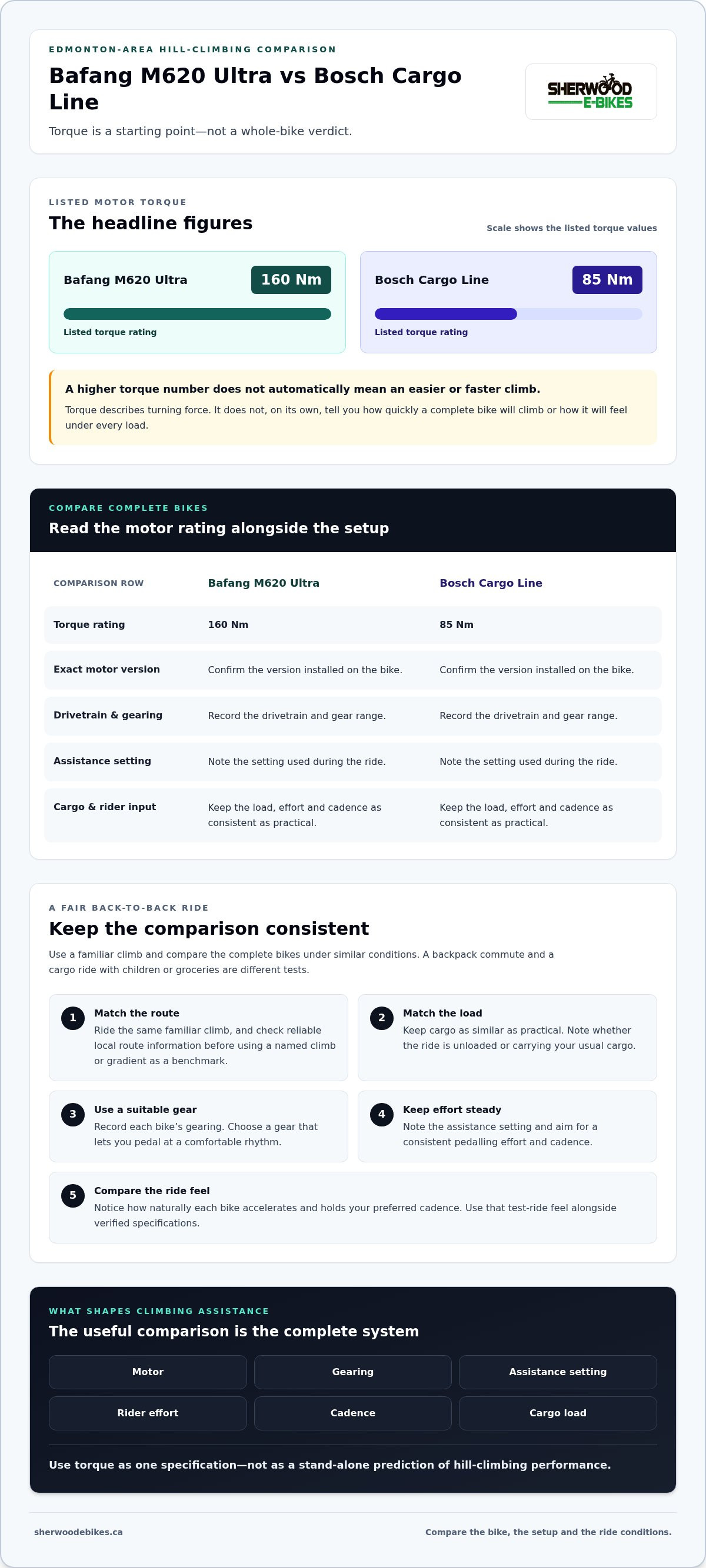
More peak torque doesn’t automatically mean an easier climb. For riders weighing the Bafang M620 Ultra vs Bosch Cargo Line hill climbing torque Edmonton question, the headline figures seem decisive: the Bafang is rated at 160 Nm, while the Bosch Cargo Line is rated at 85 Nm. It’s reasonable to expect the higher number to win, especially when you’re carrying children, groceries, or other cargo. But a motor’s rating can’t tell you how the complete bike will feel on a hill.
Gearing, rider input, assistance settings, and total load all shape the power that reaches the rear wheel. This comparison explains what torque can and can’t tell you, then gives you a consistent way to assess two systems on a familiar Edmonton-area climb. Compare complete bikes under similar conditions, not just motor specifications, and account for the difference between an unloaded test ride and a loaded cargo run. The result is a more practical way to judge which setup suits your routes and riding needs.
Key Takeaways
- Use torque ratings as a starting point, not a guarantee of climbing speed or ease.
- Compare complete bikes, including their gearing and setup, instead of judging motors by headline specifications alone.
- For the Bafang M620 Ultra vs Bosch Cargo Line hill climbing torque Edmonton comparison, focus on how each system responds under similar riding conditions.
- Keep cargo, rider effort, assistance setting, route, and battery state as consistent as practical when testing a familiar climb.
- Use test-ride feel alongside verified specifications. Sherwood E-Bikes Ltd. rentals require a signed waiver.
What Bafang M620 Ultra vs. Bosch Cargo Line torque tells Edmonton climbers
How will each complete bike handle the climb you actually ride, with your usual cargo and pedalling effort? That’s the useful question behind a Bafang M620 Ultra vs Bosch Cargo Line hill climbing torque Edmonton comparison. A motor’s torque rating describes turning force, but it can’t predict how quickly a bike will climb or how it will feel under every load.
Torque is measured in newton-metres (Nm), a measure of turning force around an axle. In an e-bike, motor torque contributes to turning the drivetrain and moving the bike uphill against gravity and other resistance. But a motor rating doesn’t measure the force reaching the rear wheel in every gear. The bike’s transmission, assistance behaviour, and your pedalling all matter.
A headline torque rating describes the motor’s turning force; on-road climbing performance belongs to the complete bike and its conditions. Use that distinction to interpret motor figures without turning one number into a verdict.
What does torque mean when an e-bike climbs?
On a climb, turning force helps the drivetrain keep the wheel moving as you and the bike work uphill. Gear choice changes how that force is delivered. A lower gear can help you maintain a comfortable pedalling rhythm, while a higher gear changes the relationship between cadence and wheel speed. The effect depends on the complete drivetrain, so a motor rating alone won’t tell you how a particular bike will climb.
Torque isn’t speed, battery capacity, or rated motor power. Speed describes how fast the bike is travelling; battery capacity relates to stored energy; and power describes the rate at which energy is delivered. These measurements answer different questions. For background on electric-bicycle systems and pedal assistance, see Understanding Electric Bicycles. Don’t choose a climbing setup from one specification in isolation.
Why Edmonton-area climbs need a whole-bike comparison
Start with the routes you ride around Edmonton and the load you expect to carry. A commute with a backpack presents a different test from a cargo ride with children or groceries. Even on the same hill, starting from a stop, changing gears, and pedalling consistently can shape your experience. Check reliable local route information before using a named climb or gradient as a test benchmark.
Compare the exact motor version and the bike it’s installed on. Record the drivetrain and gear range, assistance setting, and cargo load. Then note how naturally the bike accelerates and holds your preferred cadence. Check whether the torque and power figures describe the same version and rating type. This gives you a more useful basis for comparing the systems.
How motor, gearing, and rider input shape climbing assistance
A mid-drive motor sends assistance through the bike’s drivetrain, so the selected gear affects how the system responds as you pedal uphill. The drivetrain is part of the motor comparison, not a separate detail. For the Bafang M620 Ultra vs Bosch Cargo Line hill climbing torque Edmonton question, compare complete bike setups and how they feel with a suitable gear engaged. Don’t assume the motor name alone predicts the ride.
How gearing changes the climbing comparison
Imagine approaching an incline in a gear that makes pedalling feel heavy. Shifting to an easier gear can help you keep the pedals turning at a more manageable pace. The motor still contributes assistance, but the gear changes how your effort and motor output pass through the drivetrain to the rear wheel. A bike with different gearing may feel different on the same climb, even if its motor has a similar torque rating.
For a fair comparison, note each bike’s drivetrain and gear range. Don’t assume that two bikes fitted with the same motor have identical gearing, or that the motor’s torque figure tells you how many gears are available. Bosch eBike Drive Unit Specifications can help you identify drive-unit details. You’ll also need the bicycle maker’s specifications to understand the complete setup.
How rider input affects motor assistance
Rider effort changes the experience too. A torque sensor measures the force applied to the pedals and adjusts motor assistance accordingly. That describes the sensor concept, not a verified feature of every bike using either system. Check the exact bike’s documentation before attributing a sensor type or response to a particular Bafang M620 Ultra or Bosch Cargo Line configuration.
At the foot of a hill, a deliberate start and an appropriate gear can help you settle into the climb. Once moving, a steady cadence gives you a more consistent basis for judging how the assistance feels. Cadence means how quickly you turn the pedals; it isn’t the same as motor speed. If you start one test in a harder gear or pedal with more effort, your input may affect the comparison as much as the bike.
Usable climbing assistance depends on the motor, the bike’s gearing, the selected assistance setting, rider effort, cadence, and cargo load. Keep those factors as consistent as practical during a back-to-back ride, while using a gear and effort that feel safe and comfortable. There’s no single riding style that suits every rider or load. A parent carrying children, for example, may value smooth control at a different cadence than a rider climbing without cargo.
A properly adjusted drivetrain also helps you shift and pedal as intended. Sherwood E-Bikes offers maintenance and repair services for ongoing e-bike care.
Bafang M620 Ultra vs. Bosch Cargo Line: compare the evidence fairly
A fair comparison starts with the exact motor and complete bike, not a number copied from a headline. The figures below provide a starting point for the Bafang M620 Ultra vs Bosch Cargo Line hill climbing torque Edmonton comparison. They don’t establish which bike climbs better: the exact bike models, drivetrain details, and test conditions aren’t specified here, so those fields are identified rather than guessed.
Which specifications can be compared directly?
Use the same units and record what each figure describes. The Bafang M620 is also identified as the G510 Ultra. Bosch’s Cargo Line figure below is stated at its factory setting. Check the documentation for the specific bike to verify its motor generation and configuration.
| Comparison field | Bafang M620 Ultra | Bosch Cargo Line |
|---|---|---|
| Motor name/version | M620 (G510) Ultra; exact bike-specific version not established. | Cargo Line; exact generation and bike-specific configuration not established. |
| Maximum torque | 160 Nm maximum. | 85 Nm at the factory setting. Some sources report up to 100 Nm for newer configurations, so don’t treat that as a universal figure. |
| Power rating | 1000W nominal. This is not labelled as peak power. | 250W nominal. This is not labelled as peak power. |
| Gearing | Not specified for a complete bike. | Not specified for a complete bike. |
| Bike and test configuration | Exact bike model, drivetrain, rider, and cargo load not specified. | Exact bike model, drivetrain, rider, and cargo load not specified. |
What a side-by-side table cannot prove
These are motor ratings, not results from a controlled, repeatable climb test. Even a verified specification table can’t show how a particular bike will perform with a given gear, rider, load, assistance setting, and route. Nor can it establish a guaranteed winner. Treat discussion titles as prompts for investigation, not independent proof of specifications or riding results.
For a meaningful on-road conclusion, compare identified bikes under similar conditions and document the setup. Sherwood E-Bikes offers e-bike maintenance and repair services to support ongoing bike care. The comparison itself depends on the specific bikes and test conditions.
A practical Edmonton-area test for hill-climbing torque
A repeatable ride can tell you more about everyday climbing feel than a spec-sheet comparison alone. Choose a familiar, safely selected incline that resembles your regular Edmonton-area riding. Pick a route you can ride legally and comfortably, with room to start, shift, and stop safely. Don’t rely on an assumed gradient or a climb’s reputation; use verified route information if you plan to record or publish gradient details.
Set up a consistent comparison
Before setting off, record the bikes’ exact models, motor versions, drivetrain details, and assistance settings. Then ride the same route in the same direction, keeping your setup as similar as practical:
- Match the load. Carry comparable cargo in the same position on each bike. Note what you’re carrying so the comparison reflects your usual commute or family ride.
- Keep the starting conditions similar. Begin from the same point, use a similar starting gear, and aim for a comparable level of rider effort. Don’t sprint on one bike and take it easy on the other.
- Set assistance consistently. Record the selected assistance level for each bike. If the modes differ, note the names shown on the displays instead of assuming that similarly positioned settings provide identical support.
- Check the battery state. Start each ride with a similar indicated charge where practical, and write down the display reading. This helps you interpret differences without treating battery state as a measure of motor output.
- Repeat when needed. If wind, surface conditions, traffic, or interruptions differ noticeably, make another pass when it’s safe and practical.
What to notice on the climb
Focus on observations, not invented measurements. At the start, notice how manageable each bike feels as you begin pedalling with the chosen load. As the climb continues, pay attention to cadence, when you shift, whether the gear choice feels natural, and how the assistance responds to your pedalling. Note comfort and control too. A setup that feels demanding to manage may not suit your everyday cargo ride, even if its motor rating looks impressive.
Use the same rider for both passes if possible. If that isn’t practical, note who rode each bike, since differences in effort and riding style affect what you feel. Write down your observations soon after each attempt, including anything that made the runs uneven. Avoid publishing climb times, gradients, or performance results unless you measured them with a suitable method and can verify the conditions.
This approach makes the Bafang M620 Ultra vs Bosch Cargo Line hill climbing torque Edmonton comparison useful for your own routes without presenting a personal impression as a universal result. To assess general ride feel on a rental e-bike, explore e-bike test-ride rentals. A signed waiver is required.
Choose a climbing setup with local e-bike support
Choose based on the complete ride, not a motor label. For the Bafang M620 Ultra vs Bosch Cargo Line hill climbing torque Edmonton comparison, combine verified specifications with the bike’s gearing, your regular cargo, and how the setup feels on a familiar climb. The higher torque figure is one useful data point, not a final verdict.
Match the motor comparison to your riding priorities
Start with the way you expect to ride. A family carrying children may care most about manageable starts and predictable assistance under load. A commuter might focus on how the bike feels on a regular route and whether its gearing supports a comfortable cadence. Write down your priorities before comparing specifications so a striking number doesn’t distract from the ride qualities you need.
Then check that you’re comparing identified motor versions and complete bikes. Look for the manufacturer’s stated torque and power definitions, the actual gear range, and the specific bike configuration. If you test ride, note the assistance setting, your cargo, and how the bike responds as you start, shift, and continue up the climb. Treat impressions as personal evidence, not a promise that another rider will get the same result.
If the bikes differ in gearing, load capacity, or setup, account for those differences rather than attributing every change in feel to the motor. A controlled comparison can help narrow your options, but without matched bike specifications and ride evidence, it wouldn’t be responsible to name one system as the winner for every Edmonton-area rider.
Find local help for your next e-bike step
Once you have a shortlist, practical support can help keep your current e-bike ready for regular rides. Sherwood E-Bikes provides an e-bike maintenance and repair service. Riders in Sherwood Park, Edmonton, Leduc, Camrose, Fort Saskatchewan, Ardrossan, St Albert, Vegriville, Morinville, Wetaskiwin, and Spruce Grove can explore the store’s e-bike parts and maintenance offerings.
Test-ride rentals offer another way to assess ride feel on an e-bike. Notice fit, handling, and how the assistance feels with your own pedalling style, but don’t treat a rental ride as a direct test of either motor discussed here. A signed waiver is required for test-ride rentals.
Keep your climb notes, verified bike details, and cargo priorities together. They’ll make it easier to compare options and explain what you need from your next setup. Explore local e-bike support in Sherwood Park for maintenance and repair as you plan your next ride.
Make your next e-bike decision with confidence
Use a regular ride to put the comparison in context. Notice which setup fits your routine, feels manageable with your usual cargo, and gives you confidence to keep riding. Your priorities may change as your commute, family needs, or preferred routes evolve, so choose a bike for the riding you expect to do, not a specification alone.
The Bafang M620 Ultra vs Bosch Cargo Line hill climbing torque Edmonton comparison is most useful as a way to ask better questions about complete-bike setup and personal ride feel. Keep those questions handy as you explore e-bike options and plan for the climbs that matter to you.
Sherwood E-Bikes is a locally owned independent retailer with a physical showroom in Sherwood Park, offering a nearby place to explore e-bike support. Take your next step toward a setup that suits your riding plans: explore e-bike parts, maintenance, and rentals at Sherwood E-Bikes.
Frequently Asked Questions
Is higher torque always better for climbing on an e-bike?
No. A higher rating alone doesn’t show which complete bike will suit your climb. For the Bafang M620 Ultra vs Bosch Cargo Line hill climbing torque Edmonton comparison, first match the exact motor versions and rating definitions. Then consider how the bike feels with your usual load and riding position. A high figure may be less useful to you than a bike that feels controllable and comfortable on your regular route.
Can motor torque figures from different model years be compared directly?
Only if the figures describe comparable versions and use the same rating basis. A model name can span different generations or configurations, and a manufacturer may update a drive unit or its stated specifications. Before comparing numbers, record the model year, exact motor designation, specification document, and whether the figure is a maximum or another rating. If any of those details differ or are unclear, treat the figures as non-equivalent.
Does cargo weight change how a mid-drive e-bike climbs?
Yes. More cargo adds to the total load the bike must carry uphill, so a grocery run or child passenger can feel different from a solo ride. Weight placement can also affect balance and how the bike feels at low speed. For a useful comparison, load each bike as you’d normally ride it and secure the cargo consistently. Don’t use an unloaded ride to predict how a family or shopping trip will feel.
Can I replace a Bosch Cargo Line motor with a Bafang M620 Ultra?
You can’t determine whether a swap is suitable from the motor names alone. The exact bike frame, motor mounting, electrical system, controls, and manufacturer requirements all matter. A motor that appears comparable on paper may not be compatible with the bike’s other components. Check the documentation for the specific bike and motor before considering a replacement, and don’t assume a motor swap is a straightforward upgrade.
How does cold weather affect e-bike hill climbing in Alberta?
Cold conditions can affect battery performance, but the effect depends on the battery and the conditions. That can make a winter climb feel different from a ride in milder weather, so avoid comparing results from different temperatures as if they were a controlled test. Record the conditions and the battery’s indicated state before each ride. Follow the battery maker’s guidance for use and care in cold weather.
What information should I record when comparing two e-bikes?
Write down each bike’s exact model and motor version, drivetrain details, assistance setting, battery display reading, and cargo. Note the route and direction, starting gear, rider, and weather conditions. After the ride, describe how the bike started, which shifts you made, and whether the effort felt manageable. These notes help separate differences in setup or conditions from your impression of motor assistance.
Do the Bafang M620 Ultra and Bosch Cargo Line use the same battery system?
Don’t assume they do. Battery compatibility depends on the exact bike and system configuration, not just the motor brand or name. Check the bike manufacturer’s specifications for the battery intended for that model, including its listed system requirements. A battery that physically appears to fit isn’t necessarily an approved match. Keep each bike’s battery with its designated system unless the manufacturer documents compatibility.


