

You might assume the bike with the widest tires always wins on an icy Alberta trail, but true winter performance is often more about sensor precision than rubber width. Navigating the Edmonton river valley in January presents a unique set of challenges that standard specifications do not always capture. You likely know the frustration of watching your battery range drop by half as soon as the temperature hits minus twenty, or feeling your rear wheel slip when a cadence sensor delivers power too abruptly on a frozen patch.
Finding the right fat tire ebike means choosing a machine that responds to the specific demands of our climate. This comparison of Surface604 Shred vs RadRover 6 Plus snow handling Alberta performance helps you discover which model handles the harsh winter with the most confidence. We examine how a reliable torque sensor manages technical snow and which battery system survives a commute from Fort Saskatchewan or St. Albert. You will learn the technical differences between these two popular models, including motor efficiency and how to protect your e-bike from the corrosive road salt used across the capital region.
Key Takeaways
- Understand how the choice between a torque sensor and a cadence sensor alters your traction on icy river valley paths.
- Evaluate the Surface604 Shred vs RadRover 6 Plus snow handling Alberta data to determine which e-bike maintains stability on hard-packed snow.
- Discover why battery capacity matters when temperatures drop below freezing and how to preserve your range during long winter commutes.
- Identify key maintenance steps to protect your aluminium shell and drivetrain components from corrosive winter road salt.
The Fat Tire Ebike Face-Off for Alberta Winters
Alberta winters demand more than just a motor; they require a machine capable of handling freezing rutted slush and deep river valley drifts. Whether you're commuting through Fort Saskatchewan or exploring the North Saskatchewan River valley, the Surface604 Shred vs RadRover 6 Plus snow handling Alberta debate often comes down to how each bike manages traction. These two models represent different approaches to winter mobility. The Surface604 Shred brings mountain bike DNA and a torque sensor to the table, while the RadRover 6 Plus offers the classic high-volume stability many winter riders expect. Both bikes feature a durable Aluminium shell to protect core components from the elements. As a local specialist, Sherwood E-Bikes Ltd. provides the technical guidance needed to choose between these two distinct platforms.
Understanding Fat Tire Ebike Traction
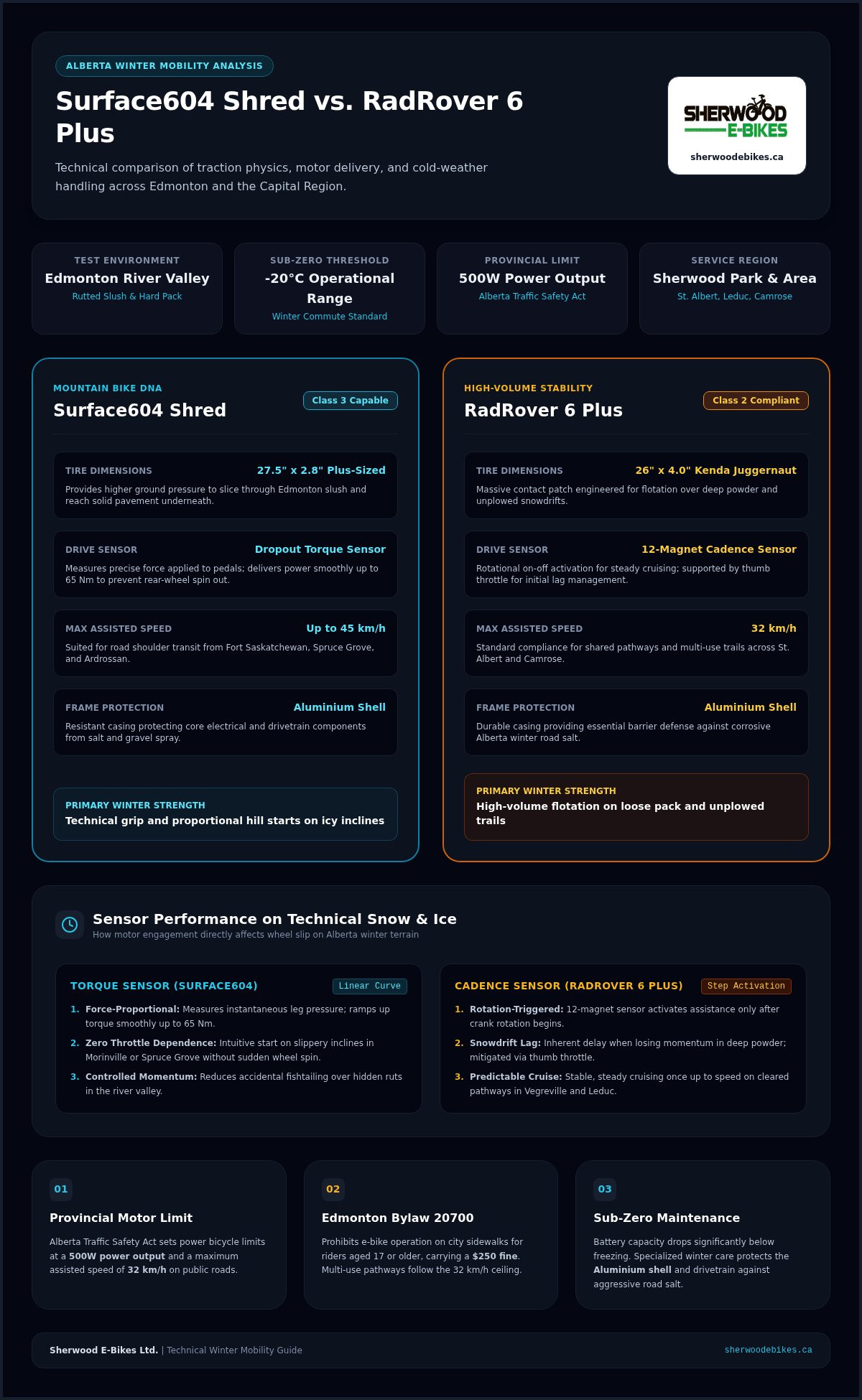
The primary benefit of fat tire bikes is flotation. By using oversized tires at low pressures, these bikes spread the rider's weight over a larger surface area to prevent sinking into fresh snowfall. The RadRover 6 Plus uses 26" x 4.0" Kenda Juggernaut tires, which provide a massive contact patch for loose pack. In contrast, the Surface604 Shred uses 27.5" x 2.8" plus-sized tires. While narrower, these tires exert higher ground pressure. This allows them to slice through Edmonton slush down to the firm pavement below. When comparing Surface604 Shred vs RadRover 6 Plus snow handling Alberta performance, the role of tire pressure becomes a critical factor for navigating icy patches in St. Albert. Your choice depends on whether you're riding over unplowed trails in Ardrossan or cleared paths in Camrose. For those needing to prep these models for sub-zero use, our e-bike maintenance team in Sherwood Park can help with specialized winterization.
Class 2 vs. Class 3: Alberta Regulations
Navigating the legal landscape is essential for riders in the capital region. Under the Alberta Traffic Safety Act, power bicycles are restricted to a 500W power output and a maximum motor-assisted speed of 32 km/h on public roads. The RadRover 6 Plus ships as a Class 2 e-bike, fitting neatly within these provincial limits. The Surface604 Shred is often configured as a Class 3 powerhouse capable of reaching 45 km/h. While this speed is a game changer for long commutes from Leduc or Spruce Grove, it requires careful attention to local rules. Edmonton Bylaw 20700 prohibits riding on city sidewalks for anyone 17 or older, with fines set at $250. High-speed capabilities are excellent for road shoulders, but riders must stick to the 32 km/h limit on multi-use pathways to remain compliant. Riders in Sherwood Park and St. Albert should verify specific municipal park rules before testing the upper limits of a Class 3 motor.
Motor Performance and Torque: Navigating Edmonton Slush
While the tires establish your contact patch, the sensor system dictates how the motor delivers its 500W power output to the ground. In the Surface604 Shred vs RadRover 6 Plus snow handling Alberta comparison, the way power is applied determines whether you maintain traction or lose control on a patch of black ice. Alberta's winter trails often feature hidden ruts and variable slush that require immediate motor response. You can review official trail standards and route planning via City of Edmonton cycling resources to prepare for these technical conditions.
The Torque Sensor Advantage in Alberta
The Surface604 Shred features a dropout-mounted torque sensor that measures the specific force you apply to the pedals. This system provides motor assistance proportional to your effort. When you are starting from a stop on a snowy incline in Spruce Grove or Morinville, the motor doesn't just dump all 65 Nm of torque at once. Instead, it ramps up power smoothly as you push harder. This linear delivery is essential for maintaining grip on the slick surfaces found throughout the river valley. A torque sensor provides linear traction control that matches rider input, ensuring the rear wheel doesn't wash out during heavy acceleration.
Rad Power's Cadence Delivery
The RadRover 6 Plus uses a 12-magnet cadence sensor. This system operates like an on-off switch that activates when the magnets pass the sensor during pedal rotation. On flat, cleared pathways in Leduc or Vegriville, this provides a predictable, moped-like experience that many commuters find comfortable. However, in deep powder or technical snow, the inherent lag of a cadence sensor can be a disadvantage. If you lose momentum in a snowdrift, there is a slight delay before the motor assists you again. Riders often compensate by using the thumb throttle to bridge this gap. While functional, it requires more active management compared to the intuitive Shred.
Climbing the steep grades of the North Saskatchewan River valley requires consistent assistance and smart gearing. The Shred's 9-speed drivetrain, controlled by a responsive Shift Lever, allows for better power management than the RadRover's 7-speed setup. If you notice your motor engagement feels sluggish during a cold snap, your sensors may need a professional calibration. You can find expert e-bike maintenance at Sherwood E-Bikes Ltd. to ensure your motor is tuned for the specific demands of an Alberta winter.
Battery Reliability and Range in Sub-Zero Temps
The Alberta winter is the ultimate test for e-bike electronics. When you wake up to a minus twenty morning in Camrose or Fort Saskatchewan, your battery's chemistry changes before you even turn the motor on. The Surface604 Shred vs RadRover 6 Plus snow handling Alberta discussion must prioritize energy density and thermal resilience. While both bikes use high-quality lithium-ion cells, the difference in total watt-hours becomes a safety factor when you are fighting through a headwind on a frozen multi-use path. Ensuring your battery has UL certification for safety is the first step in building a reliable winter setup.
Capacity and Cold Weather Sag
The Surface604 Shred offers a significant advantage with its optional 960Wh extended-capacity battery. Compared to the 672Wh unit on the RadRover 6 Plus, this extra overhead is vital for long Edmonton commutes. According to cold weather battery efficiency research, lithium-ion batteries can lose between 30% and 50% of their effective range in sub-zero conditions. This means the RadRover's 672Wh pack effectively becomes a 336Wh pack on the coldest days of the year.
Voltage sag is another reality for winter riders. As the cells get cold, they struggle to provide the 500W power output required to maintain speed. "Experts observe that sub-zero temperatures significantly increase internal resistance within lithium-ion cells, causing a rapid decline in usable capacity and an immediate drop in peak power delivery during high-load events like hill climbing." The Shred’s larger 20Ah pack spreads the load across more cells, which helps mitigate this sag and keeps the bike feeling responsive even in the frost.
Charging and Storage Best Practices
Protecting your investment during an Alberta cold snap requires strict storage habits. You should never charge an e-bike battery when the internal temperature of the cells is below freezing. Doing so can cause permanent lithium plating, which destroys the battery's lifespan and creates a fire hazard. Both the Shred and the RadRover feature removable batteries, allowing you to bring them into your home or office in Wetaskiwin or Morinville to warm up before plugging them in.
For those keeping their bikes in an unheated garage, the Aluminium shell of the frame provides some protection, but it won't stop the cold from reaching the electronics. Bringing the battery inside is the single most effective way to ensure consistent performance. If you want to learn more about keeping your ride in peak condition, check out our Alberta E-Bike Winter Storage Guide. Our e-bike maintenance specialists at Sherwood E-Bikes Ltd. in Sherwood Park can also test your battery health if you notice a sudden drop in performance after a particularly harsh cold front.
Build Quality and Winter Maintenance Requirements
Municipalities across the capital region, including Morinville and Vegriville, rely on aggressive road salt and calcium chloride to manage ice. These chemicals pose a significant threat to any fat tire ebike used for winter commuting. While the Aluminium shell on both the Surface604 and the RadRover provides a lightweight and durable foundation, it requires protection from the corrosive slurry found on Alberta roads. In the Surface604 Shred vs RadRover 6 Plus snow handling Alberta comparison, the longevity of your investment depends largely on your post-ride maintenance habits.
Hydraulic disc brakes are standard on both models, offering the stopping power needed for icy Leduc intersections. The RadRover 6 Plus uses proprietary hydraulic brakes, while the Shred typically features Tektro systems. Both systems are susceptible to the Alberta freeze-thaw cycle, which can introduce moisture into the housing. If water freezes inside, it can lead to a spongy feel or inconsistent lever pull. Similarly, the Shift Lever and chain are vulnerable to road grit. While an IPX4 water resistance rating protects the electrical harness, mechanical components remain exposed to the elements.
Fighting Corrosion in the Capital Region
Cleaning your bike after a ride through Ardrossan or Fort Saskatchewan is essential. Use a low-pressure stream of water and a soft cloth to remove salt deposits from the motor housing and chain. Avoid high-pressure washers, as they can force moisture past seals and into the Aluminium shell. Pay close attention to electrical connections where salt can cause shorts. Applying a small amount of dielectric grease can help keep moisture out of these sensitive areas. For those who prefer an expert touch, Professional E-Bike Maintenance in Sherwood Park at Sherwood E-Bikes Ltd. can provide a deep clean and apply specialized corrosion inhibitors to the drivetrain and frame.
Winter Component Upgrades
Upgrading specific parts can drastically improve your sub-zero experience. The Selle Royal Avenue Relaxed Saddle is a popular choice because its padding remains pliable even when temperatures drop, unlike standard foam seats that turn rock-hard in the cold. Visibility is also a priority during short winter days in Spruce Grove or St. Albert. Ensure your LED digital screen is set to high brightness and consider carrying a Park Tool AWS-11 Folding Hex Wrench Set. This tool is vital for quick adjustments to fenders or racks that often vibrate loose when riding over rutted ice or frozen slush.
To keep your e-bike in peak condition, schedule a winter tune-up with Sherwood E-Bikes Ltd. today.
The Final Verdict: Which E-Bike Conquers the Alberta Snow?
Deciding between the Surface604 Shred vs RadRover 6 Plus snow handling Alberta performance depends on your specific lifestyle in the capital region. While one machine focuses on mountain bike performance, the other prioritizes accessible utility for the average commuter. The choice rests on whether you need to handle the steep, unplowed climbs of the river valley or if you require a reliable cruiser for cleared municipal paths. At Sherwood E-Bikes Ltd., we recognize that local support and parts availability far outweigh the allure of free shipping when you need a specialized repair in the middle of a February cold snap.
Who Should Choose the Shred?
Riders who commute from Leduc or Fort Saskatchewan should choose the Shred for its superior battery overhead and proportional motor response. It is the definitive choice for anyone tackling the North Saskatchewan River valley trails where traction is a constant variable. The combination of Canadian engineering provenance and dual UL certification provides peace of mind for those charging their batteries indoors in Wetaskiwin or Morinville. If you prioritize a responsive, high-performance ride that feels natural on technical snow, the Shred is the clear winner.
Who Should Choose the RadRover?
The RadRover 6 Plus is an excellent fit for casual riders in flatter communities like Camrose or Vegriville. Its upright riding position is ideal for short urban trips where comfort is more important than technical trail speed. It serves budget-focused buyers who want a functional fat tire ebike but don't require the advanced sensor precision needed for deep, technical snow. If you are comfortable with basic DIY maintenance and primarily ride on maintained surfaces, this model offers a practical entry point into winter cycling.
The best way to decide is to feel the torque sensor difference for yourself. Visit our showroom at Sherwood E-Bikes Ltd. to compare these models side by side. You can book a test ride or explore e-bike rentals to ensure your chosen platform handles the Alberta winter exactly as you expect. Our team is ready to provide the expert maintenance and advice needed to keep you moving through the snow.
Ready Your Ride for the Alberta Winter
Selecting the right platform is only the beginning of a successful winter cycling season in the capital region. Whether you prioritize the precise torque sensor of the Shred or the stable flotation of the RadRover, your e-bike must be prepared for the environmental stresses of our climate. The Surface604 Shred vs RadRover 6 Plus snow handling Alberta comparison demonstrates that while both bikes are capable, their performance relies heavily on proper setup and ongoing professional care.
Sherwood E-Bikes Ltd. provides the specialized expertise needed to keep these machines running when the temperature drops. We stock genuine e-bike parts and winter accessories to ensure you aren't sidelined by the effects of road salt or extreme cold. From diagnostics to performance optimization, our full-service maintenance department supports riders across Edmonton and Sherwood Park. Book your winter e-bike service or test ride at Sherwood E-Bikes Ltd. today to experience the difference that local, expert support makes. Reclaim your winter commute with confidence and join the growing community of year-round riders.
Frequently Asked Questions
Is the Surface604 Shred or RadRover 6 Plus better for deep snow in Alberta?
The RadRover 6 Plus is generally better for flotation in deep, unplowed powder because of its 4.0 inch tires. These wider tires spread weight across a larger surface area on trails in Ardrossan or Leduc. However, the Surface604 Shred is superior for urban Edmonton slush. Its 2.8 inch tires exert more ground pressure to slice through the mess down to the firm pavement for better tracking.
How much does winter temperature affect e-bike battery range in Edmonton?
Expect your effective range to drop by 30% to 50% when temperatures fall between minus ten and minus twenty degrees. Cold weather increases internal resistance in lithium-ion cells, causing voltage sag. If your commute from Fort Saskatchewan is typically 40 kilometres, you should plan for only 20 kilometres of range in January. Always bring your battery indoors to warm up before you begin charging.
Can I ride my fat tire ebike on Edmonton river valley trails in the winter?
Yes, fat tire ebike riders can use the Edmonton river valley trails throughout the winter season. You must follow local regulations like Bylaw 20700, which requires anyone 17 or older to stay off city sidewalks. Stick to shared multi-use pathways and established trails. It's also important to use a bell or verbal signal when passing other winter enthusiasts on narrower snow-packed paths.
Do I need special tires for riding an e-bike in Alberta snow?
While standard fat tires provide flotation, many riders in St. Albert and Spruce Grove prefer studded tires for icy conditions. A fat tire ebike handles soft snow well, but studs are essential for grip on frozen ruts and black ice. If you are riding on cleared roads in Morinville, consider a hybrid tire with a high puncture protection level 7 to prevent mid-winter flats.
What is the difference between a torque sensor and a cadence sensor for winter riding?
A torque sensor measures your actual pedaling force to provide proportional motor assistance, which prevents rear-wheel spin on ice. A cadence sensor only detects the rotation of the pedals and often delivers a sudden power surge. For technical Surface604 Shred vs RadRover 6 Plus snow handling Alberta challenges, the Shred’s torque sensor offers significantly more control and safety on slippery river valley inclines.
How do I protect my e-bike from road salt corrosion in Sherwood Park?
Wipe your bike down with a damp cloth and low-pressure water after every salty ride. Focus on the aluminium shell and the drivetrain area. Apply a winter-grade wet lube to your chain frequently to block out moisture. We also suggest using dielectric grease on electrical connections. Avoid using high-pressure washers, as they can force corrosive brine into the motor seals or battery housing.
Are these ebikes UL certified for safe charging in Canadian homes?
Yes, the Surface604 Shred features UL 2271 certification for its battery system, which is a vital safety standard for indoor charging. Rad Power Bikes also prioritizes these safety certifications for the Canadian market. This is critical for Alberta riders who must bring their batteries inside to avoid charging in freezing garages. Always verify the UL mark to keep your home in Wetaskiwin or Camrose safe.
Where can I get my e-bike serviced in the Edmonton area after a winter season?
You can book professional e-bike maintenance at Sherwood E-Bikes in Sherwood Park. Our service department handles electrical diagnostics, salt damage repair, and mechanical tune-ups for all major brands. We stock genuine e-bike parts and winter accessories to keep your machine running smoothly. Whether you live in Vegreville or Morinville, our expert team provides the local support and technical advice you need.


