

A Ride1Up with a rubbing brake needs a different assessment from one that loses power mid-ride. If you’re arranging servicing a Ride1Up bike in St Albert, describing the symptom clearly helps direct the service visit.
Sherwood E-Bikes Ltd. provides e-bike maintenance, mechanical tune-ups, electrical system diagnostics, and replacement-part installation for riders in St. Albert and nearby communities. Brake noise or shifting trouble points to a different area of concern than an issue involving motor assistance, the battery, or controls. Identifying what you notice helps make the service handoff more useful.
This guide explains what an e-bike assessment can cover and how to prepare for a service visit. You’ll learn which Ride1Up model details to note, how to describe when and how a problem occurs, and what information can help distinguish a mechanical concern from an electrical one. With clear symptoms and bike details ready, you can discuss the assessment and next steps with confidence.
Key Takeaways
- Arrange a service visit when unusual sounds, inconsistent assistance, or changes in handling affect your ride.
- Mechanical tune-ups and electrical diagnostics address different concerns. Describe the symptom to help focus the assessment.
- Sherwood E-Bikes Ltd. provides e-bike maintenance and diagnostics for Ride1Up owners in St. Albert and nearby communities.
- For servicing a Ride1Up bike in St Albert, prepare the model details and note when the symptom occurs and whether it repeats.
- Review the service information, then use the online booking page to arrange a visit.
Servicing a Ride1Up Bike in St. Albert: When to Book a Service Visit
Unfamiliar noises, inconsistent motor assistance, or a change in handling can make a ride feel uncertain. If you’re considering servicing a Ride1Up bike in St Albert, first distinguish routine maintenance from a new or worsening symptom. Regular attention to the brakes, tyres, drivetrain, and other moving parts helps keep an e-bike working as expected. A sudden change, especially one that affects control or electrical operation, calls for a focused assessment.
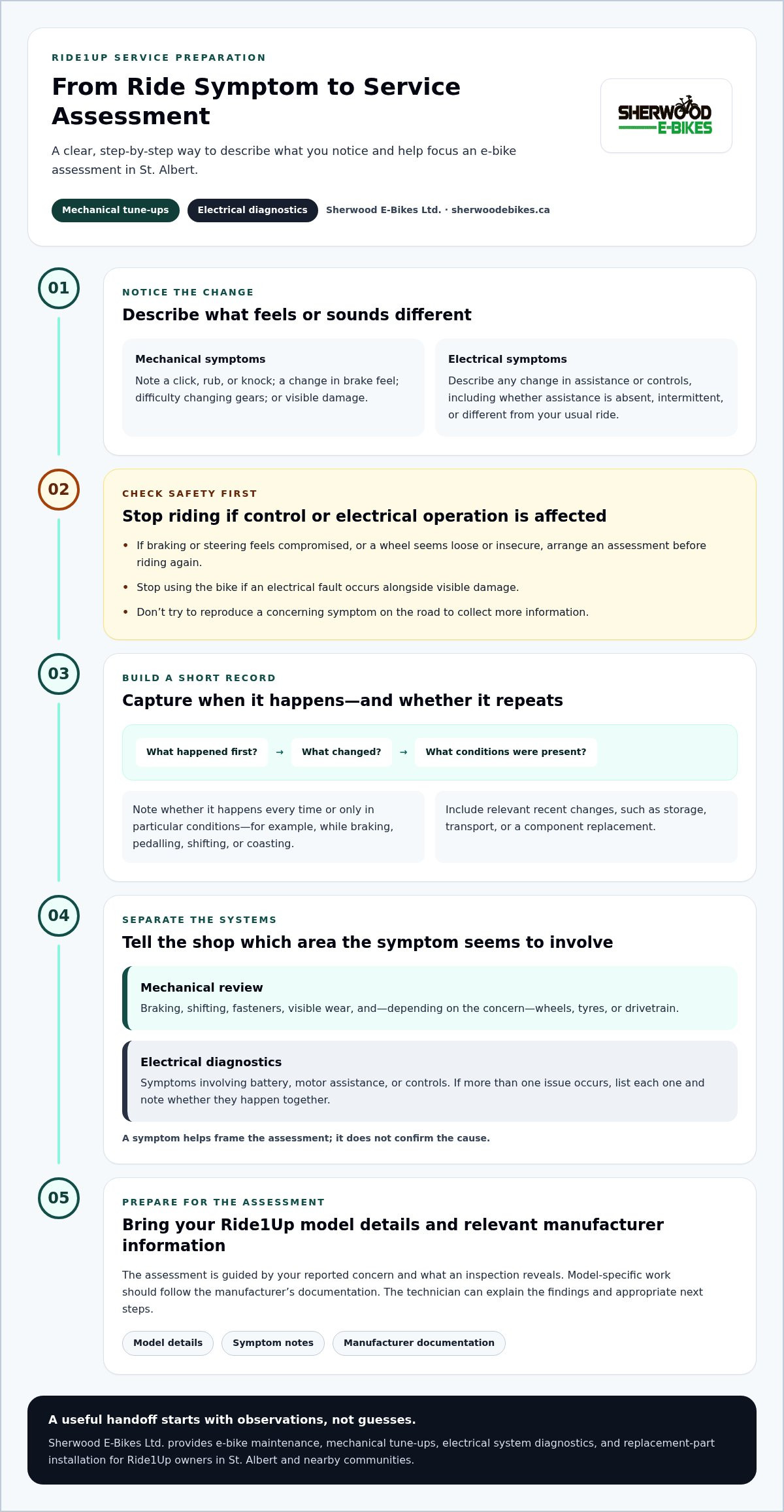
Write down what you notice and when it happens. A sound that occurs only while shifting gives a different starting point from a loss of assistance at startup. Note whether the symptom happens every time or only in particular conditions. These details help direct the assessment, but a symptom alone does not identify its cause.
For a visual example of one mechanical adjustment, watch Park Tool’s rear derailleur guide. It can help you recognize the parts involved, but it does not replace an assessment of your bike.
Which Ride1Up symptoms are worth documenting?
Keep your notes specific and factual. Record whether a sound is a click, rub, or knock, and whether it happens while braking, pedalling, shifting, or coasting. Note any change in brake feel, difficulty changing gears, or visible damage. For an electrical concern, say whether it appears at startup, under pedal effort, or during a ride, and whether it stops and returns.
- Include recent changes, such as storage, transport, or a component replacement.
- Note whether the symptom happens every time or only under particular conditions.
- Describe what you observed without guessing at the cause.
A short timeline can help: what happened first, what changed, and what conditions were present? E-bikes bring mechanical and electrical components together. The Electric Bicycle Overview provides general context on their components. Sherwood E-Bikes Ltd.’s e-bike maintenance and service includes mechanical tune-ups and electrical system diagnostics. Your description of the symptoms helps frame the assessment.
When should you stop riding and arrange an assessment?
Don’t continue riding if braking or steering feels compromised, or if a wheel seems loose or insecure. These concerns can affect control, so arrange an assessment before riding again. Likewise, stop using the bike if an electrical fault occurs alongside visible damage. Don’t try to reproduce a concerning symptom on the road just to collect more information.
For model-specific safety guidance, follow Ride1Up’s manufacturer documentation for your bike. If the cause is unclear, leave diagnosis to the assessment rather than treating a sound or display behaviour as proof of a particular fault. Clear notes explain what you observed without putting you at risk to gather more information.
What a Ride1Up E-Bike Service Assessment Can Cover
A service assessment starts with your reported concern and focuses on the bike systems relevant to it. For servicing a Ride1Up bike in St Albert, the work may involve a mechanical tune-up, electrical system diagnostics, or both. A mechanical check looks at physical components and their operation. Electrical diagnostics investigate symptoms involving the e-bike’s assistance or controls.
The assessment is guided by what you report and what an inspection reveals. A noise, change in shifting, or interruption in assistance does not point to one specific repair on its own. The technician can use your description to focus the review, then explain the findings and appropriate next steps. Model-specific instructions should follow the manufacturer’s documentation for your Ride1Up bike.
Mechanical checks for brakes, shifting, and moving parts
A mechanical tune-up can include a review of braking function, shifting, fasteners, and visible wear. Depending on the concern, attention may also go to the wheels, tyres, or drivetrain. The assessment identifies what inspection shows and what work may address the reported issue. It does not mean every part needs adjustment or replacement.
At drop-off, describe what feels different and when. For a wheel concern, say whether you notice a wobble, rubbing, or visible tyre damage. For a drivetrain concern, explain whether the chain skips, shifting feels inconsistent, or the issue appears only in certain gears. These descriptions separate what you’ve observed from what still needs inspection. Use manufacturer documentation for model-specific maintenance guidance rather than relying on a generic service interval or component tolerance.
Electrical diagnostics for assistance and control concerns
Electrical diagnostics start with the system behaviour you’ve noticed, not an assumption about its cause. Explain whether the concern seems related to the battery, motor assistance, or controls, and describe what the bike does when it occurs. For example, say whether assistance is absent, intermittent, or different from your usual ride. Those details help frame the diagnostic review, but they do not establish a fault by themselves.
Keep electrical and mechanical descriptions separate where possible. A change in assistance is different from a brake or shifting issue, even if both occur during the same ride. If you’ve noticed more than one concern, list each one and say whether they happen together. That gives the assessment a clearer starting point without assuming one issue caused another.
Ride1Up model instructions can affect how specific work should be approached. Bring or refer to the manufacturer’s documentation relevant to your model, particularly for model-specific maintenance guidance. Sherwood E-Bikes Ltd. provides e-bike maintenance and diagnostics, with the assessment focused on the reported concern and relevant bike systems.
Ride1Up Service at a Local Shop: What Owners Should Know
A local service assessment and a question about Ride1Up warranty coverage or brand-specific support are separate matters. General maintenance, such as a mechanical tune-up, addresses the bike’s condition and operation. Warranty coverage depends on Ride1Up’s written terms. Keeping these questions separate helps you understand the service being discussed without assuming a local assessment grants manufacturer authorization.
For servicing a Ride1Up bike in St Albert, the reported issue helps define the service scope. A concern with braking or shifting points toward mechanical maintenance, while a problem with motor assistance or controls may call for electrical diagnostics. The model name and relevant component details provide useful context. They do not establish access to brand-only procedures, parts, or software.
How to distinguish general maintenance from brand-specific support
A tune-up or diagnostic assessment is a service category, not proof of a relationship with Ride1Up. A local mechanic can assess a reported mechanical concern, while electrical diagnostics focus on the system behaviour you describe. The work that follows depends on the findings and the bike’s systems, not the logo alone.
When arranging service, provide the exact Ride1Up model name and any component information shown in your bike documents or on the relevant parts. This gives the assessment useful context, especially for an electrical concern. Sherwood E-Bikes Ltd. provides e-bike maintenance, mechanical tune-ups, and electrical system diagnostics. Model-specific procedures should follow Ride1Up’s documentation.
How to handle Ride1Up warranty questions responsibly
Keep your purchase record and Ride1Up warranty documents together before discussing work. Note the bike model, purchase details, and any relevant correspondence with the manufacturer. Review Ride1Up’s current written warranty terms for your coverage question. Warranty decisions follow the manufacturer’s terms. A local service assessment does not promise that a claim will be accepted or declined.
If the documentation describes a process to follow before repair work, use that guidance before authorizing work. Don’t assume third-party service will preserve coverage, and don’t assume it will void coverage either. The answer depends on Ride1Up’s written terms and the circumstances of the work. Keep service records and assessment notes with your purchase documents so you have a clear account of what was inspected or repaired.
With the model details and warranty paperwork at hand, you can discuss the practical service question separately from coverage. For local mechanical maintenance or diagnostics, review Sherwood E-Bikes Ltd.’s service options and arrange a visit with your bike details and reported concern ready.
How to Prepare Your Ride1Up Bike for Service in St. Albert
A clear handoff helps organize a service visit. Before arranging servicing a Ride1Up bike in St Albert, prepare the bike details, a short account of the concern, and relevant manufacturer documents. Then book a service visit so the reported issue can be considered alongside the specific bike and its systems.
What bike and symptom details should you record?
Write down the Ride1Up model name and any component identification you can read without dismantling the bike. Add a concise description of the symptom, when it began, and the conditions in which it occurs. Note whether it happens on every ride or only in a particular situation, such as startup, pedalling, braking, or shifting.
Include recent work or changes. A component replacement, adjustment, repair, or transport may be useful context for the assessment. Keep the notes factual: describe what changed or what you observed rather than deciding what caused the issue.
- Bike: Record the model name and visible component details.
- Symptom: Describe what you notice and when it occurs.
- History: Note recent repairs, adjustments, replacements, storage, or transport.
- Documents: Bring relevant Ride1Up manuals, purchase records, and warranty information.
Keep model-specific instructions close at hand, especially if the concern involves a procedure or safety note for your particular bike. If you’ve made a recent change, such as replacing a component, include any related paperwork or details with your notes. This gives the service handoff a clearer record of the bike’s configuration and recent history.
How to arrange a local service visit
Once your notes and documents are ready, arrange a visit through the online booking page. Include the model and a brief summary of the concern when booking, then bring the bike and relevant paperwork. Riders in St. Albert and nearby communities can use the same details to explain the issue during the service handoff.
Keep the handoff focused. Point out the symptom and mention recent component changes. If the bike has more than one concern, identify each one so the assessment can account for the full picture. Sherwood E-Bikes Ltd. provides e-bike service and maintenance, including mechanical tune-ups and electrical diagnostics.
When your information is ready, book an e-bike service visit and include your Ride1Up model and reported concern.
Book Ride1Up E-Bike Service Near St. Albert with Sherwood E-Bikes Ltd.
For servicing a Ride1Up bike in St Albert, make a clear service booking and have your model and the concern you’ve noticed ready to share. Sherwood E-Bikes Ltd. provides e-bike maintenance, mechanical tune-ups, electrical system diagnostics, and replacement-part installation. The assessment starts with your description and bike details, then focuses on the systems relevant to the reported issue.
What to expect when you book service
Use the online booking page to arrange a service visit. Name the Ride1Up model and describe the issue in plain language. Specific notes make the initial discussion more useful, and service recommendations follow the assessment findings.
Mechanical maintenance and electrical diagnostics address different service needs, so describing the concern clearly provides a practical starting point. The assessment findings inform the repair recommendation and any parts required.
Local service for St. Albert and nearby riders
Sherwood E-Bikes Ltd. serves riders in St. Albert, Edmonton, Sherwood Park, Leduc, Camrose, Fort Saskatchewan, Ardrossan, St Albert, Vegriville, Morinville, Wetaskiwin, and Spruce Grove with e-bike maintenance and diagnostics. A prepared service visit gives you a straightforward way to discuss your bike’s condition, whether you use it for commuting or recreational riding.
Ready to arrange a visit? Book an e-bike service visit and include your Ride1Up model and reported concern.
Make Your Next Service Step with Confidence
When servicing a Ride1Up bike in St Albert, a clear account of what you’ve noticed gives the service visit a practical starting point. Keep your notes and model information handy, and let the assessment findings guide the next decision. You don’t need to arrive with a diagnosis or a predicted repair. A measured approach helps you move from uncertainty toward a better understanding of your bike’s condition.
Choose a time to bring your bike in and share the concern that prompted the visit. A clear service handoff helps address the needs of your rides, whether you commute or ride recreationally. Take the next step when you’re ready: book an e-bike service visit.
With the right information in hand, you can approach service with confidence and look ahead to your next ride.
Frequently Asked Questions
Can I get a Ride1Up bike serviced in St. Albert?
Yes. Sherwood E-Bikes Ltd. provides e-bike maintenance, mechanical tune-ups, and electrical system diagnostics for local riders. For servicing a Ride1Up bike in St Albert, include the model and concern when arranging service. That gives the assessment a useful starting point. If the issue seems electrical, say whether it affects startup, pedal assistance, or the controls.
What should I bring when taking a Ride1Up bike for service?
Bring the bike, its model details, and any useful purchase, warranty, or manufacturer documents. If your records are digital, have them accessible during the service handoff. A short note can help you remember the sequence of events, especially if the issue happens intermittently. Include any recent work or parts changes, even if they seem unrelated, so the assessment has relevant context.
Can a local bike shop diagnose an electrical problem on a Ride1Up?
A local e-bike service assessment can review electrical symptoms, and Sherwood E-Bikes Ltd. offers electrical system diagnostics. Describe what you observe rather than naming a suspected failed part. For example, note whether the display turns on but assistance behaves differently, or whether the concern appears before you start pedalling. Model-specific recommendations should take the bike’s details and Ride1Up documentation into account.
Will servicing my Ride1Up bike affect its warranty?
Warranty coverage depends on Ride1Up’s written terms for your specific bike. Read the relevant documents before deciding on warranty-related work, and keep your purchase record and service paperwork together. Don’t rely on a general rule that outside maintenance always preserves or voids coverage. If you’re unsure how a term applies, refer to Ride1Up’s current written warranty information for the bike and the work being considered.
How do I describe an intermittent Ride1Up bike problem?
Record the sequence around the issue: what you were doing, what changed, and what happened next. Note whether it occurred at startup, while pedalling, or when assistance was engaged, and include any display message you saw. If it happens only under certain conditions, describe those conditions without deliberately recreating an unsafe situation. A brief timeline can make an intermittent concern easier to discuss during assessment.
Should I stop riding my Ride1Up if it makes a new noise?
Stop riding if the noise comes with a change in braking, steering, wheel security, or another concern that affects control. If the bike still feels safe, note when the sound occurs and arrange an assessment rather than guessing at its cause. A noise during braking may be useful to describe differently from one heard while shifting or coasting. Follow Ride1Up’s documentation for model-specific safety guidance.


