

A lightweight commuter e-bike, usually somewhere under about 20 kg, is easier to carry up stairs, lift onto a car rack and handle like a regular bicycle. The trade-off is typically a smaller battery, a lighter-duty motor and fewer built-in accessories. The best choice depends on how far you ride, how hilly your route is and how often you need to lift the bike.
For riders in Sherwood Park, Edmonton and St. Albert who live in condos, take transit part of the way, or simply want a bike that feels nimble, a lightweight commuter can be the most practical e-bike you own.
This guide explains what makes an e-bike light, the trade-offs to weigh, and how to test one before buying. Sherwood E-Bikes Ltd. offers commuter e-bikes, test rides and service on all brands.
Key Takeaways
- Lightweight e-bikes are easier to carry and store but usually have smaller batteries and less built-in equipment.
- Single-speed and belt-drive designs save weight and maintenance; geared bikes handle hills better.
- Check how the battery is integrated: some lightweight bikes have non-removable batteries, which matters for winter charging.
- Alberta road-legal e-bikes must have a motor of 500W or less and assist only up to 32 km/h.
- Lift the bike, ride a hill and check the brakes before deciding.
Who should choose a lightweight commuter
A lightweight e-bike suits riders who carry their bike regularly, whether up apartment stairs, onto an LRT platform or into an office. It also suits riders who want an e-bike that still feels like a bicycle when the motor is off, or who have moderate distances on mostly paved routes.
If you haul children or heavy cargo, ride long distances daily, or need maximum winter traction, a heavier commuter, cargo or fat tire e-bike may serve you better.
Where the weight savings come from
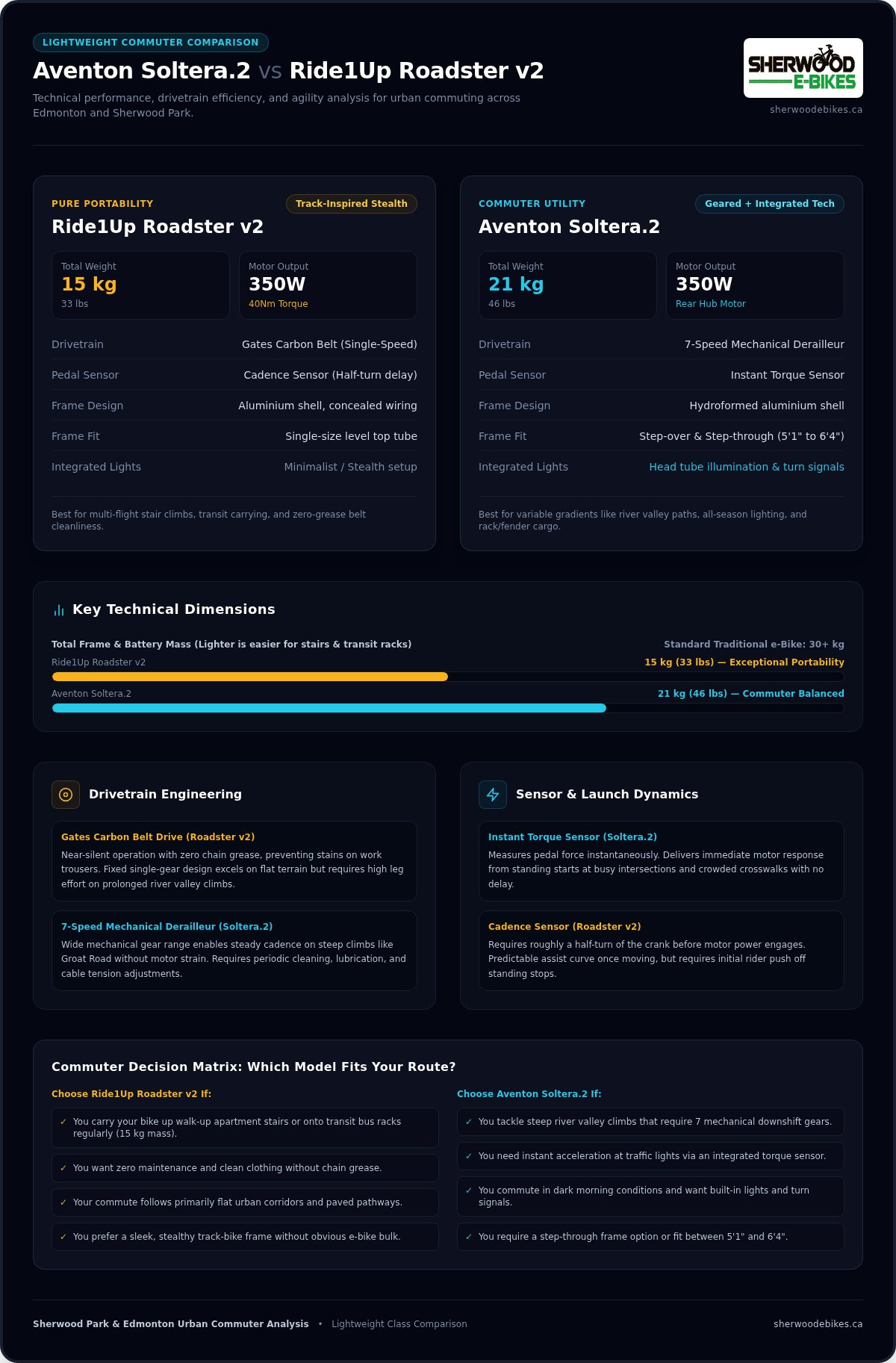
- Smaller battery: the battery is often the heaviest single part. A smaller battery saves weight but reduces range.
- Compact motor: lighter rear-hub motors or compact mid-drives provide gentler assistance.
- Simpler drivetrain: single-speed or belt-drive setups remove the derailleur and cassette.
- Frame material: aluminium frames with integrated batteries keep weight down.
- Fewer accessories: racks, fenders and suspension are often optional or absent.
Trade-offs to weigh
| Benefit | Trade-off |
|---|---|
| Easy to carry and store | Smaller battery and shorter range, especially in cold weather |
| Nimble, bicycle-like handling | Less motor support on steep or long climbs |
| Low-maintenance single-speed or belt drive | Fewer gears for varied terrain |
| Clean, minimal look | Fewer mounts for racks, fenders and lights |
| Integrated battery | May not be removable for indoor charging in winter |
Range matters more in Alberta than in milder climates. Cold weather reduces battery output, so choose a battery that covers your round trip with a comfortable margin, or confirm that a range-extender battery is available.
Test ride and buying checklist
- Lift the bike the way you would at home or on transit; check whether it’s truly manageable.
- Ride your steepest typical climb or a similar hill to judge motor support.
- Check whether the battery removes, and how you’d charge it in winter.
- Look for rack, fender and light mounts if you’ll ride in wet or dark conditions.
- Confirm the motor rating and assist speed meet Alberta rules.
Sherwood E-Bikes Ltd. offers showroom test rides so you can compare lightweight and full-size commuters side by side. Book a test ride.
Maintenance and winter use
Belt drives and single-speed setups need less routine care than geared chains, but every e-bike benefits from regular brake, tire and electrical checks. Our guide to commuter e-bike maintenance covers a practical routine. If you ride through winter, clean salt off the bike after rides, keep tire pressure appropriate for conditions, and store the battery, or the whole bike if the battery is integrated, at room temperature before charging.
Sherwood E-Bikes Ltd. provides e-bike maintenance and repair for all brands across Sherwood Park, Edmonton, St. Albert, Leduc, Fort Saskatchewan and nearby communities.
Frequently Asked Questions
How light is a lightweight e-bike?
Many lightweight commuters weigh roughly 14 to 20 kg, compared with 25 kg or more for many full-featured or fat tire e-bikes.
Is a lightweight e-bike good for hills?
For moderate hills, yes. For long, steep climbs, a bike with gears and a stronger motor is usually more comfortable.
Can I ride a lightweight e-bike in winter?
Yes, on cleared or packed routes. Range will drop in the cold, and narrow tires offer less traction than wider ones on snow.
Where can I test ride commuter e-bikes near Sherwood Park?
Visit Sherwood E-Bikes Ltd. at 2008a Sherwood Dr., Sherwood Park, or call (587) 269-2453.


