

Imagine you're halfway through a January commute in Sherwood Park when your power display suddenly drops to zero, leaving you to pedal a heavy frame against a biting headwind. It's a scenario every local rider fears, especially when a replacement battery can easily cost $800 or more. Learning how to maintain an e-bike battery isn't just about avoiding a cold walk home; it's about protecting your biggest investment from the unique challenges of our prairie climate.
You likely already realize that Alberta's extreme temperature swings are tough on sensitive electronics. The conflicting advice found online often adds to the confusion rather than helping you stay on the road. This guide clears the air and provides a reliable roadmap for your 2026 riding season. You'll learn the essential charging, storage, and maintenance habits required to double your battery's lifecycle and maintain peak performance in the snow. We also look at modern safety standards and practical tips to keep your home charging setup secure, efficient, and ready for your next adventure.
Key Takeaways
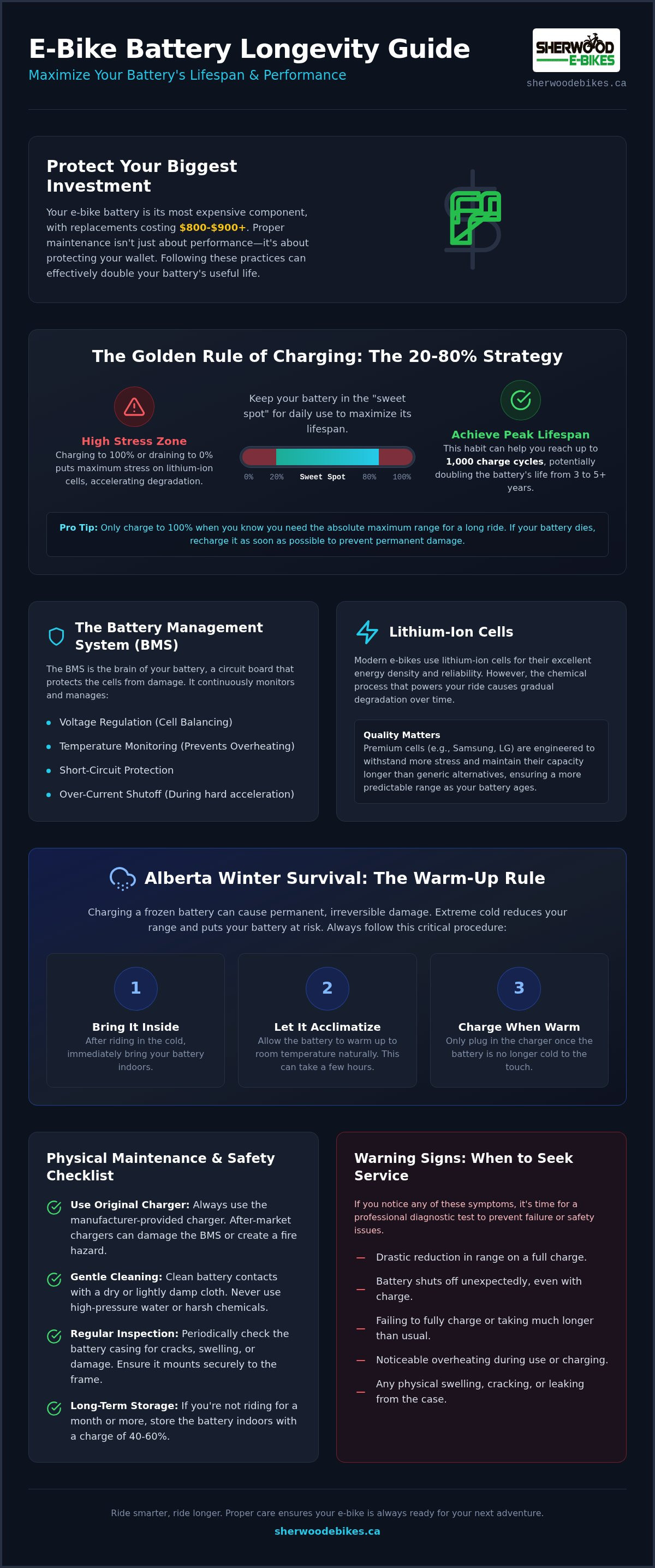
- Master the 20 to 80 percent charging rule to maximize your lithium-ion battery's lifecycle and reach up to 1,000 charge cycles.
- Protect your range in Alberta's cold climate by following the essential warm-up rule to prevent permanent damage when charging in winter.
- Learn exactly how to maintain an e-bike battery through safe cleaning methods and regular physical inspections of the electrical contacts.
- Guard against expensive replacement costs by identifying the early warning signs that your battery requires professional diagnostic testing.
- Realize the full potential of your investment with practical storage habits that keep your power source stable during long periods of inactivity.
Understanding Your E-Bike Battery Lifecycle and Chemistry
The battery is the most expensive component of your commuter e-bike. While a quality frame lasts decades, the power source has a finite lifespan defined by its chemistry. Replacing a high-capacity battery can cost upwards of $900, making maintenance a financial priority for every Alberta rider. A $900 replacement isn't just a maintenance cost; it's a significant portion of the bike's original value. By following the right protocols, you can push your battery toward the 1,000-cycle mark, effectively halving your cost of ownership over the life of the bike.
Most modern e-bikes rely on lithium-ion battery technology because it offers the best balance of weight, energy density, and reliability. Manufacturers rate these units by "charge cycles." One cycle represents a full discharge from 100 percent to 0 percent and a subsequent recharge back to 100 percent. Most e-bike batteries are rated for 500 to 1,000 full cycles. If you ride daily, this typically translates to three to five years of peak performance. Knowing how to maintain e-bike battery health starts with understanding the hardware inside the casing.
The Role of Lithium-Ion Cells
Inside your battery pack, energy moves between an anode and a cathode through a liquid electrolyte. This chemical reaction is what powers your motor during a climb. While efficient, this process causes minor physical changes to the internal components over time. Chemical degradation is inevitable, but its speed depends on your habits. High-quality cells, such as the Samsung or LG components found in Envo bikes, are engineered to withstand more stress than generic alternatives. Premium cells maintain their capacity longer, providing more predictable range even as the battery ages.
What is a Battery Management System (BMS)?
The Battery Management System (BMS) acts as the internal protector of your cells. It is a specialized circuit board that monitors every individual cell within the pack. Its primary job is to prevent overcharging and dangerous "deep discharges" that can brick a battery instantly. Learning how to maintain e-bike battery longevity means respecting the limits of this technology and ensuring the BMS can do its job effectively.
A well-functioning BMS balances the voltage across all cells. This prevents "dead zones" where some cells are overworked while others remain underutilized. If a BMS fails, the entire battery may stop working even if the lithium cells themselves are still healthy. The BMS manages several critical safety functions:
- Voltage regulation to keep cells balanced.
- Temperature monitoring to prevent overheating.
- Short-circuit protection.
- Over-current shutoff during heavy acceleration.
Smart Charging Habits to Extend Battery Life
Charging is the most frequent interaction you have with your e-bike. While it seems simple, your daily habits determine whether your battery lasts three years or five. Mastering how to maintain e-bike battery health requires moving away from the "charge to full every night" mentality common with older electronics. Modern lithium-ion systems thrive on consistency and moderate levels of charge.
The 20-80% Charging Strategy
Lithium-ion cells experience the most physical stress when they are at the extreme ends of their capacity. Keeping your battery at 100 percent for long periods creates high-voltage stress that degrades the internal chemistry faster. The "golden rule" for longevity is keeping the charge between 20 percent and 80 percent for daily use. This habit can significantly reduce the wear on your cells.
Voltage sag is a temporary drop in voltage that occurs when the motor pulls high current under load, often becoming more noticeable as the battery charge nears its lower limits. To avoid this and protect your cells, only charge to 100 percent when you know you need the full range for a long commute. If you're just heading out for a quick ride around Sherwood Park, staying within the 80 percent limit is much healthier for the pack.
Conversely, letting your battery hit 0 percent is the fastest way to "brick" it. When a battery sits at zero, the internal voltage can drop below the threshold where the Battery Management System can safely restart the charging process. If your battery dies, charge it as soon as possible to prevent permanent damage. Understanding how to maintain e-bike battery performance also involves avoiding the "top-off" myth. You don't need to plug in after every five-minute trip. Frequent, tiny charge cycles can eventually confuse the system and lead to inaccurate range readings.
Safe Charging Practices at Home
Safety is just as important as longevity. Always use the original charger provided by the manufacturer. Cheap after-market chargers often lack the sophisticated communication protocols required to talk to your specific battery. These generic units can provide incorrect voltages, leading to overheating. If you suspect your current setup is failing, our team offers specialized electrical system diagnostics to ensure your hardware is safe and efficient.
Follow these safety protocols every time you plug in:
- Never leave a battery charging unattended or overnight while you sleep.
- Charge on a hard, flat surface like a concrete garage floor or a metal rack to allow for heat dissipation.
- Avoid charging on carpets, couches, or beds, which trap heat and increase fire risks.
- Ensure your charging area has a working smoke detector nearby.
Alberta Winter Survival: Storing and Riding in the Cold
Alberta winters are legendary for their intensity. For e-bike owners, the thermometer is the most significant performance indicator you'll face. When temperatures dip below 0°C, you should expect a 20 to 50 percent drop in total range. This happens because cold temperatures slow the chemical reactions inside your cells, making it harder for the battery to deliver power. Understanding how to maintain e-bike battery health in these conditions is the difference between a successful commute and a dead unit.
Riding in Sub-Zero Temperatures
The best way to combat the cold is to keep your battery at room temperature until the exact moment you are ready to ride. A warm battery has a much higher starting efficiency than one that has been sitting in a shed. Once you are on the road, use a higher pedal-assist level than usual. While this sounds counterintuitive, it forces the battery to work harder. This generates internal heat and helps the chemistry stay active. Investing in a neoprene battery sleeve is also a smart move for Alberta riders. These covers act as a windbreak and help retain the heat generated during your ride.
After your ride, wipe down the battery contacts immediately. Snow and road salt are a recipe for corrosion. A quick dry with a microfibre cloth prevents moisture from seeping into the electrical connections. This simple step is a core part of how to maintain e-bike battery reliability throughout the slushy months.
The "Warm-Up" Rule and Thermal Shock
A critical mistake many riders make is bringing a battery from -20°C into a warm house and plugging it in immediately. This creates thermal shock. Rapid temperature changes cause condensation to form inside the battery casing, which can lead to permanent board failure or short circuits. Never charge a frozen battery. Let the pack sit in your home for at least one to two hours to reach room temperature before connecting the charger. This allows any internal moisture to evaporate safely.
The Pro-Guide to Winter Storage
If you plan to store your bike for the Edmonton off-season, follow this four-step protocol to ensure your battery wakes up in the spring:
- Step 1: Clean the battery casing and the frame mounting points with a damp cloth to remove salt and debris.
- Step 2: Charge the battery to approximately 60 percent. This is usually three out of five bars on most displays.
- Step 3: Store the battery in a cool, dry place inside your home. Never leave it in an unheated garage or a vehicle.
- Step 4: Check the charge level once a month. If it drops below 40 percent, top it back up to 60 percent.
Physical Maintenance: Cleaning and Safety Inspections
Maintaining the physical integrity of your battery is just as critical as managing its charge levels. While the internal chemistry is hidden, the external casing and mounting hardware are your first line of defence against the elements. Learning how to maintain e-bike battery housing starts with a simple rule: never use a power washer. High-pressure hoses can force water past seals and into the delicate electronics, causing immediate failure. Use a damp cloth and mild soap to keep the casing clean instead.
Regularly inspect the mounting bracket for loose bolts or rattling. A battery that vibrates or moves while you ride can suffer from vibration stress. This stress can eventually crack internal welds or damage the connector pins. Tighten any loose hardware you find to ensure the pack sits flush against the frame. This stability protects the internal components from the constant shocks of Sherwood Park's pathways and roads.
Cleaning and Protecting Terminals
The "gold" contacts on your battery and frame are the critical bridge for power. Over time, road grime and humidity can cause oxidation. This increases electrical resistance and generates excess heat during your ride. Use a dry microfibre cloth to wipe these contacts regularly to keep them debris-free. For riders facing high humidity or frequent rain, applying a small amount of dielectric grease can prevent oxidation. For a deeper look at total vehicle care, check out our guide on commuter e-bike maintenance.
Safety Warning Signs
Physical damage is not always cosmetic. If you notice your battery casing is bulging or if it emits a "sweet" chemical smell, stop using it immediately. These are signs of internal cell failure that could lead to a fire. Similarly, if the battery feels excessively hot to the touch during a normal charge, unplug it and move it to a safe, non-flammable area. Your safety depends on recognizing these early warning signs before they escalate.
The "Drop Test" is a common industry standard for safety. If you drop your battery onto a hard surface from more than a few feet, the internal structure may be compromised even if the plastic looks fine. Internal welds can crack. This leads to intermittent power or dangerous shorts. If your battery has suffered a major impact, it is time for a professional inspection. If you are worried about a recent impact or notice rattling in your mounting bracket, book a session for E-Bike Maintenance to ensure your system is safe for the road.
Professional Battery Services in Sherwood Park
While daily habits go a long way, there comes a point where DIY care isn't enough. If you notice a sudden drop in range or if your display shows inconsistent power levels, it's time for a professional health check. Learning how to maintain e-bike battery performance involves knowing when to step back and let a specialist handle the high-voltage diagnostics. Professional testing provides a level of data that consumer-grade displays simply cannot offer. It moves you from guessing about your range to having hard evidence of your battery's remaining capacity.
Diagnostic Testing and Performance Optimization
Our workshop uses specialized software to read the history stored within your Battery Management System. This data reveals exactly how the battery has been treated over its life, including total charge cycles and any instances of extreme temperature exposure. This process allows us to perform battery capacity testing, which measures the "true" health of your cells against their original factory rating. If your range feels shorter than it used to be, we can often identify "lazy cells" or balancing issues that might be fixable with a professional deep-balance. We recommend a yearly electrical tune-up at our service department to ensure your system remains efficient and safe for the coming season.
Finding the Right Replacement E-Bike Parts
When a battery finally reaches the end of its natural life, finding a high-quality replacement is critical. The market is flooded with "universal" batteries from unverified online marketplaces that often lack proper safety certifications. Using a generic battery can lead to motor compatibility issues or, in the worst cases, fire hazards. It's vital to match the exact voltage and amp-hour ratings required by your specific drive system to avoid damaging your controller. As an authorized service centre, we provide genuine support and replacement e-bike parts for leading brands like Rize and Wolff. If you're unsure about your battery's current state, book your battery diagnostic at Sherwood E-Bikes Ltd. today to get a clear picture of your hardware's health.
Finally, remember that e-bike batteries are considered hazardous waste in Alberta. Never toss a dead battery in your household trash or blue bin. You should take exhausted packs to a local hazardous waste centre or a designated recycling drop-off point. This ensures the lithium and other metals are recovered safely and kept out of our prairie environment. Proper disposal is the final step in knowing how to maintain e-bike battery standards responsibly and sustainably.
Power Your Future Rides with Confidence
Mastering how to maintain e-bike battery health is the most effective way to protect your investment and ensure your commuter e-bike remains a reliable part of your daily lifestyle. By sticking to the 20 to 80 percent charging rule and respecting Alberta's unique winter challenges, you can significantly extend the life of your cells. Small habits, like letting your battery reach room temperature before plugging it in, prevent the thermal shock that leads to premature failure and costly replacements.
As an authorized dealer for top brands, our physical showroom in Sherwood Park offers the specialized electrical diagnostic tools needed for comprehensive capacity testing. We provide the local expertise and expert advice required to keep your modern transit solutions running at peak efficiency. Whether you need a yearly check-up or specialized maintenance, our team is here to help. Book a professional e-bike battery diagnostic today to ensure your ride is ready for the road ahead. Your journey toward more efficient, modern transportation starts with a healthy and well-maintained power source.
Frequently Asked Questions
Can I leave my e-bike battery in the garage during an Alberta winter?
No, you should never leave your battery in an unheated garage during an Alberta winter. Extreme cold can cause the internal voltage to drop below a recoverable level, potentially bricking the unit. Always bring your battery inside to a climate-controlled environment when temperatures drop below freezing. This simple habit is a foundation of how to maintain e-bike battery health in our northern climate.
How many years should a typical e-bike battery last with good care?
A typical lithium-ion e-bike battery should last between three and five years with proper care. Most units are rated for 500 to 1,000 full charge cycles before their capacity significantly degrades. You'll know it's time for a replacement when the range no longer meets your daily commuting needs. Consistent maintenance and smart charging habits are the best ways to reach that five-year milestone.
Is it okay to charge my e-bike battery after every ride?
You don't need to charge your battery after every short ride, especially if it's still above 80 percent. Frequent "top-offs" can put unnecessary stress on the cells and may lead to inaccurate readings from the Battery Management System over time. It's better to wait until the battery drops below 80 percent before plugging it back in. This approach helps you stay within the optimal "sweet spot" for longevity.
What is the best percentage to store my battery at for several months?
The ideal percentage for long-term storage is approximately 60 percent, or three out of five bars on most displays. Storing a battery at 100 percent creates internal stress, while storing it at 0 percent risks a deep discharge that could permanently damage the cells. Check the level once a month during the off-season and top it back up to 60 percent if it has naturally drifted lower.
Can I use a different brand charger if I lost my original one?
No, you should avoid using third-party or different brand chargers. E-bike chargers are specifically tuned to the voltage and communication protocols of your battery's management system. A generic charger might provide the wrong current, leading to overheating or even fire hazards. If you've lost your original equipment, contact us to find authorized replacement parts that match your specific bike model safely and reliably.
Why does my e-bike range decrease so much when it is cold outside?
Cold temperatures slow down the chemical reactions inside lithium-ion cells, which increases internal resistance. This means the battery can't release energy as efficiently, resulting in a range drop of 20 to 50 percent in sub-zero weather. This is a temporary physical reaction, not permanent damage. Keeping your battery inside until you are ready to ride is a key tip for how to maintain e-bike battery performance in winter.
How do I know if my e-bike battery is actually worn out or just cold?
If your range only drops during the winter but returns to normal in the spring, your battery is simply reacting to the temperature. However, if you notice a permanent decrease in range during warm weather or if the battery takes longer to charge, it may be reaching the end of its lifecycle. Professional capacity testing at our showroom can provide a definitive answer regarding the health of your cells.
Where can I safely recycle an old e-bike battery in Sherwood Park?
You can safely recycle your old e-bike batteries at the Strathcona County Broadview Enviro-service Centre. Lithium-ion batteries are considered hazardous waste and should never be placed in household trash or standard blue bins. Proper disposal ensures that valuable metals are recovered and kept out of the local environment. If you're unsure where to go, our team can point you toward the nearest authorized recycling drop-off point.


