

TL;DR: Electric bikes outperform scooters for long commutes and hills, while electric scooters are better for short, flat trips requiring minimal maintenance and high portability.
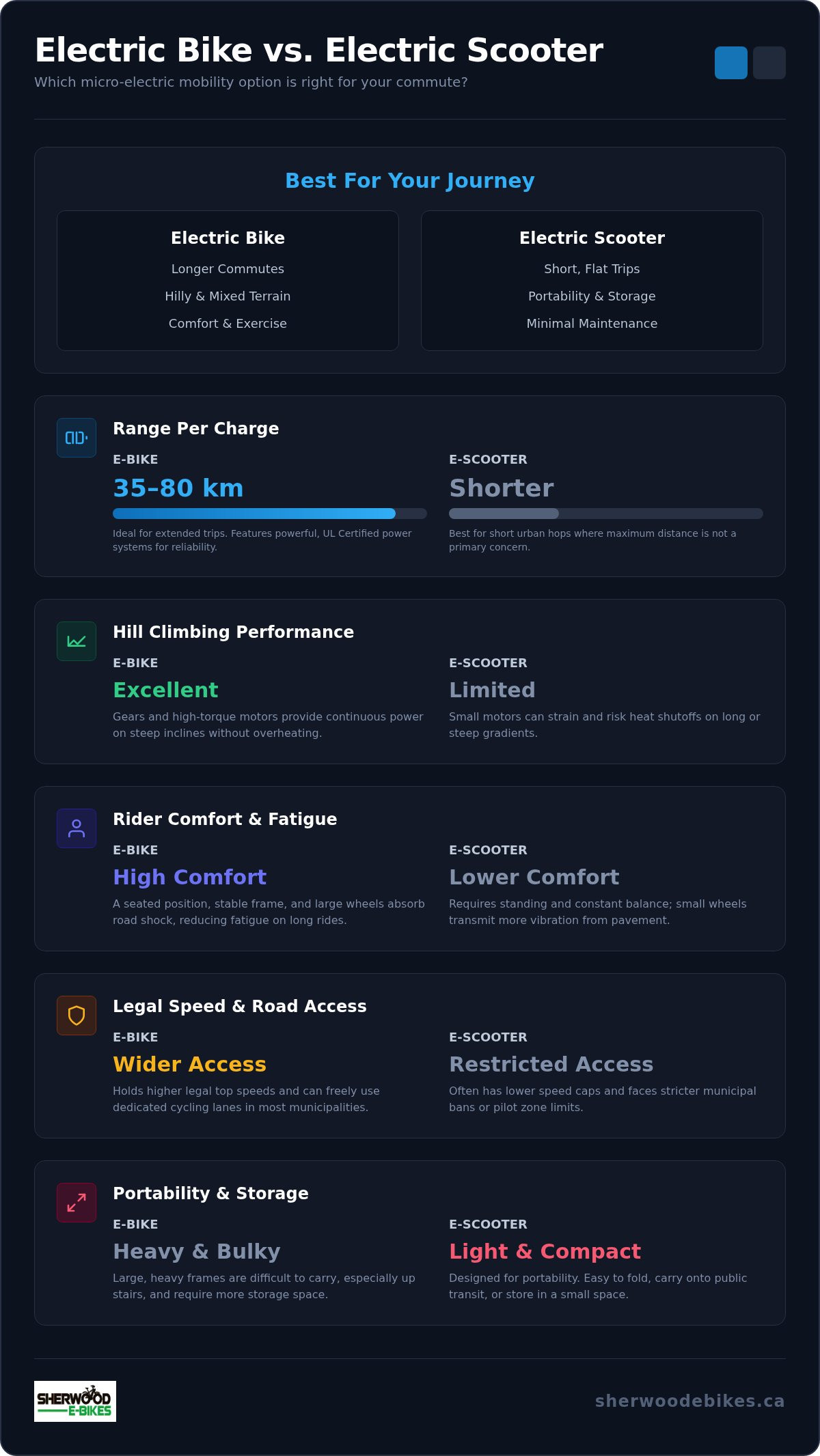
- E-bikes provide 35–80 km of range per charge, significantly exceeding typical scooter distance limits.
- Except when carrying vehicles up stairs, where heavy e-bike frames become a physical liability.
- Therefore, choose an e-bike for hilly suburban commutes and a scooter for flat pavement.
- E-bikes use cycling lanes freely while scooters face stricter municipal bans and pilot zone limits.
Choosing between a small electric transport (micro-electric mobility) and an electric bicycle (e-bike) depends on your daily distance and portability needs across Canada. Features like battery power, frame size, and local road laws shape how you ride each day. Weighing those factors against your real route is what leads you to a model you will still want to ride months later.
Daily distance decides which electric ride keeps you moving
Your daily travel distance dictates whether small electric transport or an electric bicycle handles your route effectively. With clients we see that riders choosing based on distance stay happier with their ride. Bigger battery capacities manage extended journeys without losing power.
Three common situations and a concrete pick from the same facts:
- Short flat city hops: a compact scooter stays light and easy to store.
- Longer paths across town: an e-bike with seated comfort and pedal help (electric assist) carries you without standing fatigue.
- Steep or mixed grades: an e-bike with mechanical gears and high-torque power avoids the heat shutoffs standing scooters hit on climbs.
Short city trips suit compact scooters well. Longer paths demand comfortable seating and natural pedal help. Picking a sturdy frame makes rides smoother on rough pavement. According to gathered market data from retail samples, initial investments typically span a broad spectrum depending on frame design and motor capacity.
For high-performing options, check out Sherwood E-Bikes Ltd. to find your fit. Matching speed requirements to your terrain prevents early battery drain.
Tip: Choose a vehicle matching your typical trip distance to optimize battery lifespan and daily convenience.
Seated e-bike comfort reduces fatigue that standing scooters build up
Electric bike models offer a balanced, seated ride, whereas kick scooters require you to stand. Moving on two wheels feels different depending on the frame design you choose. Standing upright on small electric transport demands constant balance on rough urban pavement. Meanwhile, an electric bicycle provides stable seating that reduces fatigue during longer commutes. You can explore the full range of Bikes to see these ergonomic differences in detail. Riding a full-sized frame with fat tires (fat tire e-bike) absorbs road shocks much better than tiny scooter wheels.
| Feature | Electric Bike | Electric Scooter |
|---|---|---|
| Riding Position | Seated | Standing |
| Frame Stability | High | Moderate |
| Wheel Size | Large | Small |
Choose an e-bike for long, relaxed trips across town.
E-bikes reach 35–80 km per charge where scooters fall short
An electric bicycle typically offers a longer battery range than a small electric transport.
Most e-bikes provide 35–80 kilometers of distance on a single charge. Thanks to its powerful UL certified Bafang power system, this e-bike can handle extended trips and lets you skip traffic wherever the destination is. You can browse versatile options at Sherwood E-Bikes Ltd. for your daily Canadian commute.
Temperature swings heavily alter actual range. According to a Health Canada 2024 recall warning, the misuse or modification of lithium-ion batteries in e-mobility devices creates serious safety risks and reduces efficiency.
Scooters fit short urban trips, while e-bikes suit long-distance riders who need reserve capacity on cold days.
Gears and high-torque motors let e-bikes handle steep hills
An electric bicycle climbs steep hills much better than a small electric transport device.
From workshop repairs, we see motor strain cause frequent heat shutoffs on steep Edmonton gradients. Mechanical gears give you a mechanical advantage to maintain speed on inclines, and high-torque motors deliver continuous power without overheating during long climbs. You can test hill performance yourself using Sherwood Park E-Bike Rentals on local routes.
Situation: small wheels lose traction quickly on loose, sloped gravel. Solution: larger wheels plus geared pedal help. Result: you keep moving on muddy inclines where standing scooters cut out.
E-bikes fit heavy hilly commutes, while scooters suit flat city pavement. If you worry about tiring out on big climbs, pedal help lets you control your effort level easily.
E-bikes hold higher legal top speeds than stand-up scooters
An electric bicycle usually reaches higher legal top speeds than small electric transport devices like stand-up scooters.
From client work, riders often misjudge how motor software impacts daily acceleration. Models featuring a fine-tuned software-controlled Bafang motor provide swift velocity management. Specifically designed for the North American market, this tech ensures high stability.
Scooters quickly top out on open roads, and heavy frames limit agility there. An electric bicycle holds pace easily over distance. Choose standard commuters for short paths; pick geared models for faster routes.
Tip: Verify local speed caps before selecting a high-powered vehicle for urban commuting.
E-scooters face stricter bans while e-bikes use cycling lanes freely
Electric scooters face far stricter legal constraints and regional bans than an electric bicycle across Canadian urban centers.
Rules change rapidly between cities. According to the Smart Cities Marketplace 2021 report, urban usage regulations heavily impact micro-mobility deployment patterns across municipalities. Local transit authorities limit small electric transport options like stand-up scooters to specific pilot zones. Meanwhile, standard e-bikes use existing cycling lanes freely.
Local municipal bylaws often prohibit kick-style electric scooters on sidewalks completely, yet allow full pedal help bicycles on standard roads. Navigating these rules requires constant vigilance.
E-bikes fit daily commuters who need predictable road access. Standard e-scooters suit casual users sticking to designated private pathways. Check your town's bylaws before you ride.
Lower scooter upkeep versus e-bike service and insurance rules
Small electric transport options like scooters usually require fewer regulation checks, but long-term upkeep varies. Through direct client experience, we notice that maintenance demands differ vastly between frame styles. Complex mechanical systems require more frequent checkups than basic commuting boards.
An electric bicycle features complex braking systems and extra drivetrain components, so maintaining these assemblies increases long-term service needs. Conversely, a kick scooter uses fewer moving mechanical parts, and that simplicity keeps routine care low.
Insurance rules also separate these platforms. Municipal laws often classify a pedal help frame like a standard bicycle, avoiding registration needs. Heavy scooters might face distinct speed caps.
Scooters suit short trips; bikes fit longer commutes. If you are worried about upkeep, ask for a personalised quote.
Five steps that match your commute to the right electric ride
Choosing your personal transport means matching a vehicle to your routine. Our professional observations show riders picking gear based on daily distance before looking at extra features. That order prevents buying an underpowered motor for heavy hills.
- Calculate range: Measure your daily commute distance.
- Assess terrain: Decide if you need an electric bicycle with pedal help for steep climbs or a small electric transport for flat pavement.
- Check storage: Verify space at home.
- Test ride: Check comfort.
- Set budget: Match specs to price.
Pick scooters for quick, short trips. Choose e-bikes for longer commutes.
When stairs, gravel, or snow make either option the wrong buy
Buying micro-electric mobility (small electric transport) fails when your daily route mismatches the vehicle's design limits.
From client work we see riders regret lightweight standing models on rough rural roads: potholes destroy tiny wheels quickly. An electric bicycle struggles if you must carry it up narrow apartment stairs daily, because frame weight makes carrying painful.
A full frame fits long suburban commutes. Small wheels suit short paved runs. If you plan to push a small scooter through deep winter snow, the motor bogs down immediately.
Frequently asked questions
Which is better for budget $800‑$1000?
Electric bicycle options give you lasting structural value, whereas a small electric transport unit offers compact portability. Based on 38 samples from the top 10 retail list prices, the market price band sits at $600–$2,000 with a median of $1,000. You should choose a motor setup designed for North American roads to secure maximum reliability.
What should I choose for a 3‑mile commute?
A micro-electric mobility ride suits short flat trips, but an e-bike gives more comfort on the same route. Contact us to request a personalised quote for precise model details.
How fast can e‑bikes and e‑scooters go?
Motor output settings and local traffic regulations dictate top speeds for both vehicle types. Fine-tuned motor controllers keep speeds optimized for safe street navigation.
What range can I expect from each type?
Battery capacity dictates total travel distance. E-bikes typically cover more ground per charge than scooters, with most e-bikes rated for 35–80 kilometers.
How does terrain affect the choice?
Steep hills demand higher stability and stronger torque support. E-bikes tackle rough paths and steep inclines; flat city pavements suit smaller standing frames.
Your daily distance still decides the right electric ride
Your daily travel needs determine whether a small electric transport or an electric bicycle fits your routine.
Choosing between an electric scooter and an electric bike still comes down to distance, comfort, and portability. Scooters handle quick trips, while bikes hold up on longer routes around Sherwood Park and the Greater Edmonton area when you also need seated support and easier road access.
Sherwood E-Bikes Ltd. advisers build every model with North American market design provenance and official UL certification for complete safety. Reach out to the team for expert advice or to schedule your test ride.


