

The right fat tire e-bike for Alberta is the one that matches your terrain, your winter plans and your storage space, not the one with the biggest motor number. Fat tires, usually around 4 inches wide, give extra float and grip on snow, sand, gravel and rough trails, and they make a forgiving ride on broken pavement.
Fat tire e-bikes are popular across the Edmonton region because they extend the riding season into winter and open up gravel roads, river valley trails and lake access paths. They’re also heavy, so it pays to compare carefully before you buy.
This guide covers what to compare in a fat tire e-bike for Alberta conditions, how to set one up for snow, and what maintenance to expect. Sherwood E-Bikes Ltd. in Sherwood Park offers fat tire e-bikes, test rides and service on all brands.
Key Takeaways
- Fat tires add traction and comfort on snow, gravel and rough trails, but the bikes are heavy; check storage and transport before you buy.
- Alberta road-legal e-bikes must have a motor of 500W or less and assist only up to 32 km/h.
- Low tire pressure is the key to snow performance; a quality pump with a low-pressure gauge is essential.
- Hydraulic disc brakes, front suspension and a removable battery are worthwhile features for Alberta riding.
- Winter salt and grit wear drivetrains fast, so plan regular cleaning and seasonal tune-ups.
Who a fat tire e-bike suits
A fat tire e-bike makes sense if you want to ride through winter, explore gravel roads and multi-use trails, or simply want a stable, cushioned ride. Riders who mainly commute on cleared pavement may be happier with a lighter commuter or hybrid e-bike, which rolls faster and is easier to carry.
Think about where most of your kilometres will be. Packed snow on Sherwood Park’s trail network, gravel range roads outside Leduc, and sandy lake paths all reward wide tires. Long stretches of dry pavement don’t.
What to compare
| Feature | What to look for |
|---|---|
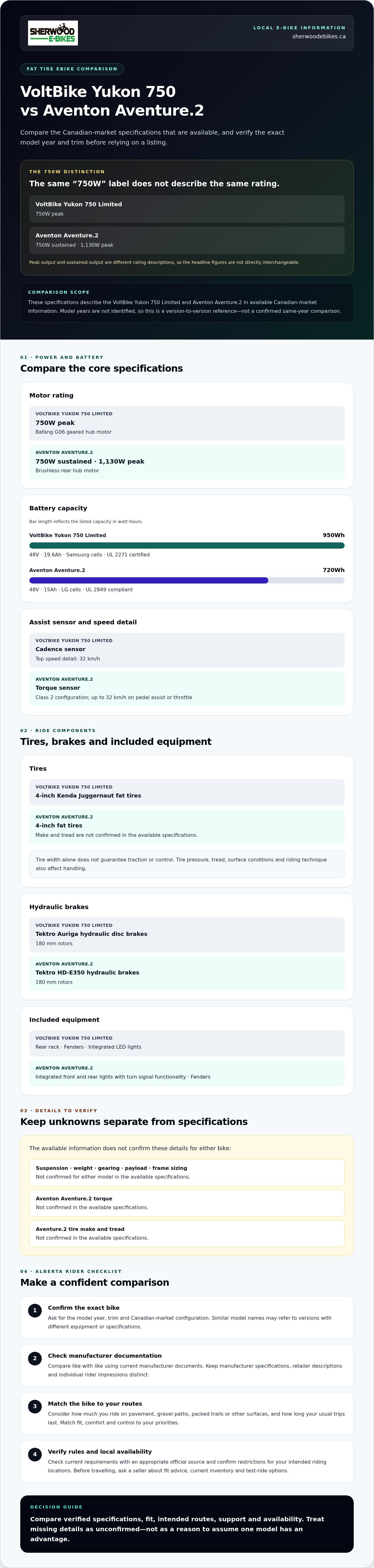
| Motor and legal setup | 500W or less for road use in Alberta, with assistance capped at 32 km/h. A geared hub motor is common; mid-drives climb steep trails more efficiently. |
| Battery | Enough capacity for your longest ride with a margin for cold-weather range loss. A removable battery lets you charge and store it indoors. |
| Brakes | Hydraulic disc brakes, ideally with larger rotors, for consistent stopping on a heavy bike. |
| Suspension | A front suspension fork adds control on rough trails; fat tires already absorb small bumps. |
| Frame style | Step-through frames are easier to mount in winter boots; step-over frames are often stiffer. |
| Sensor type | A torque sensor gives smoother, more controllable power on slippery surfaces. |
| Mounts and extras | Rack, fender and light mounts for year-round practicality. |
Compare specific models using the same model year, and treat published range figures as best-case estimates. Range in sub-zero temperatures, deep snow and low tire pressure will be noticeably lower.
Setting up for snow
Tire pressure makes the biggest difference. Lower pressure lets the tire spread out and float on snow; higher pressure rolls faster on pavement. Many riders run noticeably lower pressure in fresh snow than on packed trails, staying within the minimum printed on the tire sidewall. A pump with an accurate low-pressure gauge is worth the investment.
- Use studded fat tires if you’ll ride on ice regularly.
- Start in a low assist level on slippery surfaces to avoid wheel spin.
- Keep the battery indoors until you ride, then insulate it with a neoprene cover if possible.
- Add pogies or insulated gloves; cold hands make braking and shifting harder.
Weight, storage and transport
Fat tire e-bikes are among the heaviest bikes you can buy. Before choosing, check whether you can lift it into your vehicle or onto a rack, whether your car rack is rated for its weight and tire width, and whether it fits through doors and into storage. Removing the battery lightens the bike for lifting.
Maintenance for fat tire e-bikes
Winter riding is hard on components. Salt and sand wear chains, cassettes and brake pads quickly, and moisture can work its way into bearings. Rinse and dry the drivetrain after salty rides, lubricate the chain often, and book a tune-up in spring and before winter.
Sherwood E-Bikes Ltd. offers e-bike maintenance and repair for all brands, including electrical diagnostics, brake service and drivetrain replacement, for riders in Sherwood Park, Edmonton, Fort Saskatchewan, Leduc, Camrose and nearby communities. To compare fat tire e-bikes in person, book a showroom test ride.
Frequently Asked Questions
Are fat tire e-bikes good in Alberta winters?
Yes, on packed snow and with the right tire pressure. For icy conditions, add studded tires. Deep, fresh snow is still challenging for any bike.
Is a fat tire e-bike legal on Alberta roads?
It is if the motor is rated 500W or less and assistance stops at 32 km/h. Check the configuration before you buy, especially for bikes sold for US speed classes.
How much range will I get in winter?
Expect noticeably less than the published figure, because cold reduces battery output and low tire pressure increases rolling resistance.
Where can I test ride a fat tire e-bike near Edmonton?
Visit Sherwood E-Bikes Ltd. at 2008a Sherwood Dr., Sherwood Park, or call (587) 269-2453.


