

Bosch Performance Line CX vs Shimano EP8 motor reliability in winter depends on more than the name on the frame. The exact motor generation, the bike’s integration, and how you manage cold, moisture and road grime all matter.
If you ride around Sherwood Park, Edmonton or nearby communities, you may wonder whether slush, freezing temperatures or road salt will shorten a motor’s life. These conditions call for care, but they don’t prove that one system is more reliable. Battery behaviour, the bike’s electrical setup and routine cleaning also shape the experience.
This comparison explains how to identify the Bosch Performance Line CX or Shimano EP8 version on a bike, understand the limits of published winter guidance, and separate motor reliability from battery care and general maintenance. You’ll also find practical steps to reduce avoidable wear and learn how local e-bike maintenance and electrical system diagnostics can support winter riding.
Key Takeaways
- Identify the exact motor generation and bike model before comparing specifications or winter experiences.
- Review manufacturer temperature guidance for Bosch Performance Line CX, and note where Shimano EP8 guidance differs.
- Separate motor operation from cold-weather battery range and charging care when assessing winter reliability.
- Follow a practical routine for inspecting, cleaning, drying and storing your e-bike through Alberta’s winter conditions.
- Compare the whole bike and its service needs, not just the motor badge, when assessing Bosch Performance Line CX vs Shimano EP8 motor reliability in winter.
What winter reliability means for Bosch Performance Line CX and Shimano EP8
Winter reliability is more than peak torque or how quickly a motor responds on a climb. It includes dependable operation in the conditions the bike is designed for, durability over repeated exposure, and access to suitable diagnosis and maintenance if a problem occurs. An electric motor is only one part of an e-bike system. The battery, wiring, controls and overall bike design also affect how it performs.
Winter reliability means dependable operation, lasting durability and practical serviceability in the conditions a specific e-bike is designed to handle.
That definition matters when comparing Bosch Performance Line CX and Shimano EP8. The Bosch Performance Line CX vs Shimano EP8 motor reliability in winter question can’t be answered by comparing torque figures alone. Match your evidence to the exact motor generation and bike. Frame layout, electrical connections, battery position and care instructions can differ between bikes, even when they use the same motor name.
Which winter conditions matter to an e-bike motor?
Cold starts, wet roads, slush and road grime are part of winter riding around Edmonton. What happens after the ride matters too. Salt and grit left on the bike, moisture trapped as temperatures change, or damp storage can affect components across the system. This doesn’t mean either motor is inherently unreliable. It means the bike’s exposure and your cleaning habits belong in the assessment alongside the motor itself.
Check the manual for your exact bicycle and drive unit before relying on general advice. Care limits and instructions vary by model. Don’t assume a particular temperature threshold or water-resistance rating applies to every Bosch Performance Line CX or Shimano EP8-equipped bike.
Why motor reliability is not the same as winter range
Motor operation and battery energy are related, but they are not the same measure. Cold weather can affect the energy available from a battery and reduce the distance you can travel on a charge. A shorter range alone doesn’t show that the motor has become less reliable.
Keep the evidence separate: note whether the motor operates as expected, and compare range under similar riding conditions rather than treating a shorter trip as proof of a motor fault. Follow the documentation for your exact bike and battery for charging, storage and temperature limits. This helps distinguish cold-weather battery behaviour from motor issues and gives you a clearer basis for comparing the complete e-bike.
Bosch Performance Line CX vs Shimano EP8: compare the exact motor generation
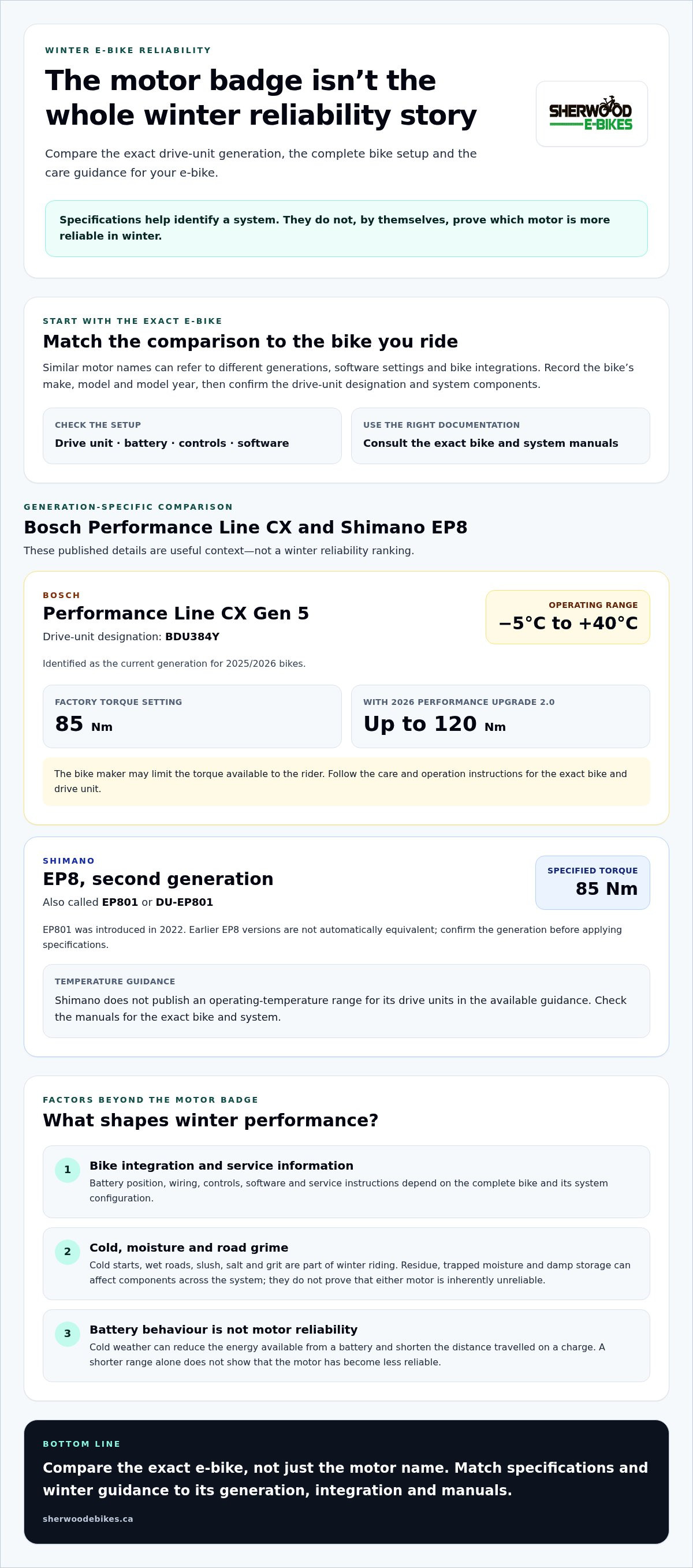
Start with the bike, not the motor badge. Record its make, model and model year, then identify the drive-unit designation and system components. Similar names can cover different generations, software settings and bike integrations. Model year and bike integration can change the comparison, so match specifications and winter guidance to the exact e-bike before drawing conclusions.
| Comparison point | Bosch Performance Line CX | Shimano EP8 |
|---|---|---|
| Generation | Performance Line CX Gen 5, model BDU384Y, is the current generation identified for 2025/2026 bikes. | EP801, also called DU-EP801, is the second-generation EP8 introduced in 2022. Earlier EP8 versions are not automatically equivalent. |
| Manufacturer temperature guidance | Bosch specifies an operating range of -5°C to +40°C for the Gen 5 drive unit. | Shimano does not publish an operating-temperature range for its drive units in the available guidance. Check the exact bike and system manuals. |
| Torque context | For Gen 5 BDU384Y, Bosch’s 2026 Performance Upgrade 2.0 can raise torque to 120 Nm from the factory setting of 85 Nm. The bike maker may limit the torque available to the rider. | EP801 is specified at 85 Nm. Don’t apply this figure to a different EP8 generation without matching documentation. |
| Integration and service information | Battery, controls, wiring, software and service instructions depend on the complete bike and its system configuration. Use the bicycle maker’s documentation alongside the motor information. | |
| Winter care | Follow the exact bike and motor manuals for operation, cleaning and storage. Don’t infer a shared water-resistance rating or care limit from the motor name alone. | |
Torque describes a performance specification, not how reliably a drive unit operates in freezing, wet or dirty conditions. The Bosch Performance Line CX vs Shimano EP8 motor reliability in winter comparison needs separate evidence about cold-weather operation, bike integration and care instructions. A torque figure can’t establish durability or prove that one system is more reliable in winter.
What should riders verify on Bosch Performance Line CX?
Record the bike model and year, drive-unit designation, battery and control system, and any software update that affects the published specifications. Match Bosch’s operating, cleaning and storage instructions to that setup. For Gen 5 BDU384Y, the stated 85 Nm factory setting differs from the 120 Nm available with the 2026 update. The bike maker may cap output.
What should riders verify on Shimano EP8?
Record the bike model and year, whether it uses EP801 or an earlier EP8 version, and its system configuration. Check the current Shimano and bicycle-maker guidance for operation, cleaning and storage. Keep generation-specific specifications and rider reports separate rather than treating every EP8 setup as identical.
For general e-bike maintenance and electrical system diagnostics in the Sherwood Park and Edmonton area, explore e-bike maintenance services.
Which system suits your winter riding? Compare the evidence, not the badge
For winter use, compare evidence by category. Manufacturer specifications describe the documented system; owner reports describe particular bikes and experiences. Neither peak torque nor a handful of positive or negative posts establishes which motor is more reliable in Alberta conditions. Look for evidence that matches the exact generation, bike setup and riding you’re considering.
| Evidence to compare | What it can tell you | Verify before purchase |
|---|---|---|
| Manufacturer documentation | Published specifications and care instructions for a particular motor or system. | Match the document to the motor generation, bike model and model year. |
| Owner reports | What individual riders experienced with their bikes in stated conditions. | Look for the same motor generation, comparable bike setup, winter temperatures and riding conditions. |
| Whole-bike design | How battery position, wiring protection and system layout fit your riding routine. | Inspect the complete bike and its intended use, not just its motor name. |
| Service and parts information | Whether documentation, compatible parts and service pathways are available for the complete bike. | Consider the bike brand’s support and local e-bike maintenance options. |
How to interpret winter owner reports
Check the details behind each account. A report about an EP8-equipped bike used for wet-weather commuting may not help you assess a different EP8 generation on an off-road bike. Give more weight to repeated, well-described reports than to broad claims, but remember that online posts don’t provide a measured failure rate. One rider’s fault or trouble-free season is an experience, not proof that Bosch Performance Line CX or Shimano EP8 is the winter reliability winner.
When service access and bike setup should influence your choice
Your riding plans should shape the decision. A daily commute on treated roads creates different exposure and service needs from occasional off-road rides through slush and grit. Consider how the bike protects its wiring, where its battery sits, and whether system documentation and compatible parts are accessible. These whole-bike details matter alongside motor specifications.
The Bosch Performance Line CX vs Shimano EP8 motor reliability in winter comparison is most useful when it helps you assess the exact bike you’ll ride and maintain. For general maintenance and electrical system diagnostics in Sherwood Park and Edmonton, see local e-bike maintenance services.
How to protect either e-bike motor through an Alberta winter
Winter care can limit avoidable exposure to slush, road grime and moisture, but it can’t guarantee fault-free operation. Use the routine below for either Bosch Performance Line CX or Shimano EP8, and follow your exact bicycle and motor instructions if they differ. Cleaning methods, storage guidance and component limits vary by model.
Before and after a cold-weather ride
- Inspect before riding. Check visible cables, connectors, motor casing and mounting areas. Look for damage, loose parts or unusual movement. Don’t pull on wiring or disconnect components unless the manual directs you to.
- Pay attention during the ride. Note new noises, intermittent assistance or warning messages. If something changes, stop and record what happened instead of repeatedly switching the motor on and off to test it.
- Clean gently after riding. Remove surface grime using a method approved in your bicycle and motor manuals. Don’t direct high-pressure water at electrical components, connectors or motor seals. Water resistance doesn’t make pressure washing or soaking appropriate.
- Dry before storage. Follow the manufacturer’s drying instructions, paying attention to wet areas around the frame and electrical connections. If snow or slush has collected on the bike, let it dry as directed before storing it.
Regular checks help you notice changes early. They don’t establish the cause of a symptom or replace an assessment if assistance becomes intermittent or a warning appears.
Cold-weather storage and charging precautions
Motor care and battery care are related, but their instructions aren’t interchangeable. Use the bicycle and motor manuals for drive-unit operation and storage, and the battery documentation for charging, storage and temperature guidance. Don’t assume one temperature limit applies to every component or bike model.
Before charging or storing the battery, follow its specific instructions, especially if it has been exposed to severe cold or moisture. If you’re unsure whether a symptom points to the motor, battery or another electrical component, avoid repeated testing and arrange an assessment.
For winter upkeep in Sherwood Park and Edmonton, explore local e-bike maintenance and electrical diagnostics.
Choose between Bosch Performance Line CX and Shimano EP8 with a clear next step
The available comparison doesn’t establish Bosch Performance Line CX or Shimano EP8 as universally more reliable in winter. A useful choice depends on the exact motor generation, the bike’s integration, the manufacturer’s care instructions and support for the complete e-bike. Published torque figures describe assistance, but they don’t prove cold-weather reliability.
Before deciding, compare the exact bicycles you’re considering. Check their model years and motor designations, then review each bike and motor manual for winter operation, cleaning, storage and battery guidance. A well-matched system is one whose documented limits and care requirements suit your riding routine, not simply the one with the more familiar badge.
A quick decision checklist for winter riders
- Confirm the details: Record the model year, motor generation and full bike model for each option.
- Review the setup: Compare battery placement, visible wiring protection and the bike’s intended use.
- Match the manuals to your riding: Check documented care instructions against your typical Edmonton-area winter conditions and ride frequency.
- Consider support: Factor in access to relevant service, parts and documentation for the complete bike.
Keep specifications, owner reports and service information in context. A report about a different generation or bike setup may not apply to the model you’re considering. Choose based on evidence that matches the bikes and your needs, rather than an unsupported brand-wide reliability ranking.
When to arrange an e-bike service assessment
Arrange an assessment if assistance interruptions recur, warning messages appear or you hear an unusual motor noise. Note when the symptom occurs and share the bike model, motor generation and any messages shown. That information can help guide maintenance and electrical system diagnosis, though it doesn’t guarantee a particular repair outcome.
For riders in Sherwood Park, Edmonton and nearby communities, local e-bike maintenance and electrical system diagnostics can support care for either system. If your bike needs attention, book an e-bike service appointment at a time that works for you.
Choose your winter e-bike with confidence
The Bosch Performance Line CX vs Shimano EP8 motor reliability in winter comparison comes down to the exact motor generation and complete bike, not the brand badge alone. Check the model year, system integration and manufacturer care instructions before treating specifications or rider reports as equivalent.
Cold-weather battery range and motor reliability are different considerations. Careful inspection, cleaning and storage can help limit avoidable winter exposure, but no routine can guarantee fault-free operation. Choose the bike whose documented requirements, setup and service support fit your riding conditions around Edmonton and Sherwood Park.
If your e-bike develops recurring assistance interruptions, warning messages or unusual motor noise, an assessment can help identify what needs attention. Sherwood E-Bikes Ltd. offers local e-bike maintenance and electrical system diagnostics for riders in Sherwood Park, Edmonton and nearby communities.
Book an e-bike service appointment when you’re ready for support. With the right information and consistent care, you can make a considered choice and keep winter rides moving with confidence.
Frequently Asked Questions
Is the Bosch Performance Line CX more reliable than the Shimano EP8 in winter?
Available information doesn’t establish either motor as universally more reliable in winter. Compare the exact motor generation and model year, the complete bike setup, manufacturer guidance and relevant service information. Torque figures describe assistance, not cold-weather durability. Owner reports can offer context, but they don’t prove a brand-wide advantage. The Bosch Performance Line CX vs Shimano EP8 motor reliability in winter question is best answered for the specific bikes you’re considering.
Can I ride a Bosch Performance Line CX or Shimano EP8 in snow?
You can ride in snow if your specific e-bike’s instructions and intended use support those conditions. Snow, slush and road grime expose the whole bike to moisture and dirt, so consider traction, visibility and post-ride care as well as the motor. Check the bicycle and drive-unit manuals for operating guidance. After a ride, clean and dry the bike as directed, and watch for warning messages or changes in assistance.
Does cold weather damage an e-bike motor?
Cold weather alone doesn’t establish that a motor has been damaged, but operating limits vary by system and generation. Bosch specifies an operating range of -5°C to +40°C for the Performance Line CX Gen 5 drive unit. Don’t apply that range to other versions without matching documentation. Shimano doesn’t publish an official operating-temperature range for its drive units in the available guidance. Follow the manuals for your exact bike and motor.
Are Bosch Performance Line CX and Shimano EP8 waterproof?
Don’t assume either system is waterproof based on the motor name. Bosch and Shimano don’t provide one system-wide ingress-protection rating that applies to every motor, battery and bike setup. Component ratings and bike designs can differ, so consult the documentation for your exact model. Avoid submerging the bike or directing high-pressure water at the motor, electrical connections or seals. Water resistance doesn’t mean every type of water exposure is safe.
How should I clean an e-bike motor after a winter ride?
Follow your bicycle and motor manuals, since cleaning instructions vary. Switch the e-bike off, remove surface grime gently and avoid directing high-pressure water at the motor, electrical components, connectors or seals. Don’t disconnect electrical parts unless the manufacturer instructs you to. Dry the bike as directed before storage, and check visible cables and connections for damage. If cleaning reveals a warning or unusual change, record it rather than repeatedly testing the motor.
Does winter affect e-bike motor reliability or battery range more?
Cold-weather battery performance can reduce the energy available for a ride, while motor reliability depends on factors such as the exact generation, bike integration, exposure and care. A shorter range doesn’t, by itself, prove a motor problem. Keep the two observations separate: note how the motor operates and compare battery range under similar conditions. Use the exact bike and battery manuals for temperature, charging and storage instructions.
When should I get my Bosch or Shimano e-bike motor checked?
Arrange an assessment if assistance interruptions recur, warning messages appear or you hear unusual motor noise. Note the bike model, motor generation, symptoms and when they occur; this information can help with maintenance and electrical system diagnosis. Sherwood E-Bikes Ltd. provides local e-bike maintenance and electrical diagnostics for riders in Sherwood Park, Edmonton, Leduc, Camrose, Fort Saskatchewan, Ardrossan, St Albert, Vegriville, Morinville, Wetaskiwin and Spruce Grove.


