

The bike with more cargo room or a bigger motor isn’t automatically the better climber. If you’re weighing the RadCity against the RadRunner for a Sherwood Park commute, that distinction matters: the best commuter e-bike for hills Sherwood Park riders need depends on the route, the load and how the bike delivers assistance.
Names and headline specifications are useful starting points, but they don’t tell the whole story. A bike can feel different once you add a work bag, groceries or other daily cargo. The RadCity and RadRunner names also cover different generations, so the exact model and configuration matter. The RadCity has been succeeded by the Radster Road, while the RadRunner line includes the RadRunner 3 Plus.
This comparison explains which specifications help you assess climbs, how each bike’s layout and carrying capacity may suit a commute, and why local riding conditions matter. You’ll also get a practical test-ride framework: try a familiar incline, assess the bike with a realistic load and pay attention to how it feels under your own pedalling. A local ride can make the choice clearer than model names alone.
Key Takeaways
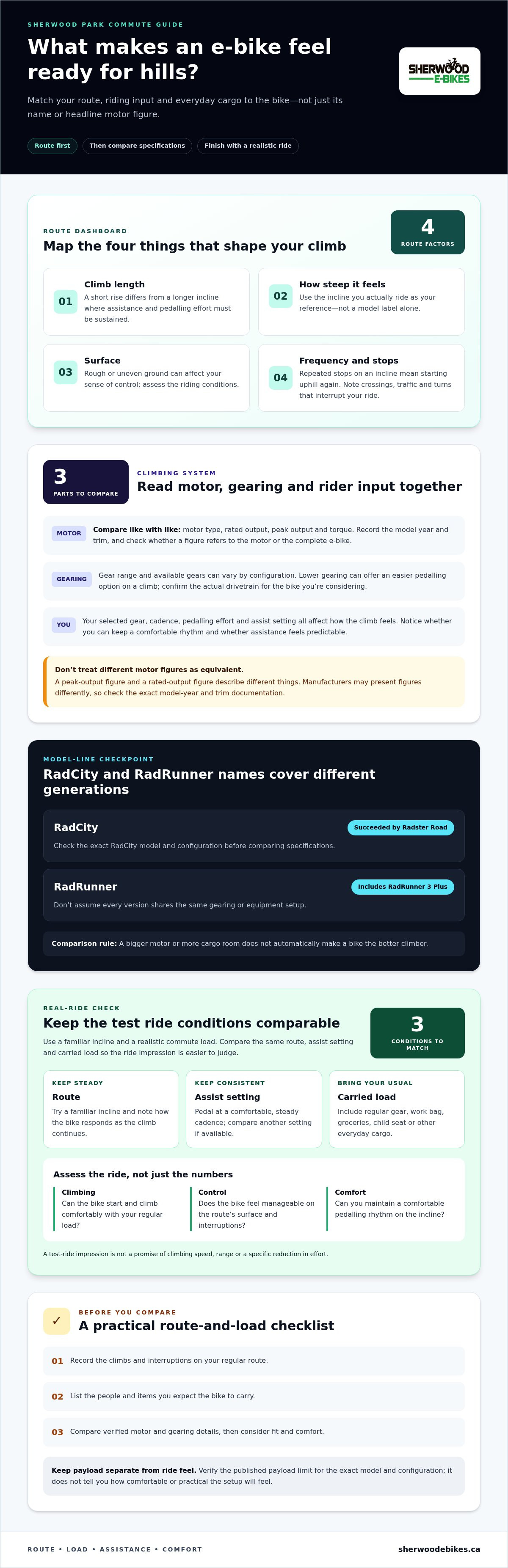
- Judge hill performance by route, rider input and commute load, not by a model name or headline motor figure alone.
- Compare the specific RadCity and RadRunner generations you’re considering; specifications can vary by model and configuration.
- Use motor behaviour, gearing and cadence to understand how much effort a climb may demand from you.
- For a useful test ride, keep the route, assist setting and carried load similar, then assess climbing, control and comfort.
- Find the best commuter e-bike for hills Sherwood Park by matching verified specifications and real ride feel to your daily commute.
What makes a commuter e-bike suitable for Sherwood Park hills?
Start with your commute, not the bike’s label. A model described as a city bike or utility bike doesn’t tell you how it will feel on your route. To identify the best commuter e-bike for hills Sherwood Park riders can rely on, compare motor assistance, available gearing, typical carried load and riding comfort against the climbs you actually encounter. Treat specifications as a starting point, then consider how those factors work together for you.
Hill suitability isn’t captured by one number. Motor behaviour affects how assistance feels as you pedal; gearing gives you options for managing your effort; and added cargo changes the work required from both rider and bike. Comfort matters too: an awkward riding position can make a longer climb and daily trip less appealing. A general overview of the electric bicycle explains different assistance systems, useful background when comparing how e-bikes deliver motor support.
Which parts of a commute make hills feel demanding?
Map the route you repeat and note four things: climb length, how steep it feels, surface and frequency. A short rise may call for a different response than a longer incline where assistance and rider effort must be sustained. Rough or uneven surfaces can also affect your sense of control, so assess the riding conditions rather than treating every climb as identical.
Pay attention to starts. On a steady climb, you can settle into a pace and keep pedalling. Repeated stops on an incline mean starting uphill again, which may feel more demanding than maintaining motion. Note where traffic, crossings or turns interrupt your ride. These observations describe the route; they don’t measure your fitness or predict exactly how much assistance you’ll want. Use both when comparing bikes.
Why rider and cargo load belong in the comparison
Assess the bike with your normal commute in mind. Include your riding gear, work bag, groceries, a child seat or any other regular cargo. Added weight changes the effort required on a climb, so a ride without your usual load may not reflect how the bike feels day to day. You don’t need to estimate a performance figure. Focus on whether the bike starts, climbs and handles comfortably for your real use.
Keep your carrying needs separate from a bike’s published payload limit. The limit is a specification to verify for the exact model and configuration, not a measure of how comfortable or practical the setup will feel. Make a short checklist before comparing options:
- Record the climbs and interruptions on your regular route.
- List the people and items you expect the bike to carry.
- Compare verified motor and gearing details, then consider fit and comfort.
Sherwood Park routes vary, so your own regular trip is the most useful reference. Bring that route profile and load checklist into your next comparison. They’ll help you judge whether a bike’s published details match the ride you need to make.
How motor, gearing, and riding input affect e-bike hill climbing
Motor numbers help you compare e-bikes, but they don’t predict exactly how a climb will feel. Rated power describes the motor’s stated output under the manufacturer’s rating method. Peak output refers to a higher output the motor may reach under particular conditions. Manufacturers may present these figures differently, so compare like with like and read the notes for the exact model year and trim.
Torque describes turning force. It can help indicate how the motor may respond as the bike moves uphill, particularly at lower speeds. But torque figures alone don’t tell you how assistance is delivered, how the bike is geared or how much you’ll pedal. The best commuter e-bike for hills Sherwood Park riders choose should make sense as a complete system, not simply have the largest number on a spec sheet.
Which motor and gearing specifications should riders compare?
Build a like-for-like comparison from current manufacturer documentation. Record the motor type, rated output, peak output and torque, then note the model year and trim beside each figure. Check whether a number describes the motor or the complete e-bike. Don’t compare one model’s peak output with another’s rated output as if they were equivalent.
Look at the gearing too. Gear range and the number of available gears can vary between configurations. Lower gearing can give you an easier pedalling option on a climb, while your selected gear and pedalling cadence affect how hard you’re working. Confirm the actual drivetrain details for each bike rather than assuming RadCity and RadRunner versions share the same setup.
How rider input and assist settings affect climbing
Motor assistance works alongside your pedalling, but the way it responds depends on the bike’s system and selected assist level. For a fair comparison, use the same assist setting on a similar climb and pedal at a comfortable, steady cadence. Then repeat at another setting, if available, and notice whether the response feels smooth, immediate or gradual. Avoid drawing conclusions from a brief burst of assistance alone.
Keep the comparison controlled. A different gear, effort level or assist setting can change the ride impression, even on the same route. Notice whether you can maintain a comfortable rhythm and whether the motor’s response feels predictable as the incline continues. Don’t treat a test-ride impression as a promise of climbing speed, range or a specific reduction in effort.
Published specifications describe the equipment; a test ride reveals how that equipment feels under you.
Use the figures to narrow your options, then assess the riding experience in person. At Sherwood E-Bikes Ltd., a showroom test ride gives you a chance to compare motor response, gearing and cadence on a real bike, with personalized advice on how the specifications relate to your commute. Bring your model-year notes so the ride and the published details stay connected.
RadCity vs. RadRunner: which commuter setup fits your hills?
These names cover multiple generations, so a fair comparison starts with the exact bike, model year and configuration. The RadCity line has been succeeded by the Radster Road, while the RadRunner range includes the RadRunner 3 Plus. The table separates those current models from the older names rather than treating specifications as interchangeable.
| Comparison point | RadCity | RadRunner | Current successors noted |
|---|---|---|---|
| Model year | Varies by generation; identify the year and trim | Varies by generation; identify the year and trim | Exact model year not specified here |
| Motor | Verify for the specific bike | Verify for the specific bike | Radster Road: 500W geared hub. RadRunner 3 Plus: 750W brushless geared hub |
| Gearing | Configuration-dependent; verify | Configuration-dependent; verify | Verify the drivetrain for the exact configuration |
| Weight | Verify for the specific bike | Verify for the specific bike | Radster Road: 33.8 kg. RadRunner 3 Plus: 34.2 kg |
| Tires | Verify size and type | Verify size and type | Radster Road: 29 × 2.2 in. RadRunner 3 Plus: verify |
| Carrying details | Check rack and payload for the exact trim | Check carrying setup and payload for the exact trim | Radster Road: integrated rear rack. RadRunner 3 Plus: 158.7 kg payload capacity |
Use manufacturer documentation for the exact model-year details before relying on the comparison. For an Alberta commute, there’s also a key distinction: the supplied research lists a 500W maximum motor output for an e-bike classified as a power bicycle. The RadRunner 3 Plus’s listed 750W motor exceeds that figure, so don’t assume it has the same classification or path access as a compliant power bicycle. Confirm current provincial requirements for the specific bike and intended use.
Where the RadCity may suit a hill-focused commute
For a specific RadCity, assess its actual riding position, gearing, motor and carrying setup rather than assuming all generations share a layout. Its successor, the Radster Road, has a 500W geared hub motor and integrated rear rack, details that may matter to a commuter considering a rack-based load. They don’t establish a universal climbing advantage; compare the exact bike’s fit and ride response with your usual gear.
Where the RadRunner may suit a hill-focused commute
The RadRunner 3 Plus lists a 158.7 kg payload capacity, which may be relevant if carrying needs are central to your choice. That figure doesn’t show how the bike feels climbing with your load, and its 750W motor raises the Alberta classification issue noted above. Check the precise configuration, then judge its posture, control and comfort against the same route and load used for the RadCity comparison.
There’s no universal winner. The best commuter e-bike for hills Sherwood Park depends on the precise configuration, your carrying priorities and how the bike feels on a representative climb. A local test ride can help you compare comfort and response in person.
How to test an e-bike for Sherwood Park hills before choosing
A repeatable ride makes it easier to tell whether a difference comes from the bike or from changing conditions. Choose a familiar, suitable incline and compare each bike with the same rider, similar assist settings and the same carried items. If conditions change between rides, such as the surface or wind, note that too. The aim isn’t to produce a lab result. It’s to get a useful impression of how each setup fits your commute.
For route planning, consult the Sherwood Park and Edmonton e-bike trails guide alongside your own regular route. Choose a climb that reflects the riding you expect, and keep the test safe and comfortable. Don’t focus only on reaching the top. Pay attention to how each bike behaves from the first pedal stroke through the full incline.
A fair side-by-side test ride
Keep the comparison consistent. Use the same bag or other regular cargo, and select comparable assistance settings. If a setting or gear doesn’t have a direct equivalent between bikes, record what you used rather than treating the rides as identical. After each test, write down your immediate impressions; memory can blur differences between similar rides.
- At the start: Notice how the bike responds as you begin pedalling uphill. Is the launch predictable and easy to manage?
- During the climb: Note whether you can settle into a comfortable cadence, how much effort you’re putting in and whether assistance feels consistent.
- For control: Pay attention to steering and balance, especially if you’re carrying the load you expect to bring on your commute.
- After the ride: Record posture, pressure points and overall comfort, along with the route, load, gear and assist setting.
Repeat the same checks on both bikes. A simple note such as “steady incline, work bag, assist setting recorded, comfortable posture” is more useful than a general impression that one bike felt better. Add any differences in route surface or conditions so you can interpret your notes fairly.
What to check beyond the climb
Your commute includes more than uphill pedalling. Try mounting and dismounting, turning at a comfortable pace and braking in a controlled area. Check that the riding position feels suitable for the full trip, not just the short climb. If you carry a work bag or other regular cargo, assess whether the carrying setup is practical and stable for your needs.
Think about ownership as well as fit. Routine checks and maintenance support dependable use over time; Sherwood E-Bikes offers e-bike maintenance and repair, including professional installation of replacement parts. Once you’ve narrowed your options, arrange a local e-bike test ride and bring your route and load notes. That gives you a clearer basis for deciding which bike feels right for the hills you actually ride.
Choose your hill-ready commuter and plan the next step locally
There isn’t one model that suits every Sherwood Park commute. Start by separating must-haves from preferences. A comfortable position and a suitable motor setup may be essential for your route, while frame layout or carrying style may come down to personal preference. The best commuter e-bike for hills Sherwood Park riders choose should match their actual route, regular load and comfort needs, not just a model name.
Use verified differences as clues, not a final verdict. The Radster Road, successor to the RadCity, has a 500W geared hub motor and an integrated rear rack. Those details may interest a rider prioritizing that motor specification and rack-based carrying. The RadRunner 3 Plus lists a 158.7 kg payload capacity, which may matter if carrying needs are a key consideration. Neither detail, by itself, proves which bike will climb or feel better for you.
Match the bike to your commute priorities
Write down your non-negotiables first: the climbs on your route, your usual cargo, the posture that feels comfortable and the assistance response you prefer. Then list preferences such as frame layout or how you want to carry your items. This keeps an appealing feature from distracting you from a practical requirement. A Sherwood Park e-bike buying guide can help you organize local options around your riding needs.
Keep the model year and configuration attached to every specification you compare. RadCity and RadRunner names span different versions, so confirm the exact bike before drawing conclusions about gearing, weight, tires or carrying capacity. If a key detail doesn’t match your requirements, treat that as a decision point rather than assuming a newer or familiar model name guarantees a fit.
Turn the comparison into a local test ride
Bring your route notes, typical commute load and a clear idea of your preferred riding position to the showroom. These details help make the ride relevant to your daily use. If you’re new to e-bike riding, e-bike rentals offer a way to experience riding before settling on a purchase. A test ride can then help you assess comfort and response for yourself.
After riding, compare your notes against your must-haves. Consider how each bike felt starting uphill, holding a steady climb and carrying your usual gear. Use the RadCity and RadRunner comparison as a framework for evaluating fit, then compare your priorities with commuter e-bikes at Sherwood E-Bikes.
Sherwood E-Bikes serves riders in Sherwood Park, Edmonton, Leduc, Camrose, Fort Saskatchewan, Ardrossan, St Albert, Vegriville, Morinville, Wetaskiwin and Spruce Grove. Bring your route and load details to the showroom, then book a local showroom test ride to compare commuter e-bike options for your commute.
Make your next commute the deciding test
Choose with the ride you want to make in mind, not an idealized version of your week. Think about what would make you feel ready to use an e-bike regularly: a riding position you enjoy, a carrying setup that works for your routine, or a response on climbs that feels comfortable. The best commuter e-bike for hills Sherwood Park is the one that fits those personal priorities and feels right when you ride it.
You don’t need to settle every preference before taking the next step. Start with the one requirement you won’t compromise on, then stay open to a different layout or feature if the ride feels better. That gives you room to make a considered choice without expecting a specification sheet to answer everything. A local comparison can turn your shortlist into a decision grounded in your own experience.
Explore commuter e-bikes and plan a local test ride. Your next commute could feel like a more practical, enjoyable part of the day.
Frequently Asked Questions
Do hills use more e-bike battery?
Yes, climbing can draw more battery power. For a useful estimate, track the battery display over several rides on your regular route, rather than judging from one trip. Note whether the battery was fully charged before each ride and whether you used accessories that draw power. That record can help you decide whether your usual riding pattern leaves a comfortable charge for the rest of your day.
What e-bike motor specifications matter most for hills?
Motor type, rated output, peak output and torque are useful details, but check that the figures come from documentation for the exact model and trim. If a specification sheet omits a figure, don’t treat it as zero or infer it from another version. Keep the manufacturer’s wording with your notes, since terms and testing methods can differ. This makes a later comparison more accurate.
Is a fat tire ebike better for a hilly commute?
Not by default. Tire width is only one part of how a bike feels. Consider whether your route includes loose or uneven sections, and how the tire rolls and steers on the surfaces you ride most. For a mainly paved commute, a wide tire may not be a benefit you need. Check the exact tire specification and ride the bike on a familiar surface before deciding.
Can I test ride an e-bike before choosing one in Sherwood Park?
Yes. Sherwood E-Bikes Ltd. has a physical showroom where you can test ride e-bikes and receive personalized advice. Use the ride to check basic fit: can you reach the controls comfortably, see the display clearly and mount and dismount with confidence? Those details can shape everyday usability, even if the bike’s specifications look suitable on paper.
How should I compare two e-bikes fairly on a hill?
Beyond noting how each bike climbs, pay attention to repeatability. If one ride is interrupted or the route is busy, don’t treat that impression as directly comparable. Record the conditions and any unusual delays, then repeat the observation when circumstances are closer. Also note small differences in control layout or display information, since they can affect how confidently you manage assistance during a commute.
Does carrying work gear affect e-bike hill performance?
Yes. Work gear adds weight, and where it sits can also influence how the bike feels to steer and balance. Pack items as you normally would, secure them so they don’t shift, and consider whether the bag or rack position is practical for your routine. Check the specific bike’s carrying limit and follow its guidance for distributing cargo before riding with a full load.
Can I rent an e-bike before deciding which one suits my commute?
Yes. Sherwood E-Bikes Ltd. offers short-term e-bike rentals, which can help you become familiar with e-bike controls and riding before choosing a commuter model. Use the experience to identify what feels intuitive and what you’d want to compare in a showroom. A rental ride can inform your preferences, though it may not represent the exact model or setup you’re considering.


