

Hauling a 65-pound e-bike up apartment stairs or lifting it onto a bus rack quickly turns an efficient morning trip into exhausting physical labour. If you want a fast ride to work without grease stains on your trousers or dead weight on the staircase, this Aventon Soltera vs Ride1Up Roadster lightweight commuter comparison evaluates the two leading choices designed to solve that daily grind.
You already know that excess weight ruins the agility of an urban bicycle, especially when navigating crowded transit routes and tight storage spaces. Discover how the Aventon Soltera and Ride1Up Roadster compare in real-world commuting, drivetrain performance, and Canadian riding conditions. We break down belt-drive simplicity versus geared mechanical range, braking safety on steep river valley paths, and essential seasonal maintenance.
Key Takeaways
- Explore how frame weights between 15 kg and 21 kg transform daily transit transfers and apartment stair climbs.
- Compare Gates belt-drive cleanliness against a mechanical 7-speed derailleur for tackling steep river valley climbs.
- Use this Aventon Soltera vs Ride1Up Roadster lightweight commuter comparison to evaluate disc versus rim brake safety on slick pavement.
- Assess how integrated, non-removable frame batteries impact winter storage routines and sub-zero range limitations.
- Identify which frame geometry and assist setup delivers the most natural ride quality across Edmonton and Sherwood Park roads.
Aventon Soltera vs Ride1Up Roadster: Commuter Concept and Core Specifications
Traditional electric models often weigh upwards of 30 kilograms, turning simple tasks like boarding an LRT car or hauling gear up walk-up flats into genuine chores. Any serious Aventon Soltera vs Ride1Up Roadster lightweight commuter comparison highlights a shared engineering philosophy: stripping away excess bulk to restore pure bicycle agility. Both machines embed compact batteries directly inside an aluminium shell, maintaining clean lines while functioning as practical, pedal-friendly urban transit tools.
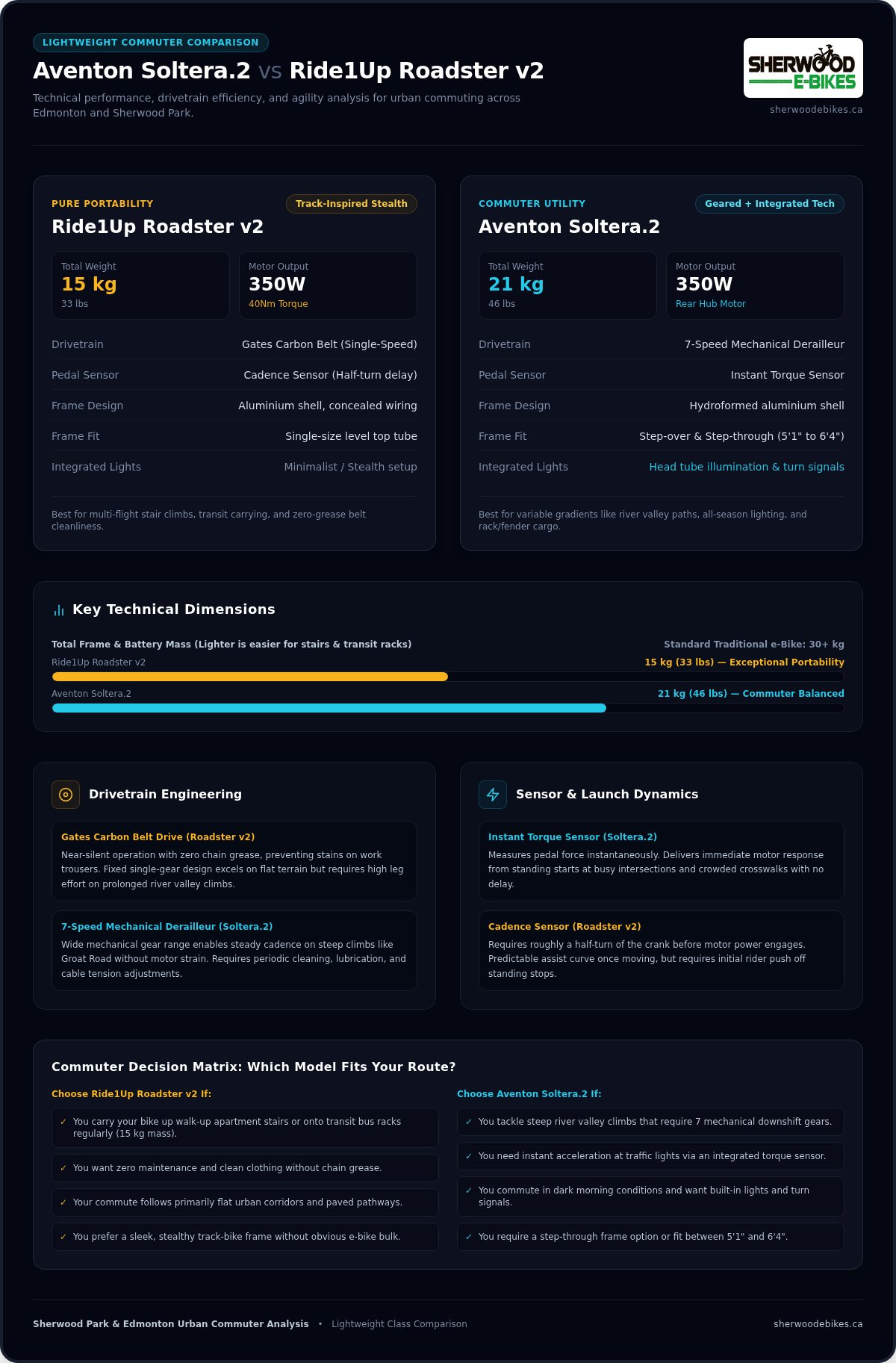
The differences emerge in frame execution and weight distribution. Ride1Up prioritizes absolute minimalism, delivering the Roadster v2 at an exceptionally nimble 33 pounds (15 kg). Aventon equips the Soltera.2 with integrated safety electronics and practical daily gearing, settling at 46 pounds (21 kg). Understanding how these structural choices alter your daily ride requires examining each frame layout.
Aventon Soltera Architecture and Design Language
Aventon constructs the Soltera around a hydroformed aluminium frame that blends contemporary commuter utility with aggressive road-bike angles. The geometry places you in an athletic, forward-leaning posture to slice through headwinds. It features integrated head tube illumination alongside frame-embedded rear turn signals for added road presence. The Soltera offers both step-over and step-through configurations across multiple frame sizes, giving riders between 5'1" and 6'4" a tailored fit with generous standover clearance.
Ride1Up Roadster Minimalist Stealth Aesthetic
The Ride1Up Roadster v2 adopts a classic track-bike profile with smooth, clean welds that hide its electric identity. Exterior wiring remains neatly tucked away inside the slim tubes, so casual onlookers rarely realize it is an electric bicycle. The level top tube on the standard frame requires careful standover consideration, particularly for shorter riders, but the centered weight distribution makes carrying the 15-kilogram frame up three flights of stairs feel remarkably natural.
When selecting between these platforms in this Aventon Soltera vs Ride1Up Roadster lightweight commuter comparison, your choice centers on utility versus mass:
- Ride1Up Roadster v2: Built at 15 kg for pure portability; features clean aesthetic welds; uses single-size aggressive track geometry; limits luggage integration to preserve stealth lines.
- Aventon Soltera.2: Weighs 21 kg with integrated turn signals and lighting; offers step-through and step-over variants; accommodates commuter racks and fenders out of the box.
If your daily commute includes narrow stairwells or bike lockers, the Roadster excels. If you require tailored ergonomics and built-in lighting for dark morning commutes, the Soltera frame proves more accommodating.
Drivetrain and Motor Performance: Belt Drive Simplicity vs Traditional Gearing
Motor wattage figures only tell half the story when evaluating how a lightweight commuter responds under real pedal pressure. In this Aventon Soltera vs Ride1Up Roadster lightweight commuter comparison, the true divide lies in how mechanical gears, belt systems, and pedal sensors interact at city intersections. Both rear hub motors run at a 350W rating, but their delivery styles feel completely different off a standing start.
Sensor choice dictates that immediate acceleration feel. Ride1Up equips the Roadster v2 with a cadence sensor, which requires roughly a half-turn of the cranks before assistance activates. Aventon incorporates a responsive torque sensor into the Soltera.2, measuring your direct foot pressure instantaneously. That instant engagement prevents awkward hesitations when launching across multi-lane avenues or pedalling away from crowded crosswalks.
Ride1Up Roadster Quiet Carbon Belt and Single-Speed Efficiency
The Roadster v2 relies on a clean Gates carbon belt paired with a 40Nm hub motor. It operates almost silently and eliminates messy chain grease entirely, keeping office trousers clean during morning commutes. The fixed gear ratio suits flat valley flats, yet it demands substantial rider leg input when you encounter prolonged river valley climbs. If you grind to a halt mid-slope, starting again without derailleur downshifting requires solid physical effort.
Aventon Soltera Geared Options and Torque Sensor Modulation
Aventon utilizes a conventional 7-speed derailleur drivetrain. Dropping into lower cogs lets you maintain a steady pedal cadence up steep climbs like Groat Road without bogging the motor down. This flexibility requires periodic chain cleaning, lubrication, and cable tension adjustments to ensure crisp shifting. The torque sensor tracks your pedalling force precisely, adjusting motor output dynamically so the assistance mirrors your natural effort across every gear.
Matching your route to these drivetrain designs comes down to maintenance tolerance versus elevation change:
- Ride1Up Roadster v2: Carbon belt drive requires zero grease or chain scrubbing; single-speed layout excels on flat urban streets; cadence sensor exhibits brief lag before assist kicks in.
- Aventon Soltera.2: 7-speed drivetrain conquers river valley inclines with minimal strain; torque sensor delivers immediate proportional assist; chain and derailleur require regular lubrication and seasonal upkeep.
Drivetrain upkeep remains the trade-off for mechanical range. If you prefer professional alignment for shifters or need seasonal belt tension checks, scheduling regular maintenance through our e-bike service centre keeps both configurations running smoothly.
Real-World Ride Quality: Handling Commutes Across Edmonton and Sherwood Park
Pavement along the North Saskatchewan River valley or across Sherwood Park arterial roads tests bicycle frames in ways smooth testing tracks never reveal. Spring thaw creates harsh frost heaves, expansion cracks, and lingering grit along multi-use pathways. Any practical Aventon Soltera vs Ride1Up Roadster lightweight commuter comparison must look beyond stripped-down catalog weights to evaluate how these rigid frames transfer surface vibrations to your hands and lower back.
Both models use rigid aluminium forks to preserve low mass. Without front suspension, tire selection and frame compliance dictate your comfort over railway crossings and cracked concrete. The two bikes take distinct approaches to tire volume and stopping hardware, directly affecting safety when sharing roadway shoulders with motor vehicles.
Tire Width, Clearance, and Pothole Absorption
Ride1Up fits the Roadster v2 with narrow 700x28c road tires. This setup delivers rapid rolling speed on pristine tarmac, but it transmits sharp jolts directly through the aluminium handlebars when crossing rough asphalt. Tire clearance is tight, restricting upgrades to wider, winter-ready commuter rubber. Aventon equips the Soltera.2 with wider 700x38c rubber, adding substantial air cushion for rutted paths while retaining clearance for wet-weather mudguards.
Stopping Power: Rim Calipers vs Mechanical and Hydraulic Disc Brakes
Braking performance marks the most critical safety division between these platforms. The Roadster v2 relies on Tektro R315 dual-pivot caliper rim brakes. They perform adequately in dry weather, but stopping distances increase substantially once rain, spring slush, or road silt coat the wheel rims. The Soltera.2 utilizes cable-actuated mechanical disc brakes that grip dedicated 160mm steel rotors, providing consistent bite regardless of moisture or rim debris.
Urban transit safety demands dependable stopping power in variable prairie conditions. Local injury data underscores why: Edmonton has recorded 31 major injury collisions involving e-bikes and e-scooters since 2021, including five fatalities. Controlled deceleration on steep descents down McDougall Hill or Victoria Park Road requires predictable stopping hardware.
- Ride1Up Roadster v2: Dual-pivot rim calipers require early lever pull on damp descents; narrow 28c tires prioritize rolling efficiency over gravel absorption; limited frame clearance restricts studded tire mounting.
- Aventon Soltera.2: Mechanical disc brakes bite reliably in wet and dusty conditions; 38c tires absorb frost heave chatter; frame clearance accommodates commuter accessories with ease.
For daily travel across unpredictable municipal pathways, the Soltera provides superior traction and wet-weather control. The Roadster demands greater vigilance, rewarding you with pure road speed on clean, dry pavement.
Battery Range, Integrated Tech, and Winter Readiness
Minimalist commuter builds achieve their low carrying weight by trimming battery capacity down to the essentials. In this Aventon Soltera vs Ride1Up Roadster lightweight commuter comparison, power delivery centers on sub-10Ah energy packs that blend seamlessly into down tubes. While these slim packs reduce overall frame bulk, they demand deliberate planning around charging habits and cold-weather riding.
Lithium-ion chemistry dominates the Canadian e-bike market, capturing an 84.15% share in 2025. That dominance highlights why battery management matters on chilly spring and autumn mornings. When ambient temperatures drop toward freezing across the capital region, chemical resistance increases, cutting real-world operational range by 20% to 30%. Knowing how each bike houses and manages its power reserve dictates whether you make it home on assist power alone.
Removable vs Integrated Batteries for Cold Climate Charging
Charging lithium cells at sub-zero temperatures damages battery chemistry and causes permanent capacity loss. Safe ownership in our climate requires warming cells to indoor room temperatures before plugging into a wall charger. Aventon designs the Soltera.2 with a removable 36V 9.6Ah (360 Wh) battery pack. You can unlatch the battery with a key, bring it into your condo or workplace cubicle, and recharge while leaving the frame in parkade storage. Ride1Up fully encases a 36V 7Ah (252 Wh) battery inside the Roadster v2 down tube. You cannot simply remove the cells, meaning you must bring the entire 15-kilogram bicycle indoors beside an electrical outlet to charge.
Lighting, App Connectivity, and Day-to-Night Visibility
Cockpit electronics diverge just as sharply between the two contenders. Aventon fits the Soltera.2 with a bright, full-colour display that provides clear readouts under glaring midday sun, backed by mobile app connectivity to configure assist modes. Integrated head and tail illumination runs directly off the main pack, keeping you visible through pre-dawn commutes. Ride1Up fits the Roadster v2 with a compact, monochrome display showing essential assist and speed figures. It skips integrated running lights entirely, requiring external clip-on accessories to meet local road visibility requirements.
Evaluating battery reserves and onboard technology highlights key daily compromises:
- Aventon Soltera.2: Removable 360 Wh battery delivers 32 to 74 km of assist; quick-release lock enables warm indoor charging; full-colour screen and built-in lighting boost commuter safety.
- Ride1Up Roadster v2: Fixed 252 Wh internal battery achieves up to 48 km of range; non-removable pack necessitates indoor whole-bike storage for cold-weather charging; bare-bones display omits factory lighting.
Routine electrical diagnostics prevent small wiring faults from stranding you mid-commute. If you need certified battery diagnostics or a seasonal checkup, book an appointment with our service specialists to verify system health before cold weather sets in.
The Verdict: Matching Your Commute to the Right Lightweight E-Bike
Selecting between these two platforms comes down to how your route balances elevation changes against physical portage. This Aventon Soltera vs Ride1Up Roadster lightweight commuter comparison confirms that neither model serves as a universal answer. Instead, each machine solves a distinct urban transit problem depending on your living situation, route topography, and willingness to perform mechanical upkeep.
Your physical environment should guide your decision. A third-floor apartment dweller riding level streets faces different physical hurdles than a commuter traversing the steep climbs between downtown Edmonton and Strathcona.
Rider Persona Breakdown: Flat Streets vs River Valley Climbs
Select the Ride1Up Roadster v2 if your daily transit route follows flat avenues, paved multi-use paths, or straightforward arterial corridors. The clean carbon belt eliminates messy oil on dress pants and simplifies seasonal storage. The 15-kilogram frame remains effortless to carry onto transit vehicles or up steep stairwells. Choose the Aventon Soltera.2 if your journey crosses varied terrain, such as Dawson Park or Victoria Park Road. The 7-speed gearing, immediate torque response, and disc braking provide superior control on damp slopes and loose gravel surfaces.
Assembly, Serviceability, and Local Support in the Edmonton Area
Ordering a direct-to-consumer bicycle box presents unexpected assembly challenges. Direct-ship models arrive partially disassembled, requiring careful handlebar alignment, headset tensioning, wheel truing, and brake caliper calibration. Fastening critical structural components without a calibrated torque wrench risks damaging aluminium threads or causing loose head tubes during heavy braking. Exploring proven alternatives like Envo electric bikes allows you to evaluate properly assembled Canadian-engineered frames designed specifically for variable climate riding.
Professional post-delivery support ensures that your lightweight commuter remains roadworthy across every season:
- Factory Assembly Checks: Verifying bolt torque specs and spoke tension prevents catastrophic steering failure on rough road shoulders.
- Braking Optimization: Bedding in disc pads or aligning caliper blocks maximizes stopping power before facing high-speed valley descents.
- Drivetrain Tuning: Correct indexing of mechanical derailleurs and proper tensioning of carbon belts prevents premature tooth wear.
Protecting your investment means establishing a dependable maintenance routine. Read our detailed guide on commuter e-bike maintenance to understand service schedules, or book a comprehensive mechanical checkup with our certified e-bike maintenance and service technicians before starting your daily route.
Upgrade Your Daily Commute with Confidence
Choosing the right lightweight commuter comes down to balancing raw portability against practical route versatility. As this Aventon Soltera vs Ride1Up Roadster lightweight commuter comparison demonstrates, the ultralight Roadster delivers clean, grease-free simplicity for flat city pavements, while the Soltera provides the mechanical gearing and dependable disc braking required for steep river valley inclines.
Whichever frame matches your routine, dependable local service ensures long-term safety and peak performance. Skip the uncertainty of unboxing and tuning an online shipment on your own. Our experienced technicians at our physical repair shop inspect spoke tension, align braking systems, and test electronic battery health so you ride away with complete peace of mind. Book a service consultation or test ride at Sherwood E-Bikes Ltd. to evaluate fit, compare drivetrains hands-on, and roll into your morning commute with absolute confidence.
Frequently Asked Questions
How much do the Aventon Soltera and Ride1Up Roadster weigh?
The Ride1Up Roadster v2 weighs 33 pounds (15 kg), while the Aventon Soltera.2 weighs 46 pounds (21 kg). In this Aventon Soltera vs Ride1Up Roadster lightweight commuter comparison, that 13-pound difference significantly influences portability. Riders who regularly carry equipment onto LRT cars, mount bikes to Edmonton transit bus racks, or tackle multi-floor apartment walk-ups find the lighter Roadster substantially easier to lift.
Can the Ride1Up Roadster climb steep hills with a single-speed belt drive?
Yes, but it requires notable rider effort on prolonged grades. The 350W nominal motor supplies 40Nm of torque, but the lack of lower gears means you cannot downshift to maintain cadence. While moderate inclines across Sherwood Park present few issues, tackling steep river valley ascents like Groat Road forces you to supply substantial leg force from a standing start.
Can I remove the battery on lightweight commuter e-bikes for charging inside?
Battery access varies by model. The Aventon Soltera.2 features an externally accessible, lockable battery pack that you can unlatch and carry into your home or office. The Ride1Up Roadster v2 conceals its power pack directly inside the aluminium down tube. Because the internal cells are not quick-release, you must bring the entire bicycle indoors near an outlet to recharge.
What happens if an online direct-to-consumer e-bike arrives damaged?
Direct-to-consumer buyers must document transit damage, contact remote support, and wait for shipped replacement components. Bent derailleur hangers, warped brake rotors, and scuffed paint commonly occur during cross-border transit. Taking the boxed shipment to an independent local repair shop ensures a certified technician inspects structural fasteners, trues the wheels, and confirms safe wiring before you ride.
Are lightweight e-bikes safe to ride in wet or freezing Canadian weather?
Lightweight models handle wet conditions if equipped with suitable braking systems and rubber. Disc-equipped options like the Soltera stop reliably on wet pavement, whereas rim calipers on the Roadster lose friction when water or road salt coats the rims. Freezing temperatures also reduce lithium battery range by roughly 20% to 30%, requiring cautious trip planning across Leduc, St. Albert, and Spruce Grove.
How long does a Gates carbon belt drive last compared to a standard bicycle chain?
A Gates carbon drive belt typically lasts between 15,000 and 30,000 kilometres, whereas a conventional bicycle chain requires replacement every 3,000 to 5,000 kilometres. Carbon belts do not rust, stretch, or require sticky lubricants that collect trail dust. This makes a belt drive ideal for riders who want minimal drivetrain upkeep during dirty spring commutes across northern roads.
Can I test ride commuter electric bikes locally before buying?
Yes, you can test ride commuter platforms locally by visiting a dedicated retail showroom. In an Aventon Soltera vs Ride1Up Roadster lightweight commuter comparison, spec sheets cannot replicate the physical sensation of frame fit or torque response. Trying out curated commuter e-bikes or booking fleet rentals in Sherwood Park allows you to test geometries and motor delivery before committing.


