

Getting started with an e-bike means matching motor assistance, hydraulic braking, and battery capacity to your local terrain so you can choose a setup that fits how you ride. Equipped with UL certified Bafang power systems, modern e-bikes offer smooth acceleration and long-range reliability tailored for Canadian riders. The decision questions that run through this guide are simple: which riding profile fits your paths, how you will manage assist and braking at speed, and whether battery habits and storage realities support daily use.
Key Takeaways: To get started with e-biking, match a motor system to your terrain and master the increased braking distance caused by the added frame weight.
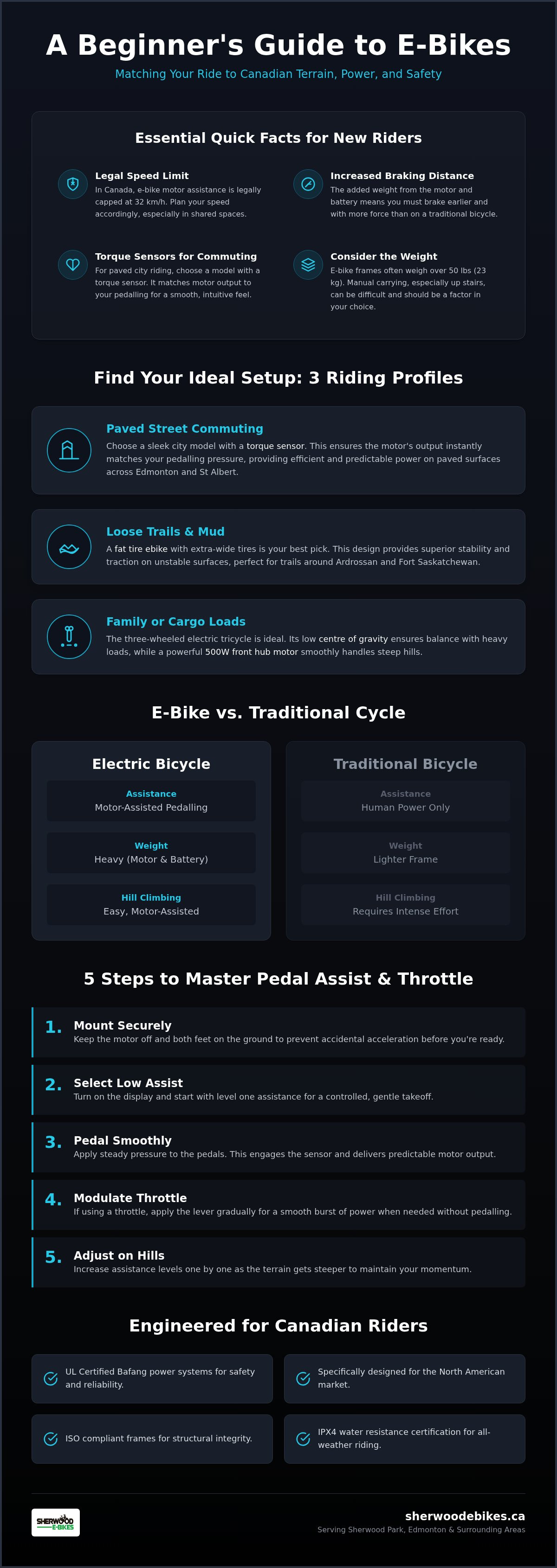
- Canadian law caps motor assistance at 32 km/h, requiring you to brake earlier than traditional cycles.
- Except when you must carry the 50lb motor-equipped frame up stairs, as manual portage is difficult.
- Select a torque sensor model for paved commuting to ensure motor output matches your pedaling instantly.
- The article's maintenance data shows drive-system wear rises quickly without proper lubrication on daily commuter setups.
3 Riding Profiles: Find Your Ideal Setup
Your ideal electric bicycle depends on how you plan to navigate paths across Sherwood Park and Edmonton, and choosing a frame type early prevents premature component wear. An improper setup increases frame stress under heavy loads. Typical situations map to clear picks from the builds riders already use:
- Paved street commuting: pick a sleek city model with a pedal pressure sensor (torque sensor) so motor output matches your pedalling input instantly.
- Loose trails and mud: pick a fat tire ebike with extra-wide tires for stability on unstable surfaces.
- Family or cargo loads: pick the three-wheeled Charge electric tricycle, whose low center of gravity supports balance and whose 500W front hub motor climbs steep hills smoothly.
Urban commuters gain efficiency on paved streets when the torque sensor tracks pedal pressure in real time. Off-road adventure riders gain traction when wide tires carry the load on loose ground. Families and cargo riders gain utility when a stable three-wheeled platform carries heavy loads without tipping the handling balance.
Visit Sherwood E-Bikes Ltd. to find your build. More on this: Sherwood E-Bikes Ltd.
How e-bikes compare to traditional cycles
An e-bike differs from a traditional cycle in motor acceleration, added weight, and higher cruising speeds, so you adjust cornering and stopping to the extra mass. Pedalling feels like riding a light bicycle with constant tailwinds.
| Feature | Traditional Bicycle | Electric Bicycle |
|---|---|---|
| Assistance | Human power only | Motor assisted pedalling |
| Weight | Lighter frame | Heavy due to motor and battery |
| Hill Climbing | Requires intense physical effort | Easy motor-assisted climbing |
The motor engages instantly as you turn the cranks. As noted in the Wikipedia Electric Bicycle Entry (2025), e-bikes use pedal assist or throttle modes to power the motor. You manage extra mass when cornering or stopping quickly.
You control power delivery using a pedal pressure sensor. You can smooth out steep inclines and ride on rough paths when you Conquer Any Terrain with Rize MD eBike, Sherwood E-Bikes Ltd. in your daily route. Choose a standard bicycle when you want full physical exertion, or select an electric model when you want to ride farther with less fatigue.
Choosing the e-bike model that fits your specific needs
Match motor power output and frame geometry to your personal daily route before you buy. For commuting across Edmonton and Sherwood Park, mid-step frame designs combined with a pedal pressure sensor give balanced handling on variable pavement. Specifically designed for the North American market, each model in the line of E-Bikes features a fine-tuned software-controlled Bafang motor that delivers even power. To Upgrade Your Commute with ENVO D50, Sherwood E-Bikes Ltd., you gain a versatile geometry suited for steep river valley climbs. Direct motor integration matters for predictable response: higher torque serves local terrain better than chasing top speed, because strong acceleration helps you handle urban traffic safely.
Frame stiffness differs when you compare traditional top-tube designs to low-step models. A rigid top-tube layout suits fast gravel rides toward Ardrossan, while open frames fit frequent stop-and-go errands in St Albert. Align the frame layout with the route you ride most.
Tip: Choose models built specifically for the North American market to ensure frame compliance and optimal throttle functionality.
5 Steps to Master Pedal Assist and Throttle
Master pedal assist and throttle in a fixed sequence so you protect battery efficiency and keep acceleration safe on busy city streets. At the Sherwood Park workshop, novices often switch to high help modes right away, which puts needless stress on the electric drivetrain.
Follow this sequence to control your electric bicycle:
- Mount securely: Keep both feet grounded with the motor power switched off to prevent accidental acceleration.
- Select low assist: Turn on the display unit and choose level one assistance for a controlled initial takeoff.
- Pedal smoothly: Apply steady pressure to engage the internal pedal pressure sensor for predictable motor output. You can Ride Smoothly with the Envo ST50, Sherwood E-Bikes Ltd. to experience balanced acceleration.
- Modulate throttle: Apply the thumb lever gradually when you need immediate power without pedalling.
- Adjust on hills: Increase assistance levels sequentially as terrain gradients steepen.
This sequence keeps speed under your control. A UL certified Bafang power system supports strong, usable output so you can skip traffic on the way to your destination. Practice these steps in open parking lots first: smooth inputs save power.
How braking differs on an e-bike
You must brake earlier and with firmer lever pressure on an e-bike because extra mass and motor power extend stopping distance. Heavy frames carrying a 500W power output take longer to slow down than standard cycles.
Mechanics in the Sherwood Park workshop frequently see cyclists exhaust their rear pads prematurely when they neglect the front brake. Balanced dual-lever pressure restores control. Hydraulic disc systems deliver smooth stopping force and handle wet roads in Edmonton with less drama than mechanical setups, which need more manual squeeze.
Speed limits for Canadian electric cycles cap motor assistance at 32 km/h on public roads. Higher speeds increase your stopping distance sharply. Riders using high-torque models like the Rize Bolt must adjust their approach to intersections. Anticipate stops early and apply gradual force to both levers to maintain traction. Proper technique prevents skidding and preserves brake components across varying weather conditions.
Managing Battery Range and Daily Charging Routines
Simple daily charging habits keep your pack ready for commutes across Edmonton and Sherwood Park. When you prepare for a winter ride, lithium cells lose efficiency in sub-zero temperatures, so storing your power pack inside protects total capacity. Plug in after your daily trip using a smart charger. A built-in battery health monitor (BMS) manages cell balance automatically.
Underinflated tires deplete your battery much quicker than freezing temperatures alone, so correct inflation keeps the motor efficient. As noted in a Urban Mobility Observatory 2019 case study, winter weather requires proper planning to maintain daily commuting distance. Treat the pack the way you treat a phone battery and charge it on a regular rhythm after rides.
The Aima eBike handles mixed terrain efficiently when you maintain pressure, storage temperature, and charge timing together, which prevents sudden depletion on longer routes.
Essential Pre-Ride Safety Checklist for Beginners
Inspect tire pressure, the pedal pressure sensor, and brakes before you mount so you have immediate stopping power. Confirm that your battery health monitor (BMS) shows full charge for your trip around Sherwood Park. Tighten accessories with the Park Tool AWS-11 Folding Hex Wrench Set or Park Tool TWS-2 Folding Torx Wrenches. Secure frame storage such as the DEUTER MONDEGO FRAME BAG so straps stay clear of moving parts.
Verify quick lever access on your Shift Lever across every gear, then test the brakes before you accelerate. A ninety-second driveway check prevents mechanical failures on fast commuter routes when you would rather skip the routine.
E-bike costs and available financing options
E-bike ownership combines initial equipment purchases, periodic battery care, and routine component maintenance over time. Investing in models like the Aima eBike or the Rize Bolt means weighing up-front cost against long-term upkeep. Flexible financing plans spread the initial purchase into manageable monthly payments. Total expenses track your riding frequency and component choices.
From servicing in Edmonton, drive-system wear rises quickly without proper chain lubrication, and daily commuter setups see higher component friction than weekend recreation models. Budget-friendly tuning stays straightforward when a Park Tool AWS-11 Folding Hex Wrench Set covers essential adjustments and holds long-term service expenses down.
Structured payment plans suit commuters who need predictable monthly costs; direct cash purchases suit riders who want no ongoing financing. Ask for a personalised quote when you need exact figures for your build.
When an Electric Bike Might Not Fit Your Life
An e-bike is a poor fit when you must frequently lift a heavy frame up steep apartment stairs. Client work shows riders struggle when carrying a 50lb motor-equipped unit into high-rise storage daily, because frame weight makes manual portage difficult.
Storage limits matter in the same decision. A full-sized Aima eBike needs adequate ground-floor space or elevator access. If room is tight, compact setups work better in that space. If you prefer pure manual effort without motor assistance, traditional options suit that goal: a pedal pressure sensor still offers natural support, yet the system adds weight you have to carry and store.
Request a personalised quote to explore lightweight configurations built for your living space in Edmonton or St Albert.
Frequently asked questions
How much do e‑bikes cost and can I finance them?
Total costs vary based on component choices like motor wattage, battery capacity, and accessories such as the Selle Royal Avenue Relaxed Saddle. Each model in the line of e-bikes is specifically designed for the North American market. Higher-tier builds include specialized gear like a pedal pressure sensor to optimize battery range. You can ask for exact figures and custom financing options sized to your setup.
Is riding an electric bike hard for beginners?
Learning e-biking is quick and intuitive for new riders in Edmonton or St Albert. Motor support activates smoothly as soon as you pedal, which gives you stability on hills. A power system equipped with a fine-tuned software-controlled Bafang motor helps keep your pace predictable. You manage speed with standard handlebars and simple gear controls from the first rides.
Do electric bikes accelerate quickly?
Electric bikes accelerate efficiently because the motor delivers rapid drive to the wheel. Every model features a powerful UL certified Bafang power system for dependable takeoff at intersections. You control this speed gain through system assist levels and smooth pedaling. That power output lets urban commuters merge into traffic lanes without strain.
How fast should I ride on my first eBike ride?
Keep your speed under 20 km/h on your initial ride until you feel comfortable. Starting in low assist modes gives you control over the extra power on local bike paths. A steady, moderate pace helps you adapt to the added frame weight. When you feel confident handling the momentum, raise your speed settings gradually.
Do I have to brake differently on an e-bike?
Begin braking slightly earlier because the motor and battery add extra mass. Pulling both brake levers evenly brings the heavier machine to a controlled stop. Upgraded disc pads help manage this momentum on asphalt or gravel tracks. Checking pad wear with a Park Tool AWS-11 Folding Hex Wrench Set keeps stopping power consistent.
How to Get Started with E-Biking
You get started by selecting the drive system that matches your Alberta terrain, then applying the same choices this guide walked through: profile, assist control, braking, battery habits, and storage. Mid-drive motors deliver balanced handling for riders in Edmonton and Sherwood Park.
Technicians observe that proper motor selection prevents early drivetrain wear on steep inclines. A pedal pressure sensor adjusts motor assistance based on your effort. You can explore high-performance models on the Rory MD mid-drive e-bike page. More on this: Conquer Any Terrain with Rize.
In 2026, the Sherwood E-Bikes Ltd. advisers offer North American market design provenance and UL certification across the lineup. Reach out to the team when you want a quote shaped around your routes and storage constraints.


